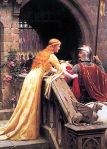

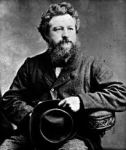
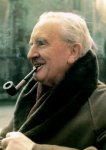
I truly have awoken Rosamond in her bower after cutting my way through the roses and thorns. I have immortalized my family name – and my family! We will forever be associated with Arthurain Legends, and Tolkein’s cosmology. I own a sacred permission to author a great legend. I have pulled Excalibur from the stone!
There is a very good chance that my Stuttmeister kindred are buried near Friedrich in the Huguenot cemetary in Berlin. Did they ever meet? My ancestors were also named after William Friedrich – who acknowlged the Rougemonts as old nobility. Thus was restored the titles given the the family of Denis de Rougemont, co-founder of the European Union, and Grail Scholar.
Jon Presco ‘Grail Scholar’
Copyright 2012
The fateful slumber floats and flows
About the tangle of the rose.
But lo the fated hand and heart
To rend the slumberous curse apart.
The threat of war, the hope of peace
The Kingdom’s peril and increase.
Sleep on, and bide the latter day
When fate shall take her chains away.
The maiden pleasance of the land
Knoweth no stir of voice or hand,
No cup the sleeping waters fill,
The restless shuttle lieth still.
~William Morris
https://rosamondpress.wordpress.com/2011/12/02/tolkien-influenced-by-pre-raphaelite-brotherhood/
Denis de Rougemont is a Swiss writer. He was born on September 8
1906, in Couvet, canton of Neuchâtel, in Switzerland. He died on
December 6 1985, in Geneva.
Denis de Rougemont comes from the loves from George de Rougemont,
Pasteur, and of Anne Sophie, born Bouvet. The family of Rougemont is
probably originating in the Franche-Comté; she was established in
Neuchâtel as of XIVème century. In 1784, it received a “Recognition
of old nobility” of the King Frederic II (Neuchâtel was then a
Prussia Principality). The members of the family of Rougemont also
belonged to the Council of State of Neuchâtel.
[edit] Influence
Robert Louis Stevenson admired Fouqué’s story “The Bottle Imp” and wrote his own version (The Bottle Imp) with a Hawaiian setting.[1] John Henry Newman and Charlotte Mary Yonge both praised Sintram and his Companions. William Morris also became an admirer of Sintram and his Companions, and it influenced Morris’ own fiction.[1] Sintram and his Companions and Undine are referred to in Little Women by Louisa May Alcott; the character Jo mentions wanting them for Christmas in the first chapter of the book and finally receives them in chapter 22. Furthermore, Aslauga’s Knight, as well as Sintram and his Companions and Undine are referred to in Jo’s Boys, the final book in Alcott’s Little Women series, where the story of Aslauga’s Knight mirrors the character Dan and his affection for gentle Bess.
He was born at Brandenburg an der Havel, of a family of French Huguenot origin, as evidenced in his family name. His grandfather, Heinrich August de la Motte Fouqué, had been one of Frederick the Great’s generals and his father was a Prussian officer. Although not originally intended for a military career, Friedrich de la Motte Fouqué ultimately gave up his university studies at Halle to join the army, and he took part in the Rhine campaign of 1794. The rest of his life was devoted mainly to literary pursuits. He was introduced to August Wilhelm Schlegel, who deeply influenced him as a poet (“mich gelehret Maß und Regel | Meister August Wilhelm Schlegel”) and who published Fouqué’s first book, Dramatische Spiele von Pellegrin, in 1804.
[edit] Marriage
Fouqué’s first marriage was unhappy and soon ended in divorce. His second wife, Caroline Philippine von Briest (1773–1831), enjoyed some reputation as a novelist in her day. After her death Fouqué married a third time. Some consolation for the ebbing tide of popular favour was afforded him by the munificence of Frederick William IV of Prussia, who granted him a pension which allowed him to spend his later years in comfort. He died in Berlin in 1843.
For Fouqué’s life cf. (only to the year 1813) Lebensgeschichte des Baron Friedrich de la Motte Fouqué. Aufgezeichnet durch ihn selbst (Halle, 1840), and also the introduction to Koch’s selections in the Deutsche Nationalliteratur.
[edit] Literary work
[edit] Romantic roots
After Dramatische Spiele von Pellegrin, his second work, Romanzen vom Tal Ronceval (1805), showed more plainly his allegiance to the romantic leaders, and in the Historie vom edlen Ritter Galmy (1806) he versified a 16th century romance of medieval chivalry.
Sigurd der Schlangentödter, ein Heldenspiel in sechs Abentheuren (1808), was the first modern German dramatization of the Nibelung legend combining Icelandic sources such as the Volsunga Saga and the Middle High German Nibelungenlied. The play and its two sequels Sigurds Rache (1809) and Aslauga (1810) were published together under the title Der Held des Nordens in 1810. The trilogy brought Fouqé to the attention of the public, and had a considerable influence on subsequent versions of the story, such as Friedrich Hebbel’s Nibelungen and Richard Wagner’s Der Ring des Nibelungen.
These early writings indicate the lines which Fouqué’s subsequent literary activity followed; his interests were divided between medieval chivalry on the one hand and northern mythology on the other. In 1813, the year of the rising against Napoleon, he again fought with the Prussian army, and the new patriotism awakened in the German people left its mark upon his writings.
[edit] Popular works
“
Were I asked, what is a fairytale? I should reply, Read Undine: that is a fairytale … of all fairytales I know, I think Undine the most beautiful. (George MacDonald, The Fantastic Imagination)
”
Between 1810 and 1815, Fouqué’s popularity was at its height; the many romances and novels, plays and epics which he produced with extraordinary rapidity, appealed greatly to the mood of the hour. Undine appeared around 1811, the only work by which Fouqué’s memory still lives today. A more comprehensive idea of his talent may, however, be obtained from the two romances Der Zauberring (1813) and Die Fahrten Thiodolfs des Isländers (1815).
[edit] Later years
From 1820 onwards the quality of Fouqué’s work deteriorated, partly owing to the fatal formal ease with which he wrote, and he failed to keep pace with the changes in German taste by clinging to the paraphernalia of romanticism. His rivals applied a sobriquet of “Don Quixote of Romanticism” to him.
Denis de Rougemont said that the troubadours were influenced by Cathar doctrines which rejected the pleasures of the flesh and that they were metaphorically addressing the spirit and soul of their ladies. Rougemont also said that courtly love subscribed to the code of chivalry, and therefore a knight’s loyalty was always to his King before his mistress.[19]
In this classic work, often described as “The History of the Rise, Decline, and Fall of the Love Affair,” Denis de Rougemont explores the psychology of love from the legend of Tristan and Isolde to Hollywood. At the heart of his ever-relevant inquiry is the inescapable conflict in the West between marriage and passion–the first associated with social and religious responsiblity and the second with anarchic, unappeasable love as celebrated by the troubadours of medieval Provence. These early poets, according to de Rougemont, spoke the words of an Eros-centered theology, and it was through this “heresy” that a European vocabulary of mysticism flourished and that Western literature took on a new direction.
 Rosamond Press
Leave a comment