My great Grandfather, Wensel Anton Braskewitz came from Bohemia to Conneticut. Braske means ‘The Son of the Rabbi’. Witz means “son of” as does Bar. Wensel married Marie Roth, a Jew. I was born to understand the Torah. Am I descended from a lineage of Rabbis?
“This Jewish surname of BRASCH was an acronymic surname from a Hebrew-Aramaic patronymic phrase BAR RABI SHELOMO, meaning ‘The son of the Rabbi’. Solomon, Samuel, Simon, Samson or some other male given name beginning with S”
The name Barabbas means ‘Son of the Rabbi’. Note the S on ABBA.
BABA means “father”.
ISH is Hebrew for MAN. SHImon SHImson.
“BARISH Jewish (Ashkenazic) acronymic surname from Hebrew-Aramaic patr. phrase Bar Rabi Shelomo, SHemuel. SHimon, Shimson, ect, i.e. ‘son of (rabbi) Salamon, Samuel, Simon, Samson, or some other male given name beginning with SH Cf BROCK. Vars B(a)rasch, Barash, Brosch, Brisch.”
The name of the ‘SON of MAN’ BAR-ISH. ISH in Hebrew means “man”
Jesus titles himself the Son of Man who is associated with Death and Resurection. I died, saw heaven, and returned to life.
“John 3:13-15 – ‘No one has ever gone into heaven except the one who came from heaven – the Son of Man. Just as Moses lifted up the snake in the desert, so the Son of Man must be lifted up, that everyone who believes in him may have eternal life.’
‘Son of man’ is a phrase with various meanings in the Hebrew bible; it was used by Jesus of Nazareth to refer to himself, in the Greek of the New Testament, translated as ὁ υἱὸς τοὺ ἀνθρώπου, it became a title signifying the Christian understanding of the Jewish Messiah.”
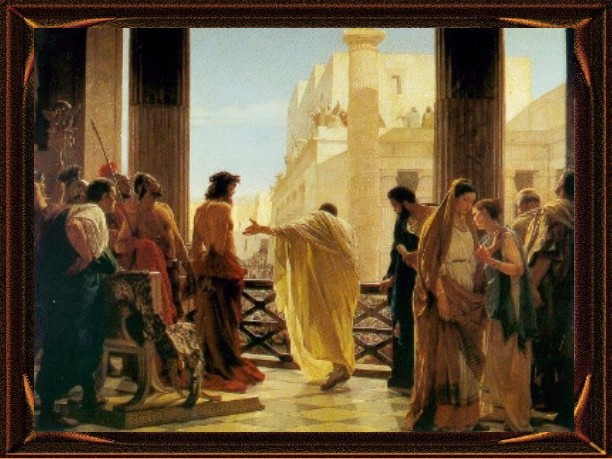
Scholars say Barrabas was Jesus who was a Bandit – a Highwayman!
So busy have you Christians been counting names, you forgot the most important name given to the Son of Peace. Too late. I warned you!
Jon the Nazarite
Parable of the Weeds
In explaining the Parable of the Weeds: Matthew 13:37,41-42
He answered and said to them: “He who sows the good seed is the Son of Man…. The Son of Man will send out His angels, and they will gather out of His kingdom all things that offend, and those who practice lawlessness, and will cast them into the furnace of fire. There will be wailing and gnashing of teeth.
Christians commonly take the phrase “son of man” in this passage to refer to Jesus himself, rather than humanity in general.
[edit] Predicting His Death and Resurrection
Passages referring to Jesus’ own imminent death and resurrection.[8]
Luke 18:31-34, Mark 10:32-34, Matthew 20:17-19
Then He took the twelve aside and said to them, “Behold, we are going up to Jerusalem, and all things that are written by the prophets concerning the Son of Man will be accomplished. For He will be delivered to the Gentiles and will be mocked and insulted and spit upon. They will scourge Him and kill Him. And the third day He will rise again.” But they understood none of these things; this saying was hidden from them, and they did not know the things which were spoken.
Matthew refers to Barabbas only as a “notorious prisoner.”[8] Mark and Luke further refer to Barabbas as one involved in a stasis, a riot.[9] John 18:40 refers to Barabbas as a lēstēs (“bandit”), “the word Josephus always employs when talking about Revolutionaries”, Robert Eisenman observes.[10]
Three gospels state that there was a custom at Passover during which the Roman governor would release a prisoner of the crowd’s choice: Mark 15:6; Matthew 27:15; and John 18:39. Later copies of Luke contain a corresponding verse (Luke 23:17), though it is not present in the earliest manuscripts, and may be a later gloss to bring Luke into conformity.[11] The gospels differ on whether the custom was a Roman one or a Jewish one, as part of the Jubilee.[12]
No custom of releasing prisoners in Jerusalem is recorded in any historical document other than the gospels. An Ancient Roman celebration called Lectisternium involved feasting and sometimes included a temporary removal of the chains from all prisoners.[13] However, J. Blinzler associates Barabbas’ release with a passage in the Mishna Peshahim 8,6 which says that the Passover lamb may be offered ‘for one whom they have promised to bring out of prison’.
Benjamin Urrutia, co-author of The Logia of Yeshua: The Sayings of Jesus, agrees with Maccoby and others who say that Yeshua Bar Abba or Jesus Barabbas must be none other than Jesus of Nazareth, and that the choice between two prisoners is a fiction. However, Urrutia opposes the notion that Jesus may have either led or planned a violent insurrection. Jesus was a strong advocate of “turning the other cheek” – which means not submission but strong and courageous, though nonviolent, defiance and resistance. Jesus, in this view, must have been the planner and leader of the Jewish nonviolent resistance to Pilate’s plan to set up Roman Eagle standards on Jerusalem’s Temple Mount. The story of this successful resistance is told by Josephus — who does not say who the leader was, but does tell of Pilate’s crucifixion of Jesus just two paragraphs later in a passage whose authenticity is heavily disputed. [18]
[edit] Predicting His Death and Resurrection
Passages referring to Jesus’ own imminent death and resurrection.[8]
Luke 18:31-34, Mark 10:32-34, Matthew 20:17-19
Then He took the twelve aside and said to them, “Behold, we are going up to Jerusalem, and all things that are written by the prophets concerning the Son of Man will be accomplished. For He will be delivered to the Gentiles and will be mocked and insulted and spit upon. They will scourge Him and kill Him. And the third day He will rise again.” But they understood none of these things; this saying was hidden from them, and they did not know the things which were spoken.
Mark 8:31-32:38
He then began to teach them that the Son of Man must suffer many things and be rejected by the elders, chief priests and teachers of the law, and that he must be killed and after three days rise again. He spoke plainly about this, and Peter took him aside and began to rebuke him….If anyone is ashamed of me and my words in this adulterous and sinful generation, the Son of Man will be ashamed of him when he comes in his Father’s glory with the holy angels.”
Mark 10:35-45 (Son of man came to serve)
For even the Son of Man did not come to be served, but to serve, and to give his life as a ransom for many.
[edit] Return of the Son of Man
See also: Second Coming
Mark 8:38-9:1 (NRSV), Matthew 16:27-28, Luke 9:26-27
Those who are ashamed of me and of my words in this adulterous and sinful generation, of them the Son of Man will also be ashamed when he comes in the glory of his Father with the holy angels.’ And he said to them, ‘Truly I tell you, there are some standing here who will not taste death until they see that the kingdom of God has come with power.’
Mark 14:62 (ESV), Matthew 26:64 (at his Trial before the Sanhedrin)
And Jesus said, ‘I am, and you will see the Son of Man seated at the right hand of Power, and coming with the clouds of heaven.’
Matthew 24:30
And then shall appear the sign of the Son of man in heaven: and then shall all the tribes of the earth mourn, and they shall see the Son of man coming in the clouds of heaven with power and great glory.
– in medieval, and modern Eastern Orthodox art the hetoimasia or empty throne was considered to be the “sign of the Son of man”.
Matthew 25:31-32
But when the Son of Man comes in his glory, and all the angels with him, then he will sit upon his glorious throne. All the nations will be gathered in his presence, and he will separate them as a shepherd separates the sheep from the goats.
(See The Sheep and the Goats)
[edit] John
John 1:49-51 (NKJV)
Nathanael answered and said to Him, “Rabbi, You are the Son of God! You are the King of Israel!” Jesus answered and said to him, “Because I said to you, ‘I saw you under the fig tree,’ do you believe? You will see greater things than these.” And He said to him, “Most assuredly, I say to you, hereafter[j] you shall see heaven open, and the angels of God ascending and descending upon the Son of Man.” (emphasis added)
This passage may be an allusion to Jacob’s Ladder. In any case, the implication is that seeing the angels ascending and descending on the “son of man” (i.e. the speaker, Jesus) would be a great wonder.
John 5:25-27 (NKJV)
Most assuredly, I say to you, the hour is coming, and now is, when the dead will hear the voice of the Son of God; and those who hear will live. For as the Father has life in Himself, so He has granted the Son to have life in Himself, and has given Him authority to execute judgment also, because He is the Son of Man. (emphasis added)
John 8:28
When you see the Son of Man lifted up, then you shall know I am. (emphasis added)
John 9:35-37
Jesus heard that they had thrown him out, and when he found him, he said, “Do you believe in the Son of Man?” “Who is he, sir?” the man asked. “Tell me so that I may believe in him.” Jesus said, “You have now seen him; in fact, he is the one speaking with you.” (emphasis added)
John 12:34-36 (NRSV)
The crowd answered him, ‘We have heard from the law that the Messiah remains for ever. How can you say that the Son of Man must be lifted up? Who is this Son of Man?’ Jesus said to them, ‘The light is with you for a little longer. Walk while you have the light, so that the darkness may not overtake you. If you walk in the darkness, you do not know where you are going. While you have the light, believe in the light, so that you may become children of light.’ After Jesus had said this, he departed and hid from them. (emphasis added)
Isaiah
Isaiah 51:11-13
11 ופדויי יהוה ישׁובון ובאו ציון ברנה ושׂמחת עולם על־ראשׁם שׂשׂון ס ושׂמחה ישׂיגון נסו יגון ואנחה׃ 12 אנכי אנכי הוא מנחמכם מי־את ותיראי מאנושׁ ימות ומבן־אדם חציר ינתן׃ 13 ותשׁכח יהוה עשׂך נוטה שׁמים ויסד ארץ ותפחד תמיד כל־היום מפני חמת המציק כאשׁר כונן להשׁחית ואיה חמת המציק׃
11 The ransomed of YHWH shall return, and come with singing to Zion; and everlasting joy shall be on their heads: they shall obtain gladness and joy; and sorrow and sighing shall flee away. 12 I, even I, am he who comforts you: who are you, that you are afraid of man (מאנושׁ : [me’enosh]) who shall die, and of the son of man (ומבן־אדם : [umiben-‘adam]) who shall be made as grass; 13 and have forgotten YHWH your Maker, who stretched forth the heavens, and laid the foundations of the earth; and fear continually all the day because of the fury of the oppressor, when he makes ready to destroy? and where is the fury of the oppressor?
Isaiah 56:1-2
ה אמר יהוה שׁמרו משׁפט ועשׂו צדקה כי־קרובה ישׁועתי לבוא וצדקתי להגלות׃ 2 אשׁרי אנושׁ יעשׂה־זאת ובן־אדם יחזיק בה שׁמר שׁבת מחללו ושׁמר ס
1 Thus says YHWH, Keep you justice, and do righteousness; for my salvation is near to come, and my righteousness to be revealed. 2 Blessed is the man (אנושׁ : ‘enosh) who does this, and the son of man (ובן־אדם : [uben-‘adam]) who holds it fast; who keeps the Sabbath from profaning it, and keeps his hand from doing any evil.
Matthew 8:20, cf. Luke 9:58
Jesus said to him, “The foxes have holes, and the birds of the sky have nests, but the son of man has nowhere to lay his head.”
Matthew 18:11 (KJV)
For the Son of man is come to save that which was lost.
In this verse, “son of man” is clearly used in reference to Jesus, within the common use of humble self-reference (see the Story of Haninah ben Dosa above) rather than referring to generic humanity.
Mark 2:27-28, cf. Matthew 12:8, Luke 6:5
And he [Jesus] said unto them [the Pharisees], “The sabbath was made for man, and not man for the sabbath: so that the Son of man is lord even of the sabbath.”
Matthew 12:38-42, Mark 8:11-13, Luke 11:29-32
Then some of the scribes and Pharisees answered, saying, “Teacher, we want to see a sign from You.” But He answered and said to them, “An evil and adulterous generation seeks after a sign, and no sign will be given to it except the sign of the prophet Jonah. For as Jonah was three days and three nights in the belly of the great fish, so will the Son of Man be three days and three nights in the heart of the earth. The men of Nineveh will rise up in the judgment with this generation and condemn it, because they repented at the preaching of Jonah; and indeed a greater than Jonah is here. The queen of the South will rise up in the judgment with this generation and condemn it, for she came from the ends of the earth to hear the wisdom of Solomon; and indeed a greater than Solomon is here. (NKJV, emphasis added)
The biblical text, Song of Solomon (Song of Songs), contains some references, which at various times, have been interpreted as referring to love between Solomon and the Queen of Sheba. The young woman of the Song of Songs, however, continues to deny the romantic advances of her suitor, whom many commentators identify as King Solomon. In any case, there is little to identify this speaker in the text with the rich and powerful foreign queen depicted in the Book of Kings. The woman of the text of the song clearly does regard “The Daughters of Jerusalem” as her peer group.[citation needed]
[edit] Account in the New Testament
The Queen of Sheba is believed[who?] to be the Queen of the South referenced in Matthew 12:42 and Luke 11:31 in the New Testament, where Jesus indicates that she and the Ninevites will judge the generation of Jesus’ contemporaries who rejected him. (Some arguments believe that The Queen of Sheba was not the Queen of the South, because she did not come from the Ends of the Earth.)
Texts from the Hellenistic period and later offered an eponymous Ninus as the founder of Nineveh, although there is no historical basis for this. The historic Nineveh is mentioned about 1800 BC as a centre of worship of Ishtar, whose cult was responsible for the city’s early importance. The goddess’s statue was sent to Pharaoh Amenhotep III of Egypt in the 14th century BC, by orders of the king of Mitanni. The Assyrian city of Nineveh became one of Mitanni’s vassals for nearly a century until the mid 14th century BC, when the Assyrian king Ashur-uballit I reclaimed it in 1365 BC while overthrowing the Mitanni Empire.[4]
Nineveh’s greatness was short-lived. In around 627 BC after the death of its last great king Ashurbanipal, the Neo-Assyrian empire began to unravel due to a series of bitter civil wars, and Assyria was attacked by its former vassals, the Babylonians and Medes. From about 616 BC, in a coalition with the Scythians and Cimmerians, they besieged Nineveh, sacking the town in 612 BC, after which it was razed to the ground. Most of the people in the city who could not escape to the last Assyrian strongholds in the north and west were either massacred or deported out of the city. Many unburied skeletons were found by the archaeologists at the site.
\ as a boy’s name is a variant of Shlomo. See Shlomo for more on origin and meaning of Shelomo.
The baby name Shelomo sounds like Shelomi, Shalom, Sholom and Shlomi. Other similar baby names are Selmo and Salomo.
 Rosamond Press
Leave a comment