



I tried to teach my daughter about the importance of genealogies, but, to no avail. If she can not see three cherries lined up in a row,and hear coin of the realm drop in the tray – it isn’t real!
Heather did not get it, why her aunt Rosamond was an archetype and thus impervious to usurpers. Now that she is kin to Elizabeth Rosemond Taylor – who couldn’t take any of it with her – then she might get what we all get in the end, a tombstone that forever recite the day we were born, and the day we die!
However, if you are a Mormon candidate for the Office of President of United States – you are allowed to locate your dead kin in your family tree and baptize them into the Mormon kingdom of God.
What is real, is, that Susan Benton married Baron Gauldree Boileau, and lived in La Caze Chateau with six of their children, till the Baron was arreted and jailed for floating railroad stock. The Baron’s brother-in-law and partner, John Fremont, fled France, and avoided jail.
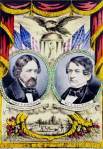
Fremont was the first Republican candidate for President. He lost. The party he co-founded has been titled ‘God’s Party’. This party and it’s candidates are given secret money by billionaires who live in homes as grand as the Chateau La Caze. How many of them flot stocks and bonds?
What became of the Baron’s art collection Napolean stole from chatteaus all over Europe? Was it kept in the basement of La Caze? What became of his six children? We know the fate of his artisitic son. Surely Elizabeth Rosemond Taylor would be honored in the Fremont-Benton family tree – even if it full of rascals and real skallywags!
Jon Presco
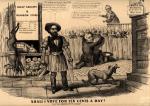
Slavery was not the only issue on voters” minds during the 1856 presidential election. In this cartoon published in Philadelphia, the artist satirized the Republican and Democratic candidates” appeals to northern workers. In the background “Ten Cent Jimmy,” a derisive name given by labor advocates to Democratic nominee James Buchanan, promises a working class gathering he will put them “on the same plan as the laborers of Europe, Ten Cents a Day.” In the foreground, Republican nominee John Fremont, dressed in a carpenter’s smock cuts a bargain with former president James Fillmore, crouching behind the fence, who promises to throw his support behind Fremont if he can’t beat Buchanan. On the left, a “Cheap grocery & provision store” offers pork, cabbages, and other produce at prices beyond the purchasing power of a working man making Buchanan’s promised ten cents a day. On the right is the boardinghouse of “Mrs Woodbee Late Pierce” a disparaging reference to Democratic incumbent Franklin Pierce, which offers rooms to mechanics at an exorbitant three dollars a week.
Baptism for the dead, vicarious baptism or proxy baptism is the religious practice of baptizing a living person on behalf of one who is dead, with the living person acting as the deceased person’s proxy. Those who practice this rite view baptism as an indispensable requirement to enter the Kingdom of God, and thus practice Baptism for the Dead to give those who have died without ever having had the opportunity to receive baptism the opportunity to receive it by proxy if they wish. Baptism for the Dead is best known as a doctrine of the Latter Day Saint movement, where it has been practiced since 1840. It is currently practiced by The Church of Jesus Christ of Latter-day Saints (LDS Church), where it is performed only in dedicated temples, as well as in several (but not all) other current factions of the Latter Day Saint movement.
Advocates of this practice believe it is referred to in The New Testament in 1 Corinthians 15:29. The practice was forbidden by the Catholic Church in the 4th century[citation needed] as an aberrant practice of heretical groups, and is not practiced in modern mainstream Christianity, whether Catholic, Eastern Orthodox, or Protestant.
Now that the GOP has been transformed by the rise of the South, the trauma of terrorism and George W. Bush’s conviction that God wanted him to be president, a deeper conclusion can be drawn: The Republican Party has become the first religious party in U.S. history.
We have had small-scale theocracies in North America before — in Puritan New England and later in Mormon Utah. Today, a leading power such as the United States approaches theocracy when it meets the conditions currently on display: an elected leader who believes himself to speak for the Almighty, a ruling political party that represents religious true believers, the certainty of many Republican voters that government should be guided by religion and, on top of it all, a White House that adopts agendas seemingly animated by biblical worldviews.
Indeed, there is a potent change taking place in this country’s domestic and foreign policy, driven by religion’s new political prowess and its role in projecting military power in the Mideast.
l
CHAPTER XXVIII
FREMONT’S LATER CAREER
Through the formation of the Wall Street corporation, Fremont realized at least two million dollars. Had the Company not been wrecked within such a short time, he would have made even more.
After the Civil War, he devoted his time and fortune to the promotion of overland transportation. He laid the foundation of the Kansas and Pacific Railroad, the Atlantic and Pacific Railroad, and the Memphis and Pacific Railroad, in the last of which, through the misconduct of French agents in Paris, his fortune was really lost.
While promoting railroads, he and his family lived luxuriously. He had been so greatly benefited by the stock-selling scheme of the Mariposa Company that he thought he could be successful in promoting stock to build railroads. Being only a visionary dreamer, however, with no practical experience in corporate financing, he became an easy mark for shrewd schemers.
His Memphis and El Paso Railroad had been chartered by the State of Texas and given 18,000,000 acres of land, on the strength of which, bonds were floated. Several millions of dollars worth of these bonds were sold in France, but the agents and banking house kept forty per cent, leaving but sixty per cent for the building of the proposed railroad.
In 1870, the Company became insolvent and Fremont and many of his friends lost everything, to say nothing of the losses sustained by thousands who had purchased stock on the glittering representations of agents. Fremont’s inside knowledge as to the condition of the Company gave him advance information of the impending failure and he could have used that knowledge to save a part of his fortune, had he been dishonest.
The following article appeared in the Mariposa Gazette of April 17, 1874:
“Fremont’s brother-in-law, Baron Boileau, who was sentenced to imprisonment by a Memphis and El Paso R. R. affair, is confined in the conciergerie in Paris. Mme. Boileau and her six children were at last accounts at Boulogne, dependent on the generosity of friends.
“Nine or ten years ago, Baron Boileau was the French consul at New York City, trusted, respected, popular and accomplished. While there, he married Susan, daughter of Colonel Thomas H. Benton, who served thirty years in the United States Senate and who was long the political autocrat of Missouri. The marriage was happy. After his union with Miss Benton, Baron Boileau was appointed French minister to Ecuador, but certain acts of his while Consul at New York were brought to the notice of the government and led to his recall from Ecuador and his discharge from his country’s service.
“While in New York, he became involved in railroad schemes and was induced to recommend, in his capacity as an official agent of the French government, the negotiation of the Memphis and El Paso Railroad bonds. It was for this plain violation of the country’s law, that his government, rigid in such matters, recalled, discharged, fined, imprisoned, in short, ruined him.
“The same Court, which tried him, found General Fremont guilty of raising money on the Memphis and El Paso R. R. bonds, by false representations and sentenced him to serve a year in prison. He made good his escape from France and is beyond the reach of the French Government, it being a strange fact, that although France and America upheld a common cause and fought side by side on fields of battle, they have with each other no extradition treaty.
“Mrs. Fremont was the favorite daughter of Colonel Benton, a woman of rare accomplishments and great ambition. Her hopes have withered; she beholds, as the result of an unfortunate speculation, her husband, who once almost grasped the highest prize in this country’s gift, declared a felon by a friendly Republic and the devoted companion of her sister, hurled from a high pinnacle into ruin and disgrace. How marvelous and melancholy are some of time’s mutations?”
It was later proven that Fremont was not guilty of misrepresentation in the sale of bonds in France. That he acted with absolute honesty but with a lamentable shortness of business judgment, was proven by a letter sent him by the unfriendly Receiver of the defunct company, which read as follows: “I deem it fair that throughout the long and careful scrutiny which I have made into the affairs of the company, I have found no proof that would sustain the charges brought against you, regarding the fraudulent sale of the company’s bonds in France.”
Fremont had proven a dismal failure as a business man and had wrecked many of his friends and relatives.
In 1878, he was appointed Governor of Arizona Territory, by President Hayes, and served four years, at a salary of $2000 a year. On his way out to assume his duties, he visited San Francisco and was given a reception by the Society of California Pioneers.
Early in 1890, in view of his services to his country, as explorer, administrator and soldier, Congress restored him to the rank of Major-General, and then placed him on the retired list, at a salary of $6000 a year. This was the first time for many years that he could enjoy a comfortable income.
On May 9th, he went to the Treasury Department to ask that his salary be not retained to meet a supposed old debt, when he was informed that the Government actually owed him $21,000 and that a clerical error forty years previous had been responsible for making it appear that he was indebted to the Government for $19,000. When he received the news, he fainted, but soon revived as he was handed a warrant for the amount due. He did not live very long to enjoy his new competency, for on July 13th, he passed away, at the home of his adopted daughter in New York City. The high distinction of being “Major-General, U. S. A.” was cut on his tombstone and it will be recalled that the same title appeared after his name on the deed when he signed away his Mariposa Estate for a consideration of over six millions of dollars.
The Nation will always be indebted to him for his important part in the opening up of the far western country, comprising half a continent. During the years, 1842 to 1847, with the famous Kit Carson, as guide, he made three expeditions through the then almost unknown regions between the Missouri River and the Pacific Ocean, in which, his daring and fortitude, amid unfriendly savages, through hazardous mountain wilds and inhospitable deserts, have seldom been surpassed.
He has been appropriately termed the “West’s Greatest Pathfinder”. Undoubtedly, he did more to open up the far western country than any other man and his detailed and accurate descriptions of that vast region helped to save many lives during the first great overland gold rush. In addition, his promptness, combined with his energy and patriotism, and that of his followers, saved California from becoming a British possession. English Admiral Seymour afterwards declared that if he had arrrived with his fleet a few days sooner at Monterey, the flag of England would have floated over California, all in accordance with a plan arranged by British Consul Forbes and Emissary Priest Macnamara.
For his services, in geographic and scientific discovery, he was recognized and rewarded by the Royal Geographic Societies of both London and Berlin. In 1861, he was chosen by the King of Prussia to be a Knight of the Society of Merit, to fill a vacancy caused by the death of Macauley. Another noteworthy distinction, which he prized, was the friendship of Baron von Humboldt, the great German geographer and explorer, who founded the modern science of physical geography.
Major-General Fremont should have been one of the wealthiest men in the United States. His patent to the vast Mariposa Estate, rich in mineral wealth, made him several times a millionaire, but he lacked the business ability to keep his money. He was a dreamer and his philosophy of life is best expressed in a letter which he once wrote to his wife; “There are two Gods which are very dear to me, Hope and Sleep. Both make the time pass lightly.” He was successful in some things, but a failure in other things. He tried to play too many parts, yet the God of Hope always cheered him
n 1789 the French Revolution, the Gillet leave Caze, the towers of the castle were beheaded and all the signs of nobility deleted. Gauldree Charles Henri-Denis Boileau was born July 15, 1773 in area ( Pas-de-Calais ) receives the field Lacaze, the dowry of his wife, Charlotte Emilia Livron, granddaughter of President Gillet de Lacaze. En 1810, il achète également le château de Laballe situé sur la commune de Parleboscq à François de Cours Monlezun. In 1810 he bought Castle Laballe also located in the town of Francis Parleboscq Monlezun Course.
http://fr.wikipedia.org/wiki/Ch%C3%A2teau_de_Lacaze
This article relates to the castle of the Moors. For its homonym in Lozere, to see Castle of Caze.
Castle of Lacaze
Construction beginning
XIV E century
Fine construction
XIX E century
Protection
Registered voter MH (12/08/1992)
Coordinates
43.943056,0.03416743° 56 ′ 35 ″ Northern
0° 02 ′ 03 ″ Is/43.943056,0.034167 [1]
Country
France
Old provinces of France
Gascogne
Area
Aquitaine
Department
Moors
Common Frenchwoman
Parleboscq
Géolocalisation on the chart: Moors
Géolocalisation on the chart: France
(See situation on chart: Moors)
(See situation on chart: France)
to modify
The Castle of Lacaze is a castle located in the commune of Parleboscq, the department of the Moors and the Aquitaine region. It is registered with the Historic buildings by decree of August 12 1992 [2].
Synopsis
[masquer]
1 Presentation
1.1 Occupants of Caze
2 Notes and references
2.1 Sources
2.2 Bibliography
3 related Articles
Presentation[to modify]
The construction of the castle dates from the beginning of the XIV E century. The windows are bored to the XVI E century and of the enlargings undertaken to the XVIII E century (houses) and XIX E century (houses and terrace). With the French revolution, the turns are decapitated. These turns were not immediately restored. The owners carried out the setting out of water using sloping roofs. A document of 1843 shows these roofs which give to the castle the aspect of an old manor.
It is between 1910 and 1914 qu ‘ Adolphe Whitcomb makes raise the turns and the crowns of crenels and of let us merlons. It is the same for crowning of the adjacent building in the east. Finally one must with Mr. Christopher Oldham in 1981 and 1982 the restoration of the frontages, the framings of the openings and especially the effective cover of the octagonal turrets. On the other hand the central turret of staircase preserves its structure of guet [2].
occupants of Caze[to modify]
The stronghold of Caze appears as of the end of the XI E century.
In 1230: Caze belongs to the Viscounts of Marsan then. Arnaud de Marsan, first lord of Caze. Quoted in an act of paréage of June 2, 1289 per which the count of Armagnac, the king of France Philippe IV the Beautiful one, and Edouard Ier, king d’ Angleterre committed himself defending it. It is their vassal. Let us not forget that since 1152, with the marriage of Aliénor of Aquitaine and the duke of Normandy Henri Plantagenêt, Aquitaine becomes English and that in 1154 the duke of Normandy becomes king d’ Angleterre.
In I290: Arnaut-wolf of Lasserre, knight of Bedeyssan. It occupies Arouille (Saint-Justin). It is besieged by Raymond Arnaud, Bâtard of Foix, which is supported by the count de Foix and the king of France Philippe IV the Beautiful one. Although supported by the English, Arnaut-wolf of Lasserre is beaten and expelled of Arouille. But Edouard I er, king d’ Angleterre comes to his help and gives him the stronghold of Caze (1290)
In 1550: Pons de Pons marries Francoise de Marsan and obtains from Jeanne d’ Albret the ennoblement of its grounds of Caze, which are high under marquisat.
In 1687: The family of Pons sells Caze to Joseph Gillet, who becomes marquis of Caze. To advise at the Parliament of Bordeaux (1691). President with Mortier (1692). A first marriage in 1692 with Jeanne Marie de Ségur, descent Jeanne Marie. A second marriage in 1710 with Francoise of Bouzet, girl of the marquis de Poudenas, descent Pierre Gaston, Jean Baptist, Jeanne Francoise. In 1714, he becomes First President of the Parliament of Bordeaux. The same year, it buys the Viscount of Gabardan. In 1734 on December 9, he dies regretted Parliament and of the public.
In 1714: Pierre Gaston de Gillet becomes marquis of Caze. He is already count de Castelnau d’ Eauzan, Viscount of Gabardan, he becomes adviser of Louis XV at the Parliament of Bordeaux in 1730. In 1738, president of the Second Room of the Investigations. In 1744, II fact of writing a consent of enumeration which specifies that Marquisat includes/understands about fifteen smallholdings to which adds the mill of Pedaynet (Espercus). There exists a right of fouage known as of Saint Andre, a right of patronage and nomination for the Saint-Joseph vault of the church of Gararret.
In 1779: Jean Baptist François de Gillet. Knight, Lord, Marquis of Caze, Count de Castelnau d’ Auzan, Adviser of the King Louis XVI, First President of the Parliament of Navarre. Only high, average lord and low Dispenser of justice on all the extent of Marquisat of Caze which includes/understands the parishes of Bouau, Mauras, Mura, Saint Michel, of Esperoux, Saint Cricq and Sarran.
In 1789 with the French revolution, of Waistcoat leave Caze, the turns of the castle are decapitated and all the unobtrusive signs of nobility. Denis Charles Henri Gauldrée-Boileau born on July 15, 1773 in Aire (Pas-de-Calais) receives the field of Lacaze, of the dowry of his wife, Charlotte Emilie de Livron, little girl of President Gillet of Lacaze. In 1810, it also buys the castle of Laballe located on the commune of Parleboscq at François de Cours Monlezun.
In 1820, it resells Laballe [1] with Jean Dominique Laudet de Mirande (Gers). 1822, we are under Louis XVIII, it is general advisor, then appointed royalist, re-elected in 1824, but beaten in 1827, under Charles X by the baron de Cauna. He dies on May 25, 1830, Officer of the Legion of Honour and knight about Saint Louis.
Charlotte Emilie de Livron, widow of Denis Charles Henri Gauldrée Boileau, preserves Caze some time then sells it to Mr Amiel who resells it with Mr Dominique Jean Barthier.
In 1844: Louis Adhémar de Guilloutet, grandson of Louise Monge (1779-1874), itself girl of the mathematician Gaspard Monge, born on August 6, 1819 in Port-Sainte-Marie (Lot-et-Garonne) becomes owner of Caze. 1850, Mayor of Parleboscq during 10 years, under the Second Empire and the III E Republic. 1863 Deputy during 18 years. 1869 general advisor during 38 years. He was deeply Bonapartiste. He obtains from Napoleon III the fastening of the commune of Parleboscq at the department of the Moors. II work in favour of Armagnac and Caze becomes a famous vintage. II fact of restoring the 7 churches of Parleboscq. In 1902, he dies after having wasted his fortune. At that time Caze extends on 580 hectares.
In 1900: Adolphe Whitcomb, General advisor of the canton of Gabarret becomes owner. He is killed in 1914 with the battle of the Marne, whereas he was lieutenant of staff of the 110e brigade of infantry.
From 1923 to 1958, Lucien, Ernest, Gaston and Jean Pascal are the owner of Caze
In 1958, the Godefroy family becomes owner.
In 1963, the family of Robillard becomes owner.
In 1973, Soft & Sidicki become owner.
In 1981: Chritopher Oldham, new owner, restores the castle. II entrusts the control of work to Roderick Galloway and the monitoring of work external with the Architect of the Building industries of France.
Denis Charles Henri Gauldrée Boileau was born in Aire in the department from the Pas-de-Calais, on September 15, 1773, wire of a military father, police chief of the wars in Artois [1], resulting from a family of the Parisian middle-class [2].
During the Revolution and the Empire, it carries out a career in the military intendance: he is associated police chief of the wars, then starting from 1807, ordnance officer of the Large army. For this reason, it takes share in the campaigns of Germany and Russia, and it is made chevalier of the Legion of Honour, in 1813.
During these displacements, it constitutes an important collection of painting, of which some are spoils of war [3]. This collection, bought by the town of Bordeaux in 1829, includes/understands two hundred and eighty paintings of works Italian, Flemish, German and Dutch. This unit places Bordeaux among the very first public collections of Dutch paintings of France [4].
Denis Charles Henri Gauldré Boileau marries in 1798 Charlotte Emilie de Livron, little girl of president Gillet of Lacaze.
He receives dowry of his wife the castle of Lacaze, located on the commune of Parleboscq, then in ruin, which is on an old stronghold marquisat of four hundred hectares [5]. He raises, under the Restoration, the name of Lacaze and titrates from now on marquis. Him the restorations of safeguard and the refitting of the castle are owed.
It buys, also, the Laballe castle, in 1810, at François of Course-Monlezun, former serviceman who held it since 1781 of Barbotan, lord of Laballe. Thus, during ten years, the two castles of Parleboscq belong to the same owner. June 28 1820, it sells this good to Jean-Dominique Laudet de Mirande.
He is member of the general advice of the Moors, when he is elected appointed by the college of this department November 20 1822, by 72 votes out of 89 voters and 139 registered voters, against 10 with the Lamarque general. He takes seat at the right-sided, supports the Villèle ministry, and he is re-elected, on March 6 1824, by 72 votes (81 voters, 141 registered voters), against 7 with Mr. Pômolié of Saint Martin’s day.
“With the legislative Room, the author of the Biography of the deputies of the septennial Room wrote about it, Mr. de Lacaze holds, as speaker, a happy medium between those which speak and those which do not say anything. Its name appears sometimes in the commissions. It gave an opinion, in the last session, in favour of the law of the sacrilege. In connection with profanations and sacrileges, it found art to skilfully place in its speech the praise of Monseigneur the Minister of Justice. In the meeting of March 19 1825, Mr. de Lacaze made a praise of the law on the reduction of the revenues…”.
II represents itself with the elections of November 24 1827, but does not obtain that 22 vote against 50 with the elected official, Mr. de Cauna.
It is made knight of Saint-Louis, and Officer of the Legion of Honour in 1825.
 Rosamond Press
Leave a comment