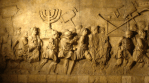



On the temple wall, facing the courtyard, for all devout Jews to see, was placed the gifts that Queen Helena the Nazarite, gave. One was a gold Menorah that reflected the rising sun, and the words from Numbers on the judging of a Sotah, a woman accused of adultery. were not these words like molten gold when the sung rose?
Jews came from all over the world to the temple and read these words. Why is it that no Christian minister or priest knows what Jesus wrote in the dust?
How long must we wait for the truth and the answer? Not long!
Jon the Nazarite
Helena helped keep Hebraism alive. Talmud Tractate reads: “Helena had a golden candlestick made over the door of the Temple. When the sun rose its rays were reflected from the candlestick and everybody knew that it was the time for reading the Shema.”
http://www.jewishencyclopedia.com/articles/865-adultery
Guilt Tested by Ordeal.
As “the eye of the adulterer waiteth for twilight, saying, No eye shall see me” (Job, xxiv. 15), Adultery is a crime usually difficult of proof, and the Biblical code contained provision for the case of the woman who was suspected of Adultery by her husband. Moved by the spirit of jealousy, he brought her before the priest in the sanctuary, and she was there obliged to undergo the severe “ordeal of the bitter waters.” A full account of the details of this ordeal is given in Num. v. 11-31; these details may also be found amplified in the Mishnah. The suspected woman was taken to the local court by her husband and there his charge was made. The court assigned two doctors of the law to escort the parties to the Great Sanhedrin at Jerusalem. The purpose of the hearing before the Sanhedrin was to evoke a confession. The Sanhedrin appealed to the woman and suggested various causes that might have induced her to go astray, and finally asked her to confess. If she admitted her crime, she was divorced from her husband at once and lost her property rights under her Ketubah. But if she denied it, she was taken to the East Gate of the Temple, in front of the Nicanor Gate, and there was placed in charge of a priest, who performed the ceremony mentioned in the Book of Numbers. He rent her garment so that her breast was exposed, and loosened her hair; she was draped in black; all ornaments were removed from her person, and a rope was tied around her chest. Thus publicly exposed (only her servants being prevented from seeing her), the jealousy-offering was placed in her hands. It was a humble offering of barley meal, without oil or incense upon it, the feed of beasts, typifying the meanness of the crime that she was supposed to have committed. The priest then placed some of the dust of the Tabernacle in an earthen vessel full of water, and charged her with the solemn oath of purgation (Num. v. 19-22). After this the priest wrote the oath on parchment, blotted it out with the water, which he caused her to drink, and the jealousy-offering was then offered upon the altar (Soṭah, i. 4-6; ii. 1-3).
If the woman refused to submit to the ordeal, and there was circumstantial evidence of her criminality, she was obliged to separate from her husband (Soṭah, i. 5). Whatever may have been the actual significance of this ordeal when first established, within Talmudic times it had merely a moral meaning. It was simply a test under which the woman, if guilty, was likely to succumb and confess. R. Akiba says: “Only when the man is himself free from guilt, will the waters be an effective test of his wife’s guilt or innocence; but if he has been guilty of illicit intercourse, the waters will have no effect”; and he based his opinion on a text in Hosea, iv. 14 (Sifre, Naso, 21; Soṭah, 47b). In the light of this rabbinical dictum, the saying of Jesus in the case of the woman taken in Adultery acquires a new meaning. To those asking for her punishment, he replied, “He that is without sin among you, let him first cast a stone at her” (John, viii. 7).
Ordeal Annulled.
This rabbinical interpretation of the law relating to the ordeal practically annulled it, and it soon fellinto disuse. During the Roman invasion of Palestine, and the last days of the commonwealth, the Sanhedrin, under the presidency of Johanan ben Zakkai, abolished the ordeal entirely; as the Mishnah states, “when adulterers became numerous, the ‘ordeal of the bitter waters’ ceased, and it was R. Johanan ben Zakkai who abolished it; as it is written (Hosea, iv. 14), ‘I will not punish your daughters, when they commit whoredom, nor your spouses, when they commit adultery; for themselves are separated with whores, and they sacrifice with harlots’” (Soṭah, ix. 9). For it appears that under the Roman régime, immorality spread among the people, the judges became corrupt, the springs of justice were defiled, and general demoralization resulted (Graetz, “History of the Jews,” ii. 237, 238). Probably for this very reason Queen Helena of Adiabene, the illustrious and munificent proselyte to Judaism, favored the ordeal; for she presented a golden tablet to the Temple with the chapter from the Law engraved on it, to be used for the rite of the ordeal (Tosef., Yoma, ii. 3; Mishnah Yoma, iii. 10; Gem. ib. 37b). But even if it had not been abolished, the rite would have sunk into abeyance with the fall of the Temple, because, according to the Law, the ceremony could not be performed elsewhere.
The Law in Patriarchal Days.
In the patriarchal days the Adultery of the wife required no proof, for whenever the head of the family suspected her, he could kill her. Thus Judah ordered his daughter-in-law, Tamar, to be burned because of her supposed Adultery (Gen. xxxviii. 24). Her crime consisted in unlawful intercourse with a man other than the brother of her deceased husband. For at first it was the custom, and afterward it became the law, for the widow of a man who had died without leaving issue, to marry his brother, so that the child of this union might be of the blood of the deceased and bear his name (Deut. xxv. 5, 6; see Levirate). In such cases the widow was really considered the betrothed of her brother-in-law, and her intercourse with another than himself was punishable as Adultery. When the punishment of the adulteress and her paramour was taken out of the hands of the husband and assumed by the civil law, this, like every other crime, had to be proved by two or more witnesses, before a conviction and sentence could follow (Deut. xix. 15; Maimonides, “Hilkot Ishut,” xxiv. 18).
Under the theory of the Talmudists, which still further mitigated the severity of the law, the woman could not be convicted of Adultery until it was proved that she had been previously cautioned, in the presence of two witnesses, not to have any communication with the suspected man, and that, in spite of such caution, she had met him secretly under circumstances that would make the commission of the crime possible (Mishnah Soṭah, i. 1, 2; Gem. 2b). This caution was given to her because of the general tendency of the rabbinical law toward mercy, based in this case on a technical interpretation of the Biblical text (Num. v. 13). Practically, it worked an acquittal in nearly every case. If, however, the husband was not satisfied with the result, the right of divorce was left open to him, although, when divorced under such circumstances, the wife did not lose her property rights under the ḳetubah. If rumors of the wife’s Adultery were circulated during the absence of the husband, the court had the right to summon and caution her with the same effect as though it had been done by her husband (Maimonides, “Hilkot Soṭah,” i. 11).
Sifre 19 and Tosefta Sota 5:2 interpret Numbers 5:28 (“And if the woman be not
defiled, but be clean, then she shall be free, and shall conceive seed”) as a promise
of possible reward to the woman exonerated by the sotah ritual. Shaar Ha’Gilgulim
says that the acquitted woman will conceive a son within a year.
Talmud Brakhot 31b attributes Rabbi Ishmael with the opinion that if the
woman had been barren, she will become fertile. Rabbi Akiva is attributed in this
Talmud passage with arguing that such a promise is not feasible. If this were the
reward, then women might purposely place themselves under suspicion in order
to undergo the sotah ordeal and reap the reward. Rabbi Ishmael suggests instead
that the reward is an incremental benefit, such as painless instead of distressful
childbirth, sons instead of daughters, lanky instead of stubby children, or fair
instead of homely children.
In its debate on what is the reward for the acquitted woman, Talmud Brakhot
31b uses Hannah’s famous prayer as the basis for concluding that an innocent
barren woman who undergoes the sotah ritual is promised children.
Hannah’s Desperate Prayer
The first two chapters of I Samuel describe the plight of Hannah, the beloved
but childless wife of Elkanah. Distraught, Hannah goes to the Tabernacle to pour
out her heart and pray for a child.
Talmud Brakhot 31b interprets the verse “Hannah spoke in her heart” (I Samuel
1:13) as a lament that G-d created her with organs that were never used. Talmud
Brakhot 31b gives a further interpretation to the verse in I Samuel 1:11, “if thou
will indeed look” as a threat by Hannah to G-d that if He does not answer her
prayer, she will force the situation by putting herself under false suspicion of
adultery in order to undergo the sotah ritual and be rewarded with a child by her
husband within a year.
Hannah’s threat should be understood in the context of the desperate need
of a barren woman to have a child. The need is so drastic that she is willing to
compromise herself in order to try the only option available. Her aim is to exact
from G-d that which she believes is the main purpose of her life.
http://groups.yahoo.com/group/Christine_Rosamond/message/481
VERSE 1-2: – “but Jesus went to the Mount of Olives. Early in the morning he came again to the temple. All the people came to him, and he sat down and taught them.”
So, here hardly even taking a break, Jesus is back in the temple early in the morning; all the people were coming and He was continuing to teach.
VERSE 3- 5: – “The scribes and the Pharisees brought a woman who had been caught in adultery, and placing her in the midst 4they said to him, “Teacher, this woman has been caught in the act of adultery. 5Now in the Law Moses commanded us to stone such women. So what do you say?”
Here the scribes and Pharisees had brought this adulterous woman, but obviously not to justify the law, if so they would have also brought the man. He had broken the law just as much she had. The law required that both be stoned to death.(Lev. 20:10)
They were simply using this woman as a trap hoping to trick Jesus. The Romans didn’t permit the Jews to carry out their own executions, so if He had ordered her stoned they would have reported Him to the Romans; if He had said she should not be stoned, they would accuse Him of breaking Moses’ law.
VERSE 6 – “This they said to test him, that they might have some charge to bring against him. Jesus bent down and wrote with his finger on the ground.”
We aren’t told what, if anything, Jesus wrote in the dust with His finger. Some see a connection to when God wrote the ten commandments, but there is no scriptures to substantiate this view. There is no reason to debate what He may have written, or to think it was mistakenly left out of this scripture.
VERSE 7 – “And as they continued to ask him, he stood up and said to them, “Let him who is without sin among you be the first to throw a stone at her.”
This is a tremendous statement about being judgmental toward not only the adulterous woman, but all sinners. Jesus said that only the sinless were worthy of casting the first stone. While we as Christians cannot condone sin we are not to be so quick to pass judgment, that is God’s role, not ours. We are to show forgiveness and compassion. This is not easy, but is an example of how the Church is suppose to operate.
https://rosamondpress.wordpress.com/2011/12/16/concieved-on-yom-kippur/#

 Rosamond Press
Leave a comment