Jon
http://www.trumanlibrary.org/oralhist/rosenmn.htm
Click to access ZionistCoverup.pdf
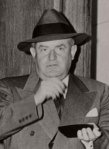
Rosenman was born in San Antonio, Texas, son of Solomon and Ethel (Paler) Rosenman. He served in the U.S. Army during World War I and graduated From Columbia Law School in 1919. He was a member of Phi Beta Kappa and Delta Sigma Rho.[1][2]
He became active in Democratic politics, and was elected to the New York State Assembly (New York County 11th District in 1922-26); and the New York Supreme Court (1st District, 1936–43).[3]
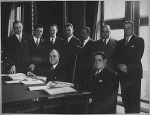
Rosenman was an advisor to Presidents Franklin Roosevelt and Harry S. Truman. Under their administration he was a leading figure in the war crimes issue. He was also the first official White House Counsel — then called Special Counsel—between 1943 and 1946.
He was a speechwriter under both presidents, helping Roosevelt with his speeches from his days as governor. While he was not heavily involved in speechwriting during FDR’s first term, he started traveling to Washington to help out with important talks during the 1936 campaign and was a key speech aide for the remainder of FDR’s life. He officially joined the White House after ill health forced him to have to choose between his judicial work and his presidential work.
He submitted his resignation as Special Counsel upon FDR’s death but Truman asked him to stay on, initially through V-E Day, then through V-J Day, and finally into 1946. Even after leaving the White House he would periodically return to aid the president with major speeches, including his acceptance speech to the 1948 Democratic convention.
[edit] Editor
Rosenman edited The Public Papers and Addresses of Franklin D. Roosevelt published in 13 volumes from 1938 to 1950. They have been immensely influential in the study of the New Deal and FDR’s policies, and, given the enormous mass of data at the Roosevelt Library in Hyde Park, it is used by historians as a guide, a conceptual framework, and a source. His selections have given rise to some accusations of partisan selectivity and of deviations from a delivered speech, the work still holds up remarkably well as an important piece of scholarship, and Rosenman will long be remembered as the Thucydides of the Roosevelt era, according to Hand (1968).
Another former Chairman of the Joint Chiefs of Staff, General George J. Brown, told an audience at Duke University that “[the Jewish lobby] is so strong you wouldn’t believe now. We have the Israelis coming to us for equipment. We say we can’t possibly get the Congress to support that. They say, ‘Don’t worry about the Congress.’ This is somebody from another country, but they can do it.” [CURTISS, p. 267] Brown’s comments almost cost him his job when Jewish lobbying groups attacked him with charges of anti-Semitism.
A distinction must be made, wrote Republican Senator Charles Matthias, “between ethnicity, which enriches American life and culture, and organized ethnic interest groups, which sometimes press causes that derogate from the national interest.” American elected politicians, adds the senator, “have been subjected to recurrent pressures from what has come to be known as the Israel lobby.” [BLITZER, p. 134]
“During the 1944 presidential campaign,” notes Steven Spiegel, “[Franklin D.] Roosevelt was pressured into promising to work for the establishment of Palestine as a free and democratic Jewish commonwealth [i.e., modern Israel].” [SPIEGEL, S., p. 12] “There were so many Jews in Roosevelt’s advisory entourage — Samuel Rosenman, Benjamin Cohen, Felix Frankfurter, David Lilienthal, Bernard Baruch, Anne Rosenberg, Sidney Hillman, and David Niles,” says Jewish scholar Barnet Litvinoff, “as well [Louis] Brandeis, [Henry] Morgenthau [Roosevelt’s Secretary of Treasury from 1933-45], and [Herbert] Lehman [the governor of New York] — that many people believed that the President himself must be descended from German Jews.” [LITVINOFF, S., p. 41] (“During the war, Republican campaigners, referring to Roosevelt’s prominent Jewish associate Sidney Hillman, put up billboards across the nation: ‘It’s Your Country– Why Let Sidney Hillman Run It?”) [NOVICK, P., 1999, p. 42] “David Lilienthal was chosen by Roosevelt to direct the Tennessee Valley Authority, an agency that virtually reshaped the role of government toward business. Later, he was also chairman of the Atomic Energy Commission.” [PLESUR, M., 1982, p. 142]
At least three of Roosevelt’s “Palace Guard”, reputedly his seven “most intimate advisers,” were Jewish (Frankfurter, Niles, and Rosenman). [MURPHY, B., 1983, p. 257] Rosenman was an official Roosevelt speechwriter; Frankfurter, a Supreme Court justice, was an unofficial one. The judge also “gradually advanced himself till he was virtually an informal campaign manager [of Roosevelt’s presidential campaign], playing a central role in every aspect of the campaign, from drafting speeches to plotting election strategy. [MURPHY, B., 1983, p. 194-195, 205] “Roosevelt surrounded himself with so many unmistakably Jewish advisers,” notes Barbara Matusow, “that his enemies took to branding his programs the ‘Jew Deal.’” [MATUSOW, B., MAY 2000, p. 79] “During the Roosevelt presidency,” notes Doris Kearns Goodwin, “though Jews constituted only 3 percent of the U.S. population, they represented nearly 15 percent of Roosevelt’s top appointments. Indeed, so prominent were Jews in the Roosevelt administration that bigots routinely referred to the New Deal as the Jew Deal and charged that Roosevelt was himself a Jew.” [GOODWIN, D.K., 1995, p. 102] Leo Rosten was a “popular Jewish writer” and head of the Office of War Information’s ‘Nature of the Enemy’ department. [NOVICK, P., 1999, p. 27] In 1943, William Bullitt, a former ambassador was complaining that “the Roosevelt administration’s emphasis on the European war as opposed to the Asian one was the result of Jewish influence.” [NOVICK, P., 1999, p. 28]
Roosevelt himself once joked, when running into Samuel Rosenman, Stephen Wise (a rabbi and World Zionist Organization president) and Nahum Goldmann (who succeeded Wise in the Zionist group) outside his weekend home in the country (where Rosenman rented a home nearby): “Carry on, boys, Sam will tell me what to do on Monday … Imagine what [Nazi leader] Goebbels would pay for a photo of this scene: the President of the United States taking his instructions from the three Elders of Zion.” [GOLDMANN, N., 1978, p. 156] (Decades earlier, President Theodore Roosevelt’s Jewish circle included Oscar Solomon Strauss, the Secretary of Commerce and Labor who declined an offer to become the country’s Secretary of Treasury. “He was afraid,” says the director of the American Jewish Historical Society, Michael Feldman, “too close an association of Jews and money would be bad for the image of the Jew.” [LIEBLICH, J., 8-19-2000, p. A10] Earlier there was Julius Rosenwald, the Sears-Roebuck mogul: “An unabashed admirer of the solid conservatism of William Howard Taft, and one of his most loyal supporters within the Jewish community, Rosenwald contributed generously to the campaigns of every Republican candidate of his era. He was an especially ardent backer of his friend Herbert Hoover, contributing $50,000 to Hoover’s 1928 presidential campaign and becoming a close adviser and confidant during his presidency.”) [DALIN, D., 1998] Close to Hoover was also Lewis Strauss, Hoover’s “private secretary” and “lifelong friend and trusted confidant.” “Strauss’ volunteer job would not only start a lifelong friendship with Hoover but also open up channels of cooperation and amity between Hoover and leading members of the jewish community.” [WENTLING, S., 2000, p. 377, 382] “In March 1919, as the feast of Passover approached, Hoover was asked to ensure that the Jews of Poland received flour in time to make Passover bread. The chief readily complied.” [WENTLING, S., 2000, p. 383]
As early as the 1940s, Zionist propaganda to move American foreign policy to Zionist dictates was massively orchestrated. As Melvin Urofsky notes
“Zionist groups organized massive petition and letter-writing campaigns.
President Roosevelt received one such petition in January 1945
seconding the Biltmore program [favorable policy to the Jews in then-
Palestine] and signed by more than 150 college presidents and deans
and 1,800 faculty members drawn from 250 colleges and universities
in 45 states. A total of 41 state legislatures and hundreds of municipalities,
representing more than 90 per cent of the nation’s population, approved
pro-Zionist resolutions.” [UROFSKY, M., 1978, p. 34] )
http://radioislam.org/thetruth/27govt1.htm
Truman’s political proclivity to take Zionist advice was reinforced by the fact that he was a believing Christian steeped in Bible lore. From his boyhood Truman had been a “dedicated student of the Bible” and quoted it often. His speeches were full of Bible references and his knowledge of scripture informed not only his concept of morality but also his notions of Palestine’s history. [9] Thus, he believed he knew all that was important to know about Palestine. In particular he “knew” that Palestine was destined to be the God-given home of the Jews. Stettinius’s suggestion that the State Department knew something important about Palestine that might run against this assumption caused the president to unfairly accuse many in the department of bias. “They were an anti-Semitic bunch over there,” Truman said of the State Department’s Near East office personnel. “They put the Jews in the same category as Chinamen and Negroes.”[10]
This Christian fundamentalist orientation blended with a general cultural and religious outlook (shared by a majority of Americans) that identified the United States with the biblical myth of Hebrews conquering their “promised land.” This story line had been alive in the U.S. mind since the days of puritans and pilgrim settlers. It had been used to rationalize the movement westward and give a religious flavor to U.S. “manifest destiny.” From the 1920s onward, U.S. Zionists made use of this identification. They tirelessly asserted a similarity between the U.S. pioneer experience and the experience of Zionist settlers in Palestine. In the process they described the Palestinian Arabs as the equivalent of American Indian “barbarians.”[11]
Truman had no trouble falling in with this mythology. He was raised to believe in the concept of a God-blessed America. While the United States was a latter day promised land in the New World, Palestine was unquestionably the land promised by God to the Jews. He knew all about that from his Bible studies. As to contemporary Palestine, Truman claimed that he “knew the Arab point of view.” [12] By this he probably meant that he had read Roosevelt’s correspondence with Arab leaders and had such correspondence himself in his first years as president. However, there is no evidence that he sought to educate himself about the realities of Palestine that lay behind Arab concerns. Of the Palestinians themselves he probably knew nothing. Thus Truman’s knowledge and sympathies were completely one-sided. And they were based upon a steadfast belief that Bible stories were true history.
In this case the religiously influenced outlook shaping Truman’s views of Palestine were in tune with his assumed political needs. It fit neatly with his conviction that he needed the support of U.S. Jewry to win the 1948 elections and that U.S. Jews were Zionists.
Truman’s Class Bias and the Domestication of the Palestine Issue
As previously suggested, Truman’s advisors created a staunchly pro-Zionist information environment within the White House. That meant that among the Oval Office staff there were no critical voices when it came to Zionist plans for Palestine. What opposition he did encounter came from outside the president’s immediate setting. In this case, it came from the State Department. Unfortunately, Truman’s upbringing and personality caused him to have a class-based prejudice against what he believed to be the privileged, upper class personnel employed at the State Department. This attitude was another part of his insecurity complex mentioned above. In the case of the State Department personnel, Truman’s disdain expressed itself in his insistence (in the “I give the orders and you carry them out” format) that they cater to his lifelong passion for supporting those he considered worthy underdogs. In this case, the underdogs were the displaced Jewish refugees in Europe.[13]

 Rosamond Press
Leave a comment