

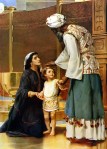
What is done? What become of the Ark that was in Samuel and Saul’s care? What if they are one and the same? Did David, and his scribes usurp the Kingdom of God…………THE NAME?
Jon the Nazarite
Hannah indeed gives birth to a son and names him Samuel because `I asked the Lord for him’ (1:20). The Hebrew word ‘Sha’ul’ means asked for or borrowed, which is in fact the Hebrew name of Saul. When she brings him to the priest Eli to consecrate him to God she says: `For this child I prayed and the Lord has granted me what I asked of Him what I asked from him [or borrowed from him]. And I too give him back to the Lord for all his life, borrowed to the Lord’ (1:27-28). The word `Sha’ul’ appears, in various grammatical variations, four times. The text uses an interesting play on the word `Sha’ul’. Hannah could be construed to say I am this child’s surrogate mother for God and I now return him to God for he is God’s special son. The text suggests a dual ownership of the `gift’ child between God and Hannah. 14 When Samson’s mother is told my an angel that she will conceive she tells her husband ‘I asked not from whence he came’ (sha’lta’hu) (Jud. 13:6) and when her husband Manoah asked the angel his name he said ‘why do ask my name which is a secret’ (tish’al), another connection from Saul and Samson. Later on (chapter 8) the people will ask for a king. Paradoxically Sha’ul – this king – eventually becomes Samuel’s great protagonist. So the question remains why was, Samuel named Samuel and not Sha’ul? 15 Is Saul the one asked for; is a king asked for and not a prophet? If Saul is a failure as king is Samuel a failure as prophet? Is the author telling us that Samuel was scheduled to be the first King, but the plot went awry? 16 Was the dual ownership of this ‘gift’ for a prophet or a king? Who was to be `the anointed one’ to whom Hannah refers to in the last verse of her song of Thanksgiving – an apparent prefiguring of the anointed king? (2:10) Did Hannah remain in Shiloh to protect her ownership? ‘And Elkanah went to Ramah to his house’ (2: 11), Elkanah not Hannah.
SAMUEL, THE POLITICAL REVOLUTIONARY AND SAUL THE TRAGIC KING
‘When Samuel was born, she [Hannah] said words of Torah,/ For this lad I prayed./ When he grew up and did the deeds of his life,/she asked, For this lad I prayed?’. (Yehuda Amichai 1 )
PROLOGUE
Saul, the first king of Israel, is a tragic figure. Why should the first king of the chosen people, chosen by God and his prophet Samuel be a tragic figure? He had the potential for greatness and the seeds of self destruction. Was Saul’s character flawed or was he fated to be tragic? Why would God choose a flawed figure as His choice for the first King of Israel? God’s great prophet, judge and high priest, at the time is Samuel; what role does he play in this tragedy? Can one say of Saul that he was fated to be a tragic figure? The Greeks believed in fate and therefore that Oedipus could not avoid his fate. Shakespearean tragedies are different from Greek tragedies. In Shakespearean tragedies the protagonist may be fated but he has choices. Some may be more fated than others.
One such figures is Othello, the Moor of Venice written by William Shakespeare. Othello appears to be the victim of his own character flaws.
Othello, is chosen Commander of the Venetian armed forces and declares Cassio as his assistant. Iago had expected to be appointed as second in command and seeks revenge. Othello then falls in love with a Senator’s daughter, Desdemona and secretly marries her. Othello, naive of Iago’s character, puts Desdemona in his care, during his battle with the Turks. Iago tells his friend Roderigo who is also in love with Desdemona, that she is in love with Cassio. Iago tells Roderigo that if he kills Cassio, he, Iago will arrange for Desdemona to love him. Iago aware of Othello’s flaw, jealousy, manipulates his own friend Roderigo, and Othello’s associate Cassius to destroy Othello. Iago convinces Othello, by manufacturing evidence that Cassio and Desdemona are lovers. Othello kills Desdemona and them himself. Before his suicide he declares “Who can control his fate”? But Othello’s tragedy is not fated. It is based on his own character flaws and the machinations of the most evil figure in Shakespearean literature, Iago. His own jealousy and his naivety toward the evil Iago, destroyed him. Othello commits suicide as does Saul – the only such figure in the Bible. 2
Is Othello with his character flaws a tragic figure? Can one compare Saul and Samuel to Othello and Iago. Othello and Saul both suffer from identical character flaws: jealousy, naiveté and rigidity. Can one compare Samuel and Iago as orchestrators of the respective tragedies? It does not require Samuel to be evil as is Iago. Or is Saul fated to his tragic end. What can fated mean in a religious text? If so what is the role of God in the Saul/Samuel tragedy?
INTRODUCTION
Samuel is an enigma. He is to replace a High Priest, but he is not a priest and the priestly family he is to replace is not, in fact replaced (I Sam. 14:3; I Kings 2:26-27). According to his mother’s song he was to be an anointed king, yet he anoints a king who is a failure. In I Samuel he is the anointer of David, but in Chronicles he almost does not exist. In the Psalms (and according to himself) he is comparable to Moses.
Samuel’s life coincided with an era of political transition for the Israelites who forced a change from a judgeship system of government to monarchy. These changes began while Samuel reigned as Judge. But before he replaced the judgeship system, he replaced the importance of the priesthood with the system of Prophecy. He made the Prophet more important than the Judge and then he tried to make it more important than the kingship.
He was the last of the judges, the first of a series of Prophets and eliminates (to some degree) the growing power of the Priesthood. And he anointed the first King, Saul and Saul’s successor David. Samuel himself consolidated the power of judgehood, priesthood and prophecy. Of the leaders beginning with Moses through Samuel and to the end of Biblical history, none held all three positions. Moses was a judge and prophet. Not even Moses, the greatest of the prophets was high priest. Could Samuel’s rejection by the people have been a rejection of tyranny or potential tyranny? All of the major judges 3 arose as saviors when Israel was attacked by enemies. Between the major judges and even within the rule of some individual judges the political system was instable. None of the Judges succeeded in uniting the tribes and competition among the tribes for leadership was frequent. Political power was diffused and the judgeship system was inherently discontinuous. The judgeship system of government consisted of a loose federation of twelve tribes. The unifying factor in this federation was their belief that God had conferred upon them a covenant via their biological father Abraham and their spiritual father Moses. The covenant was symbolized by the Ark at Shiloh.
Neither Samuel nor Eli (his predecessor) were typical of the major Judges. Both acted as High Priests and men of God and at times as military leaders. Both attempted to have their sons succeed them. A previous attempt at continuity after the Judge Gideon had failed, when Gideon refused to become king and the attempts by his sons to create an hereditary system failed.
When Samuel’s sons failed as leaders the elders saw the system of discontinuity returning. They demanded a monarchy. They would solve the problems of continuity, of unifying the tribes and of a creating and maintaining a professional army. This was to be a system of centralized power. The people saw that the neighboring kingdoms had a monarchical system and they continually invaded Israel. Were they asking to follow the idolatrous neighborhood kingdoms?
In a battle against the Philistines, the Ark was brought by the Israelites from Shiloh to the battle ground, to protect their soldiers. The army of Israelites lost the battle (30,000 soldiers died) and for the first time ever the Ark was lost – captured by the Philistines. Later Samuel defeated the Philistines and recovered the Ark, but it was never returned to Shiloh. The capturing of the Ark must have been a traumatic event in early Israel history. The `house’ which contained the Ark was destroyed. This destruction appears to be one of the most under reported traumatic events in Jewish history. (This was actually the First Temple – why was it so unreported?) We know of the `house’ because Eli, the High Priest and his apprentice Samuel lived there. `Eli was lying down in his room . . . and Samuel was lying in YHVH’s sanctuary, where the Ark of God was’ (I Sam. 3:2-3). We only hear of the destruction of the `house’ four hundred years later. According to Jeremiah God threatened to destroy the `First’ Temple as he had destroyed Shiloh. Now go to the place which used to be mine at Shiloh . . . I shall treat this Temple that bears my name . . . just as I treated Shiloh (Jer. 7:12,14). And again `I shall treat this Temple as I treated Shiloh, and make this city [Jerusalem] a curse for all the nations of the world’ (Jer. 26:6).
The capture of the Ark and the destruction of its `house’ may have suggested the failure of the judgeship system. Within less than a generation David was anointed as King of the combined tribes – the United Kingdom of Israel. He captured Jerusalem and installed the Ark (which had been ignored for thirty years) to Jerusalem.
By the time of King Solomon the Israelites political system had completely changed. The tribes were united. The king was almost a secular monarch, the Temple was built and a cultic priesthood installed and a prophetic system expressed God wishes to the people. A professional army was installed and continuity guaranteed. It soon failed as the northern tribes separated from Judah. The period beginning with Samuel was the beginning of this political revolution. Samuel represented the old order and saw himself representing God and His kingdom. Saul represented the new order, partially of secular power, certainly an at centralized government at least as seen by Samuel. Samuel reacted poorly to this revolutionary change in the form of government.
Was Samuel defending the old order against the new order represented by Saul and/or was he defending his position when his sons were rejected? Saul, the first King of Israel can be seen as a tragic figure. Was the tragedy of Saul due to flaws in his character? As we will see, Saul’s character flaws included jealousy, rigidity and naiveté. Samuel was the judge/priest/prophet who reluctantly anointed him as King. Their lives became intertwined in a negative symbiosis. Samuel is the only man who attempted to be judge/priest and prophet. He did not see the need for a monarchy (see chapters 8; 10:10-17; 12) but he, nevertheless anointed Saul (9; 10:1-16) and saw Saul’s victory (chapter 11). Perhaps he would have liked to see Saul fail. Saul, given his flaws, seemed an odd choice for the first King of the united tribes of Israel.
Both protagonists, Saul and Samuel, are flawed and die as failures. Samuel mother called him a borrowed gift from God and she was his surrogate mother; a powerful combination. Samuel’s failure is very different than Saul’s. Samuel failed to prevent a monarchy developing but was involved with its failure. Saul name means borrowed, we do not know his mothers name and as we will see his father treats his adult son as if we were a servant. He is a borrowed personality and has no core identity. He seems fated to fail.
SAMUEL
The Book of Samuel begins by describing Samuel’s father. Elkanah lives in the hill country of Ephraim … and is an Ephratite (I Sam. 1:1) . There is nothing in the text of Samuel suggesting that Elkanah is a Levi. (Priests are required to be of the tribe of Levi and descendants of Aaron, Moses’ brother and the first High Priest.) He is never noted as assisting the Priest, he is described as an Ephratite. In the Book I Chronicles he is called a Levi (I Chron. 6:6). Why is Samuel is never called a High Priest, although he acts as one, being in charge of the sacrifices? Is this because Samuel usurped the High Priesthood and the Book of Chronicles seen by most commentators as Davidic propaganda needed some justification for the anointer of David?
Elkanah had two wives, one Peninah who had children and the second Hannah who was barren of children. Elkanah loved Hannah despite her childlessness. 4 He gave her a special portion of the sacrifice as symbol of his love. Peninah recognizing that she is not as beloved as Hannah, humiliates Hannah for her barrenness. Elkanah, for his part loves her as a person despite her barrenness. By telling her that he loves her more than ten sons, he is establishing her personhood regardless of her value as the mother of sons. 5 But Elkanah did not understand her anguish and she cannot answer him. A loving husband is not a substitute for one child and certainly not for ten children. 6 Jacob who loved Rachel, also did not understood the anguish of a barren woman. Is it possible for a man with children to understand his wife without children? 7 Hannah is not called a barren woman, but a woman who had no children because God closed her womb. Sarah, Rebekah, Rachel and Samson’s unnamed mother are called barren women. Sarah suggests Hagar to Abraham 8, Rebekah simply waits not knowing Isaac has prayed for her, Rachel goes to Jacob seeking death if he can supply motherhood to her. Samson’s mother hears an angel. Hannah goes directly to God. She is God-infused.
Hannah prayed silently (the first silent private prayer noted in the Bible 9) asking God for a special son. 10 She volunteers to let no razor touch his hair, making him a qualified ‘Nazir’. 11. (The Dead Sea Scroll and the Septuagint refer to Samuel as a Nazarite. 12) Hannah then says `I will give him to You God for all the days of his life’ (1:11). Eli, the High Priest, first thinks she was drunk, but upon hearing her prayer tells Hannah her wish will be granted.
What kind of mother would ask for a son – a special son- and then say she will give him back to God? Sarah received a special son in her old age, and God asked for him back in the akeda of Isaac. Abraham did not tell his wife Sarah of God’s request, because she would have refused. If fact when, according to Jewish Midrashim, she heard about the akeda from Satan she instantly died of shock. Hannah did not discuss this request of her’s with her husband Elkanah.
Samson’s mother was told by an angel that she should not drink intoxicating wine and she would have a child; and not to cut his hair and that he shall be a Nazir. Both of these barren women are told they will have a child after a period of barrenness and they are not to cut the child’s hair. Neither is told that the child is not to drink although that is the requirement for a Nazir. But one of the mother’s (Hannah) is accused of being a drunk and the other told that she should not to drink. A comparison is being made between Samuel and Samson. Both names begin with the same first two Hebrew letters, `shin’ and `mem’. These spell the word `name’ an alternative use of the name of God. Both are introduced with the phrase ‘And there was a man’ (I Sam. 9:1 and Jud. 13:2), both are warriors and both die of their own hands. 13
Hannah indeed gives birth to a son and names him Samuel because `I asked the Lord for him’ (1:20). The Hebrew word ‘Sha’ul’ means asked for or borrowed, which is in fact the Hebrew name of Saul. When she brings him to the priest Eli to consecrate him to God she says: `For this child I prayed and the Lord has granted me what I asked of Him what I asked from him [or borrowed from him]. And I too give him back to the Lord for all his life, borrowed to the Lord’ (1:27-28). The word `Sha’ul’ appears, in various grammatical variations, four times. The text uses an interesting play on the word `Sha’ul’. Hannah could be construed to say I am this child’s surrogate mother for God and I now return him to God for he is God’s special son. The text suggests a dual ownership of the `gift’ child between God and Hannah. 14 When Samson’s mother is told my an angel that she will conceive she tells her husband ‘I asked not from whence he came’ (sha’lta’hu) (Jud. 13:6) and when her husband Manoah asked the angel his name he said ‘why do ask my name which is a secret’ (tish’al), another connection from Saul and Samson. Later on (chapter 8) the people will ask for a king. Paradoxically Sha’ul – this king – eventually becomes Samuel’s great protagonist. So the question remains why was, Samuel named Samuel and not Sha’ul? 15 Is Saul the one asked for; is a king asked for and not a prophet? If Saul is a failure as king is Samuel a failure as prophet? Is the author telling us that Samuel was scheduled to be the first King, but the plot went awry? 16 Was the dual ownership of this ‘gift’ for a prophet or a king? Who was to be `the anointed one’ to whom Hannah refers to in the last verse of her song of Thanksgiving – an apparent prefiguring of the anointed king? (2:10) Did Hannah remain in Shiloh to protect her ownership? ‘And Elkanah went to Ramah to his house’ (2: 11), Elkanah not Hannah.
Elkanah asked Hannah to go to Shiloh to the yearly sacrifice, she says not until I am ready to give Samuel to Eli. Elkanah says `do as you wish … may God do His wish’ (1 Sam. 1:23). What does Elkanah mean by his odd statement? Does Elkanah resent Hannah giving away their son? Does he realize that he has lost his son to God? Abraham agreed to sacrifice his son Isaac, did anyone ask Elkanah? 17
Hannah delivered her son, Samuel to Eli. The text the states that ‘ha’na’ar’ ‘no’ar’. The word ‘ha’na’ar’ means the youngster and ‘no’ar’ is of the same root with slightly different punctuation(1:24). What is the double use of the word `na’ar’? We do not know at what age she weaned him or how long she raised and educated him. He was apparently more than a child but less than an adult, a youngster. The double `na’ar’ can mean he was a youngster who acted as a youngster. A Midrash explains the double use of `na’ar’ by saying that Samuel saw people waiting for Eli to prepare the sacrifice. Samuel told them they did not need a Priest to prepare the sacrifice, they could do it on their own. Eli later confirmed that according to halakhah (Jewish law) Samuel was correct but he thought they should have waited out of respect. 18 As we will see in chapter 13, Saul is punished by being deprived of his kingdom because he did not await Samuel and prepared a sacrifice himself. It is ironic that Samuel was permitted to be disrespectful to the High Priest and judge Eli, although remaining within the law but when the King of Israel was disrespectful to Samuel, the High priest/judge/ prophet, but also remaining within the law, it is a sin against God. His kingdom is taken away (1 Sam. 13:13-14).
Hannah leaves her son Samuel with the song or hymn described as being written by Hannah.) 19 (It has similarities to David’s hymn of praise in 2 Samuel 22, and also resembles some of David’s Psalms. Was this written by one of David’s song writers or even David himself? 20
Hannah reads or sings this hymn as she leaves Samuel to Eli. It symbolizes how she raised him. And she raised him to youngster-hood (na’ar) not just until childhood. She tells him God gave him to her, that she is his surrogate mother for God and she gives him back to God, God the Rock. 21 (1 Sam. 1:27-28) That he is the horn of God (1 Sam. 2:1) her deliverance and his birth was her power. She talks about the barren woman having seven children (verse 7) and is saying he is the equivalent of seven children. Did Pennina have seven children or have ten children as noted by Elkanah (1 Sam. 1:8). Hannah eventually gives birth to a total of six children including Samuel, thus she is not referring to her own children, but saying that Samuel is the equivalent to seven children. Her husband had compared her to ten sons (the Ten Commandments?) when she was barren (1 Sam. 1:8). Both numbers have symbolic meaning in Judaism, but seven, the number of days God created the world is more significant. She then tells him that he is God’s anointed (verse 10), his equivalent king. She raised him to believe in his own grandiosity. She did not raise him to be humble like his model Moses.
We are now introduced to Eli’s two sons and they are compared to Samuel. The remainder of chapter 2 and chapter 3 we have a series of interspersed verses criticizing Eli’s sons and conversely praising the goodness of Samuel.
‘The child [Samuel] did minister to the Lord’ (2:11). `The sons of Eli were wicked and they knew not the Lord’ (2:12). ‘But Samuel ministered before the Lord’ (2:18) and even wore an ephod, the robe of a Priest. Hannah, his mother brought him a new robe each year, perhaps the ephod. And Samuel grew before the Lord’ (2:21) Eli disciplines and rebukes his sons but they fail to listen (verses 22-25). Again, `Samuel, grew in esteem and favor both with God and with men’ (2:26). A `man of God ‘ (an Angel) comes and tells Eli his sons are evil and as a result they will all die on the same day 22 and his house will be destroyed. God will raise a faithful Priest (inferring Samuel, but not named) who will do His wishes (2:35). This section concludes `Young Samuel was in the service of the Lord under Eli’ ( 3:1).
This series of statements about the evil of Eli’s two sons and the goodness of the young Samuel presents an interesting paradox. We later discover Samuel’s own two sons are engaged in evil. His inability to control his sons parallels Eli’s failure with his sons. Eli’s house is destroyed because of his inability to control his sons. What fate awaits Samuel’s house? If Samuel’s house can be construed to include the first king he anointed – Saul – one may conclude that he is as great a failure as was Eli.
In chapter 3 Samuel experiences his first vision of God. The Lord called out to Samuel. Samuel mistaking the voice for Eli went to Eli’s bedroom, but Eli said I have not called. This occurs twice more. Then Eli says if it happens again say `Speak Lord, for your servant is listening ( 3:9). 23 When Samuel hears the voice again he responds `Speak, for your servant is listening’. Samuel remembers the form yet omits the essential word, that he is addressing God. He could not remember the five words (in Hebrew) that Eli told him and left out `Lord’ (3:10). 24 As we shall hear, this is only the beginning of Samuel’s inability to listen. God tells Samuel what the angel had told Eli the day before. And reluctantly Samuel tells Eli what he had already heard from the voice of God. Once again, after hearing of the evil of Eli’s sons we read `the Lord revealed Himself to Samuel’ (21).
We are then told of a war in which Eli’s sons die and when Eli, 98 years old, hears of his sons death he dies. The next four chapters involve wars, the loss of the Ark and how the Ark travels and plagues the enemies of God. At the end Samuel humbled the Philistines. The Ark was returned to Kiryat Yearim, but is never returned to Shiloh nor used again in Samuel’s lifetime.
‘Samuel grew old and he appointed his sons judges over Israel’ (8:1). Samuel seems ready to retire and appointed his sons as his successors. Judges have not appointed their sons as successors since this would create a dynastic rule. Why does Samuel believe he the right to appoint his sons as his successors? When Gideon, a very successful Judge was asked by the people to become an hereditary ruler he refused. Perhaps Samuel recognized the problems inherent in a lack of continuity, which as we shall see the people recognize. But he chose his sons (Joel and Abijah) which we are told are evil.25 They took bribes. The Elders assembled and declared your sons are not like you. We have been told three times of Eli’s evil sons 26 and Eli being held responsible for his sons’ behavior. This has been interspersed with information about the goodness of Samuel. The sudden statement regarding Samuel’s sons is shocking. Is Samuel equally responsible for his sons as Eli was for his? Eli’s dynasty was flawed due to his flawed children, are Samuel’s equally flawed?
Besides rejecting Samuel’s sons as judges, the elders declare that they need a king `like all other nations’ (8:5). It may not be the sons of Samuel that are the real problem, but the inadequacy of the judgeship system. 27 Does, being like other nations, mean believing in local gods as other people do? Not necessarily, in Deuteronomy where the commandment to have a king is first revealed, God states that `I will set a king over [you] as do all the nations about me’ (Deut. 17:14). God’s concern is idolatry as he states to Samuel (8:8). The people want continuity, unification and a professional army. This they perceive as the components of nationhood, being a nation like other nations.
Samuel experiences their demand for a king as a personal rejection. Does he see himself as being asked to demote himself, to remove his judgeship power? This despite that several times in the Book of Judges we have been told ‘In those days there was no king in Israel, and everyone did as he saw fit’ (Jud. 17:6;18:1; and 19:1) including the last verse of Judges (21:25). God tries to assuage Samuel’s pain by telling him it is He the people rejected not Samuel. That God is assuaging Samuel is transparent. The people are not rejecting God, but requesting what had been promised them. It is the judgeship system the people are rejecting. The people argue that they need a king to fight their wars (8:20). Samuel prays to God, no doubt to reject the peoples’ request. God then tells Samuel to heed the people (8:7). God repeats this to Samuel `heed their demand’ (8:10), but tell them to avoid idolatry and tell them of the laws of kingship. Moses told the people in the desert that they could have a king after they arrived in the promised land (Deut. 17:14-20). Moses then told them of the laws of kingship. First the king is not to economically oppress the people by keeping many horses, wives and silver and gold. Secondly the king must keep the scroll of the law at hand, he must study it, read it and obey it, for it is the word of God. When Samuel informed the people of the conditions of the law, he emphasized to them that a king may be a tyrant. He will be permitted to take your sons into his army, confiscate your property and even lay claims to your daughters to be his slaves. He does not tell them of the need for the king to study and keep the law. He neglects to tell them of God’s concern about their turning to idolatry. Samuel was attempting to dissuade the people, through the potential of economic and physical burdens, from their desire for a King. The text tells us Samuel `reported all the words of the Lord to the people’ (8:10). However despite God telling him twice to heed the people Samuel fails to tell the people that God considers their request for a king (to be a `nation like other nations’) as potentially idolatrous (1 Sam. 8:8), but that He has reluctantly agreed to this request. It is paradoxically God whom they may be rejecting who agrees to the people’s request, while Samuel refuses (for the time being) to be the king-maker. Nevertheless, the people reject Samuel’s fear mongering and say we want to be like other nations and have a King to fight our battles. God comes again to Samuel and in addition to saying `Heed their demand’ as God has told him twice, adds the concrete instruction `appoint a king for them’ (8:22). God may not endorse their demand but He does not reject it. Let them live with their choice. Samuel, however, does not listen to God or the people’s voices. Samuel’s inaction to the word of God and to the people who asked him to `appoint’ (8:5) and `give us a king’ (8:6) appears as obstructive and self serving. In fact Samuel tells them to go home and fails to relay the message that God approved their request.
INTRODUCTION TO SAUL
Saul is introduced as the most handsome and tallest man in Israel. His father Kish, a rich man, lost some asses. He tells Saul to take a servant and go find them. Saul is not a young man, he has an adult son Jonathan whom we shall meet shortly. Why not send only a servant – it is only a few asses? Saul is obedient, perhaps the servile son of a powerful father. After searching for awhile Saul says to his servant let us return home or father will worry about us. Is there no way of sending message to his father that they are OK.? The servant says there is a man of God in town let us talk to him. We have been told earlier that Samuel traveled all Israel and judged ( 7:16) and spoke `to the whole House of Israel’ ( 7:3) and yet Saul does not know of the seer, only the servant seems to know of his existence and whereabouts. Saul says but what can we bring him; we cannot go empty handed. I have nothing what do you have? Does one need money to ask of a seer? The servant tell Saul he has 1/4 shekel. The servant is knowledgeable and decisive (and carries the money), Saul appear as a passive peasant with a servile personality even to his own servant. He reminds us of Eliezer, Abraham’s servant who is required to find Isaac a wife.)
Saul and his servant meet some young girls and asks whether the seer is in town. Yes he is right ahead. Hurry and you will find him by the altar. You will find him right away. Even young girls know about the seer.
One day earlier God told Samuel I will send you a king tomorrow. As soon as Samuel saw Saul, God said this is the man. Saul approaches and says where is the seer? Samuel says I am the seer. The peasant Saul does not recognize the seer and the seer needs God’s direct statement to recognize the future king. As we shall see later when Samuel chooses a son of Jesse as king he chooses the wrong son, he indeed needs God to point out to him who is the chosen one.
Why does the narrator present Saul, the King-elect of Israel as a naive servile peasant? His servant is more aggressive, Saul is ignorant of the seer and even after the girls tell him he is there he does not see the seer.
Samuel says to Saul we are all awaiting you. Why Me? Samuel responds `and to whom does all the gift in Israel belong? Is it not to you and to your father’s house?’ (1 Sam. 9:20) This Delphic-like statement is Samuel’s notification to Saul that he is destined to be the first King of Israel. Samuel invites Saul to a special dinner. Samuel sits Saul at the head of the table and Saul is given a special portion of the meat.
Samuel takes a vial of oil and anoints the King-elect. 28 Saul is anointed as ‘Nagid’ (ruler) 29 (10:1) not as King ‘Melech’ which is what God instructed him (8:22). While the difference between ‘Nagid’ and king is unclear in ancient Israel, God’s instructions were clear. Among the future events, Samuel tells Saul is that he will meet a band of Prophets and he should prophesy with them. Saul, will thus become the only king of Israel (or Judah) to be a king/prophet. Did Samuel do so to ensure that he, as Chief prophet, would still be in charge and Saul be subservient? Given what we know of Saul and Samuel it would be difficult for the Majestic Samuel not to feel superior to the servile Saul. Samuel then tells Saul `when these signs will come to you, do for yourself what your hand will find’ (10:7). Just what Saul is to do is made unclear. Was Saul to do something with the prophets?
In a critical statement Samuel tells Saul to go to Gilgal and wait for me for seven days `until I come and to instruct you what you are to do next’ (10:8). What was the connection between verse 7 – ‘do for yourself what your hand will find’ – and 8 ‘wait for me . . .and I will instruct you’?
Saul takes his leave of Samuel. As Samuel prophesied Saul indeed meets a band of prophets, and Saul indeed prophesies with them. A man asks is Saul too among the prophets? And who are their fathers? Is the question being asked who now is Saul’s father, the powerful Kish or the powerful Samuel? In the Delphic-like statement Samuel first used to inform Saul of his kingship, he used the term it belongs to the `house of your father’. Who indeed is the father?
Samuel tells the people that despite your rejecting of God, He has ordained that you may have a king. The choice will be made by lot. The only other time a lot is used before this incident to find someone is to discover the sinner, Achen, who caused the Jewish people to lose the battle of Ai (Josh. 6: ). Later, the heroic Jonathan who disobeyed his father’s foolish oath, is discovered by lot. Choosing by lot thus is not necessarily a complimentary way of choosing a person. Saul is chosen but he is hiding. God tells the people where he is hidden. As noted earlier Saul continues to act with his servile personality, not really wanting to be King.
But some scoundrels said, `How can this fellow help us’? (1 Sam. 10:27) So they scorned him. They are ironically right, how can this man help?
In the next chapter (11) Saul gathering an army of 330,000 men heroically defeats the Ammonites after an attack at Jebash-Gilead. But when the people of Jebash-Gilead seek help they do not seek Saul. Saul living in Gibeah, hears weeping and discovers the problem. The people do not come to their king for help. To gather the people he cuts up an ox in twelve parts and sends one to each tribe to gather an army. This is an obvious comparison to one of the most horrible acts described in the Book of Judges. A Levite travels to Gibeah and there when he is threatened he hands over his concubine who is raped all night. The man divided her body into twelve parts and send them to all the tribes (Jud. 19:29). And who did not come to fight over Gibeah for the Levite? The people of Jebash-Gilead. What an odd way to introduce the first coming victory of the new King.
The battle is won. Then a very strange statement appears in the text. ` And the people said to Samuel: `Whosoever said Saul shall rule over us’ shall die. (1 Sam. 11:12). What does this mean? In verses 1-11 Saul in fact appears not as a king but as a Judge/savior, as of old. In none of these earlier verses is Saul referred to as king. He simple hears people crying about some disaster. There is no recognition that Saul is King-elect. In verse 7 Saul says `whoever does not go forth after Saul and Samuel.’ Thus the implied new Judge and old Prophet are symbolically related. Verse 12 can imply that the people want Saul to be Judge and are rejecting kingship. Or perhaps it refers to those in the previous chapter who spurned Saul (1 Sam. 10:27). Or perhaps as suggested by Jewish Midrashim the verse (12) is meant derisively.
It appears that the conflict continues; there are those who favor the combined team of Samuel continuing as Prophet and Saul as Judge versus those who favor Saul as King. But Saul is a victorious commander; he finally speaks up and declares `no one will die today’. Samuel then says in response let us go to Gilgal to renew the monarchy. What renewal? Saul has yet to be crowned. It almost appears that Samuel has admitted defeat and recognized that Saul is King of Israel. And they went and Saul was finally crowned King.
However Samuel did not acquiesce so readily. Samuel then delivers a long speech defended himself, the old order and incredibly his sons – those evil sons – who were rejected by the people. Samuel says I have done as you wished and crowned a king for you. He does not note how long it took him to obey God’s command to heed the people. But he does say I am old, you have a king and my sons are still here. How are the people to respond to the words my sons are still here? Is he telling them that they can still advice you, despite their evil inclinations? Samuel then asks have I ever taken an ox or oppressed you? Is he comparing himself to the king he described in chapter 8? The people confirm that he did not. Conversely his sons were accused of having received bribes during their judgeships. He then compares himself to Moses and Aaron (and other judges). 30 He asks God to confirm their evilness and He does so by sending thunder and rain in the non-rainy season. But Samuel says fear not, God will not forsake His people. Unless you do wrong in which case He will destroy you and your King. Samuel then says he will continue to act for God and protect their interests. Samuel is setting up the new system of prophet-ship under the monarchy.
How should this speech be understood? It is clearly self defensive. Samuel still feels personal rejection when if fact his evil sons were rejected. He still does not recognize that the people were right in terms of his sons. Is it not ironic that Samuel’s mentor Eli, a Judge/High Priest (if not a prophet) has unworthy sons and Samuel the first and only unquestioned Judge/Prophet/High Priest fails in the same way, with unworthy sons. 31 Eli’s dies at the age of 98 and his family and legacy appear to be destroyed. Samuel dies at the age of 52 according to Jewish Midrashim and his family (sons) and his legacy ( his chosen king Saul) are destroyed. Is his death at a relatively young age a further criticism of him?
Samuel feels rejected and King Saul is the symbol of that rejection. `The Lord your God was your King’ (12:12). God does not respond except when Samuel says if you do evil God will reject you. The people understand and say `we have added to all our sins, to ask for ourselves a king’ (12:19). Samuel as we shall see later regarding Saul, used his power, position and charisma to convince the people that he is right and the people ought to feel sinful and guilty.
Saul finally stood up to Samuel and Samuel crowned him. Samuel’s feelings toward Saul will become more and more clear in the next three chapters (13-15).
THE KINGSHIP OF SAUL
Chapter 13 opens with the statement that Saul had reigned for two years. 32 Saul’s son Jonathan is introduced as a soldier who killed the Philistine governor. Quickly we are told that Saul assumes the credit for his son’s heroism. 33 Saul gathers an army to fight the Philistines, but the Philistines have a much larger army `as numerous as the sand on the seashore’ (13:5). Saul’s army consists of 3,000 men who are frightened and deserting their commander and King. What happened to the Judge/savior who mustered 330,000 men? Why is the newly crowned king unable to raise a sufficient army to fight the Philistines? Why does Saul fail immediately upon being crowned?
Saul waits at Gilgal for Samuel to bring the sacrifice and pray for God’s help. Why does he wait at Gilgal? Saul waits for seven days as his army deserts him – they now only 600 men. He finally prepares the sacrifice himself. As soon as Saul finished presented the sacrifice Samuel then comes. And says `What have you been doing’?. Saul responds that my army has been deserted me and you had not come. I need God’s help and so I brought the sacrifices myself. Samuel responds `you have acted foolishly in not keeping the commandments that the Lord your God laid upon you. Otherwise the Lord would have established your dynasty over Israel forever. . . The Lord will seek a man after His own heart (13:13-14).
It is difficult to understand this development. What indeed has Saul done to incur Samuel’s and according to Samuel, God’s wrath?
He prepared the sacrifice himself. He did not wait for the High Priest. This same High Priest we have learnt from a Jewish Midrash, that it was not necessary for a priest to prepare the sacrifice. The fact that this Midrash was written, centuries later, tells us that Jewish commentators realized the inconsistency of the priest/prophet criticizing the king. By noting that Samuel himself had told people they could prepare the sacrifice themselves, the Midrashic author is stating that what Saul did was acceptable. David and Solomon prepared sacrifices and some of David’s sons acted as priests. 34 Is Samuel referring to the event before Saul’s coronation two years earlier, when Samuel told him to wait in Gilgal for seven days for a sacrifice? Why should a two year old request be valid now in a critical stage of war? 35 If Samuel believed that the request was still valid why did he wait until the last possible moment, the seventh day, when a critical war situation had ensued. Why did he not come immediately, instead of waiting until the sacrifice preparation was completed? Was Samuel just waiting for Saul to begin so he could criticize him? The text not Saul, tells us that he, Saul, waited the seven days. It was Samuel who failed to come at the appointed time. 36 Which of God’s commands had Saul disobeyed? Even if Samuel believed his command of two years earlier to be still valid, have his commands become God’s command? God does not speak in this entire chapter. What does it mean that you have lost the dynasty that `the Lord would have established’? Did Samuel expect the king to be a savior/judge and not a dynastic king? 37 Did God only give Saul a one time kingship and not a dynasty? Were their conditions for Saul to fulfill and if so what were they? 38How does Samuel know God has rejected Saul and has decided to choose another king? As we will see in the first verse of chapter 15, the rejection seems forgotten. Has Samuel and not God, disowned Saul? Samuel disowns Saul when he appears to be taking over the priestly role and in Samuel’s eyes, diminished him, Samuel. Saul, the servile son of Kish, intimidated and diminished as he is by Samuel, cannot even respond. Is this treatment by Samuel befitting towards the King of Israel? Is this the way the judge/prophet/high priest who thinks of himself as Moses-like treats the King and H/his people?
 Rosamond Press
Leave a comment