I wanted to save my life. The councilor that did my intake at Serenity Lane gave me six months to live. If I replapsed, I would be dead. Somehow, for some reason, God led me to make the most perfect choice. I consider myself a Rabbi. In 1992 I began my autobiogrpahy ‘Bonds With Angels’ so that I might help others who suffer from the disease of alcoholism. I had no desrie to become a Biblical Scholar.
Since I made this discovery, I have been having long discourses with my Reader. recently, Biblical scholars are concluding Samuel and Saul are one and the same. Saul was not a king, but a Judge, thus a Nazarite. King David was not only a bloody man, he was a drunken bloody man, who sides with the Philistines against the Jews, his won people. He dances like a drunk before the Ark of the Covenant when he entered Jerusalem. Nazarite obtained from alcohol. Samson was a Nazarite and fought battles against the Philistines who plowed his wife for secrets, so they could own the secret of his strength.
David was a tricky and treacherous usurper. Why the Jews look upon him as a National Hero – God only knows?
Jon the Nazarite
Culture and religion
Philistine culture was almost fully integrated with that of Canaan and the Canaanites. The deities they worshipped were Baal, Astarte and Dagon, whose names or variations thereof appear in the Canaanite pantheon as well.[2]
The Philistines were also renowned for both their production and consumption of alcoholic beverages. Numerous finds have exposed a well-managed spirits industry, from breweries and wineries to retail outlets that advertised beer, wine, and strong drink. Among the most numerous artifacts unearthed from Philistine ruins are beer mugs and wine craters (large drinking bowls). The story of Samson’s wedding feast alludes to the Philistine practice of engaging in weeklong drinking parties, as the Hebrew word misteh, translated as “feast” in Judges 14:10, indicates a “drinking feast.”
But David thought to himself, “One of these days I will be destroyed by the hand of Saul. The best thing I can do is to escape to the land of the Philistines. Then Saul will give up searching for me anywhere in Israel, and I will slip out of his hand.”
So David and the six hundred men with him left and went over to Achish son of Maoch king of Gath. David and his men settled in Gath with Achish. Each man had his family with him, and David had his two wives: Ahinoam of Jezreel and Abigail of Carmel, the widow of Nabal. When Saul was told that David had fled to Gath, he no longer searched for him. 1 Samuel 27:1-4, NIV
The sons of Eli
The sons of Eli, Hophni and Phinehas, meanwhile, were behaving wickedly, for example by taking for themselves all the prime cuts of meat from sacrifices, and by committing adultery with the women who served at the sanctuary entrance. Eli’s very well aware of their behavior does nothing to stop it, the sons continued, and so, according to the text, after a vision from the lord, Samuel prophesies to Eli that Eli and his family will be punished for this, with all men dying before reaching old age and being usually placed in positions subservient to priests from other lineages. The curse alludes to a previous (not appearing elsewhere in the Bible) promise from God of Eli’s lineage continuing eternally (c.f. similar promises to King David and Jehonadab). While this continuation is not revoked, a curse is placed on all of Eli’s male descendants forever. As a sign of the accuracy of this future, Eli is told by the man of God that his sons will die on the same day.
[edit] Samuel’s training
Eli goes on to train Samuel. When Samuel hears Yahweh speaking to him, he thinks it is Eli at first; Eli, who doesn’t hear Yahweh calling Samuel, eventually realizes the truth, and instructs Samuel on how to respond. Samuel is told that Yahweh’s threat (which isn’t elaborated further) will be carried out on Eli and his family, and that there is nothing that can be done to prevent it. Eli asks Samuel what he had been told, insisting that he be told the whole truth, and so Samuel does; Eli reacts by saying that Yahweh will do what he judges best.
[edit] Philistine attack and the death of Eli
Judges in the Bible
In the Book of Joshua: Joshua
In the Book of Judges: Othniel • Ehud • Shamgar • Deborah • Barak† • Gideon • Abimelech† • Tola • Jair •Jephthah • Ibzan • Elon • Abdon • Samson
In First Samuel: Eli • Samuel
†Not explicitly described as a judge
This box: view · talk · edit
Some years later, when Samuel has grown up, the Philistines attack Eben-Ezer, eventually capturing the Ark of the Covenant from the Israelites and killing Eli’s sons, who accompanied the Ark to battle as priests. Eli, who is 98 and blind, is unaware of the event until he asks about all the commotion; a man from the battlefield has run to Shiloh to report on events. When Eli is told what has happened, he falls over backwards, and dies from a broken neck. He was a Judge of Israel for a total of 40 years.
Hophni (Hebrew: חָפְנִי, Modern Hofni Tiberian Ḥop̄nî) and Phinehas or Phineas (Hebrew: פִּינְחָס, Modern Pinehas Tiberian Pînəħās) were the two sons of Eli. The Books of Samuel describe them as the officiating priests at the sanctuary of Shiloh at the time of Hannah.
In the Biblical narrative, Hophni and Phinehas are criticised for engaging in illicit behaviour, such as appropriating the best portion of sacrifices for themselves, and having sexual relations with the sanctuary’s serving women. They are described as “sons of Belial” (1 Samuel 2:12, “wicked men” in the NIV). Their misdeeds provoked the indignation of Yahweh and lead to a divine curse being put on them, and they subsequently both died on the same day, during a battle against the Philistines at Eben-ezer. On hearing of his death, and of the capture of the ark, Phinehas’ wife gave birth to a son that she named Ichabod, and then she herself died. According to Flavius Josephus (Antiquities 3.354), Phineas officiated as high priest, because Eli had resigned as high priest because of his advanced age.
In the Talmud, some commentators argue that Phinehas was innocent of the crimes ascribed to him, and that Hophni alone committed them, though Jonathan ben Uzziel declares that neither was wicked, and that this part of the Biblical narrative, in which the crimes are imputed to them, should be regarded as having a figurative meaning.
According to another part of the Books of Samuel, Ichabod had a brother, Ahitub. That he is referred to as Ichabod’s brother, rather than as another son of Phinehas, is considered by biblical scholars to suggest that Ichabod, barely mentioned in the Bible, was actually an important figure.[1]
Philistines (English pronunciation: /ˈfɪlɨstiːnz, -staɪnz, fɨˈlɪstɨnz, -tiːnz/;[1] Hebrew: פְּלִשְׁתִּים, Plištim), Pleshet or Peleset, were a people who occupied the southern coast of Canaan at the beginning of the Iron Age (circa 1175 BC). According to the Bible, they ruled the five city-states (the “Philistine Pentapolis”) of Gaza, Askelon, Ashdod, Ekron and Gath, from the Wadi Gaza in the south to the Yarqon River in the north, but with no fixed border to the east.[2] The Bible paints them as Israel’s most dangerous enemy.[2] The total population of Philistia after the arrival of immigrants was around 25,000 in the 12th century BC (immediately after the migration), rising to a peak of 30,000 in the 11th century BC; the Aegean element was not more than half the total, and perhaps much less.[3]
The Sea Peoples were a confederacy of seafaring raiders of the second millennium BC who sailed into the eastern Mediterranean, caused political unrest, and attempted to enter or control Egyptian territory during the late 19th dynasty and especially during year 8 of Ramesses III of the 20th Dynasty.[1] The Egyptian Pharaoh Merneptah explicitly refers to them by the term “the foreign-countries (or ‘peoples'[2]) of the sea” (Egyptian n3 ḫ3s.wt n p3 ym[3][4]) in his Great Karnak Inscription.[5] Although some scholars believe that they invaded Cyprus, Hatti and the Levant, this hypothesis is disputed.[6]
It has been suggested that the Casluhite Philistines formed part of the “Sea Peoples” who repeatedly attacked Egypt during the later Nineteenth Dynasty. Though they were eventually repulsed by Ramses III, he finally resettled them, according to the theory, to rebuild the coastal towns in Canaan. Papyrus Harris I details the achievements of the reign of Ramses III. In the brief description of the outcome of the battles in Year 8 is the description of the fate of the Sea Peoples. Ramses tells us that, having brought the imprisoned Sea Peoples to Egypt, he “settled them in strongholds, bound in my name. Numerous were their classes like hundred-thousands. I taxed them all, in clothing and grain from the storehouses and granaries each year.” Some scholars suggest it is likely that these “strongholds” were fortified towns in southern Canaan, which would eventually become the five cities (the Pentapolis) of the Philistines.[15] Israel Finkelstein has suggested that there may be a period of 25–50 years after the sacking of these cities and their reoccupation by the Philistines. It is quite possible that for the initial period of time, the Philistines were housed in Egypt, only subsequently late in the troubled end of the reign of Ramses III would they have been allowed to settle Philistia.
Death of King Saul
The Philistines Attack Again
Once again the Philistines under Achish resolved upon attacking the land of Israel. So complete was the trust of Achish in David, that he claimed the latter’s help, and appointed him the chief of his bodyguard. The Philistine army marched out at once and pitched its camp at Shunem, in the very heart of the hostile country, in the district of Issachar, between the mountains of Tabor and Gilboa.
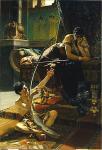
Saul and the Witch of Endor
The new Philistine invasion greatly alarmed Saul. Though his heart bode him ill, he quickly led forth his army and encamped at Gilboa. Anxiously, King Saul turned to G-d for help and counsel; but neither by dream, nor by vision, nor by prophets, did he obtain the wished-for advice. Goaded to despair, he bethought himself at last of the witches who were believed to be able to raise the dead and to cause them to communicate with the living. To a woman of Endor, Saul determined to resort for help. Disguising himself, he went to her house at nightfall with two companions.
At first the woman was afraid, for witchcraft was forbidden in Israel on penalty of death. Saul, however, swore that nothing should happen to her and bade her call up the spirit of Samuel. The woman obeyed and proceeded to practice her strange art.
Presently the spirit of Samuel appeared and informed Saul that the battle with the Philistines would be lost and that Saul and his sons would die. Saul fell prostrate to the ground, fainting. For a long time he refused to rise and to refresh himself; at last the entreaties of his companions and the woman prevailed upon him to sit down to the meal she had prepared, for he had tasted no food all the preceding day and night.
David Returns to Ziklag
Meanwhile, all the chiefs of the Philistines had united their forces into one vast army. David and his six hundred followers were in the rear of Achish. When the Philistine leaders saw them, they would not allow David, their most dangerous enemy, who had humbled them repeatedly, to remain in their midst during the battle, and they pressed upon Achish to dismiss him and his band.
David had to return to Ziklag with his followers. But mournful and desolate was the sight which met him upon his return. The Amalekites, taking advantage of the defenseless state of the country, had among other deeds of violence, sacked and burnt Ziklag, led away its flocks and herds, its women and children, and seized their property. David’s own two wives were among the captives. A loud wail of horror and despair burst from the bereaved Israelites who, in their anger, threatened the life of David, to whom they imputed their misfortunes. But David soothed the rage of his men, and at once announced his intention of pursuing the audacious invaders. He led his soldiers in breathless haste southward; but only four hundred of them could endure this exhausting march, the rest remained behind, wearied and fainting before they crossed the brook Bezor. On his march, David found an Egyptian in the fields, apparently dead. He carefully tended and refreshed him, and thus saved his life. Asked who he was, this man related that he had been ill and had, therefore, been left behind by his Amalekite master when the army returned from burning Ziklag, and that he had lain in the fields for three days and three nights without food. The Egyptian, on receiving the solemn pledge that he would not be delivered up to his former master, was ready to lead David and his soldiers to the camp of the enemy.
The Amalekites were feasting and reveling in the camp, surrounded by their recently acquired spoil, when they were surprised by David and his handful of followers and completely routed. Four hundred young men alone of the vast host of the heathen escaped upon their swift camels. All the captive women and children of the Israelites were rescued; not one of them was missing; all their property was recovered, and, in addition to it, immense booty was taken from the invaders. The conquerors returned joyful and happy to their brethren at Bezor, with whom they divided the spoil.
Death of Saul and Jonathan
While David was fighting the Amalekites, a furious battle was raging between the Philistines and the Jews.
The tide of battle swiftly turned against the Jews, as Samuel had predicted, and Saul’s army was utterly routed. The king’s own sons Jonathan, Abinadab, and Malkishua were among the slain. Many fled for their lives. Saul was severely wounded by the Philistine archers. Then, giving up all hope and dreading the thought of falling into the hands of his heathen enemies, he called upon his armor-bearer to slay him. But the man was afraid and durst not obey. Saul, therefore, fell upon his sword to kill himself. However, the wound not proving immediately mortal, he entreated an Amalekite who had by chance come near the place, to pierce him with his sword, and the stranger, seeing that the king could not possibly recover, did as he was requested. Saul’s armor-bearer, now unwilling to live, died also by his own hand. The Philistines then occupied without a struggle many of the Hebrew towns, deserted by their inhabitants who had fled in despair. On the next day, the Philistines came to the battle-field to strip the slain. When they recognized the bodies of the king and of his three sons, they set up a wild shout of rejoicing, cut off Saul’s head, and took his arms, which they sent to their own country to be kept in a chief temple of Ashtarte; but the bodies of Saul and of his sons they fixed on the wall of Beth-Shan, a town not far from the Jordan opposite to the territory of Gilead. They were rescued, however, by the brave men of Jabesh, who brought them into their town and buried them under a tamarisk-tree. All the people kept a fast for seven days.
David Mourns for Saul and Jonathan
David was in Ziklag, confident that the great heroes of Israel, Saul and Jonathan, would once again, with G-d’s help, prevail over the enemy. But soon he was stunned with grief. There came running into the city a messenger with his blood-stained clothes rent, and with earth upon his head. He bore in his hand the royal crown and bracelet, which he laid before David with all signs of homage. He then related the defeat of the Israelites and the death of Saul and his sons. Grief and mourning prevailed among the Jews of Ziklag. All tore their garments and abstained from food that day.
David sincerely mourned the death of Saul and Jonathan and the defeat of Israel. In a lament he composed over the fallen princes, David proved his deep affection for Saul and Jonathan, and his sincere grief at the terrible catastrophe that had befallen Israel;
“The pride of Israel is slain upon thy heights.
“How are the heroes fallen!
“Tell it not in Gath,
“Proclaim it not in the streets of Ashkelon,
“Lest the daughters of the Philistines rejoice,
“Lest the daughters of the heathen triumph!
“Ye mountains of Gilboa!
“Let there be no dew and no rain upon you,
“Nor fields for first-fruit offerings;
“For there the shields of the heroes were tarnished,
“And the shield of Saul as though he had not been anointed with oil.
“From the blood of the slain, from the fat of the heroes,
“The bow of Jonathan never shrank back,
“And the sword of Saul returned not empty.
“Saul and Jonathan, beloved and graceful in their lives,
“Were not parted in their death.
“They were swifter than eagles, they were stronger than lions.
“Ye daughters of Israel, weep over Saul!
“Who clothed you in scarlet and precious garments;
“Who put golden ornaments upon your apparel.
“How are the heroes fallen in battle!
“O, Jonathan, thou wast slain upon thy heights!
“I am grieved for thee, my brother Jonathan!
“Thou wast very dear to me!
“How are the heroes fallen!”
Saul, the first crowned Jewish monarch, was survived only one son Ishbosheth, aged forty. Jonathan too left a son Mephibosheth, at that time five years old. When the sad tidings arrived from the battle-field of Gilboa, his nurse, in her alarm, tried to flee with the child; he fell, and was lamed for life.
 Rosamond Press
Leave a comment