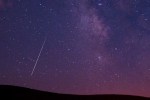
“What may have been the highlight of this event was the appearance of a large blue-white fireball over Southern California at 3:38 UT. Forsyth said it left a yellow train which lasted over three minutes. As the train drifted and became diffuse, it took on the shape of a horseshoe.”
It appears Cyrus the Great took to heart the praise from Yahweh, and worshipped Him, he and his Persian people watching over the Jews from afar, and looking for a sign another Savior (Horn) another Horn will be raised to deliver God’s Children from their enemy.
Did Meher Baba, the Persian, prepare the way for Yahweh in America?
Jon the Nazarite
Personal accounts of the 1946 Giacobinids are interesting. Several
friends of mine saw the display in 1946. Stan Mott of Ottawa, Canada
was up in North Bay, Ontario with the group led by Dr. Peter Millman.
He was the group’s official recorder – manually recording all the
observations! Mott said that there were so many meteors that they
just started watching specific areas, like the head of Draco. With
all the point meteors, he said that “it looked like the eyes were
just winking.” When asked if there were lots of both bright and faint
meteors, he said that most seemed to be about magnitude 2, but then
added that they gave up on anything fainter than about magnitude 3.
He said that there were a mixture of long and short meteors, and that
some had trains. Most of the meteors seemed to be white in color. He
said that it “really did look like a shower,” and that “the meteors
were coming fast and furious, with several at any instant.” It was
cold in North Bay, and they were all bundled up in heavy blankets. In
Stan’s words, they all looked like “Tibetan monks studying the stars
for omens… ”
The 1946 Return
During 1940 to 1945, activity continued to be absent, but astronomers were already making predictions for the very favorable 1946 return. In that year, the comet was expected at perihelion on September 18, so that Earth would cross the comet’s orbit just 15 days after the comet!
The Draconids were best placed for observers in the Western Hemisphere during October 9/10, with excellent meteor counts not only coming from all across the United States, but Canada and even Venezuela. European observers did detect the Draconids, but the radiant was very low over the horizon and, though spectacular, it was at least one-fourth the strength of that seen in America. Observations were also made in Czechoslovakia for slightly more than one hour prior to morning twilight. Some of the more interesting observations are as follows:
At the University of Oklahoma Observatory, B. S. Whitney led a team of 10 observers during the period of 1:23 and 4:34 UT. Taking counts every 10 minutes, they determined that maximum came around 3:50 UT (October 10) when estimated hourly rates were near 3000.
From Southern California, numerous counts were tabulated at Griffith Observatory. From that observatory, R. Michaelis and K. Bouvier observed rates of 55 per minute between 3:45 and 4:02 UT. E. L. Forsyth (Fallbrook) detected 63 per minute at 3:50 and G. W. Bunton (Sunland) observed 180 per minute around this same time.
In England, Prentice evaluated the British observations and noted a maximum rate of 965 per hour. The radiant was then very low over the horizon and it was determined that the ZHR was actually 2250.
At Skalnate Pleso Observatory (Czechoslovakia) observers fought clouds, moonlight and morning twilight to observe the Draconids. Maximum occurred at 3:53 UT with a corrected rate of 6800 per hour. Two secondary maxima occurred at 3:23 and 3:40. Analysis revealed the half-time of the shower to have been 0.65 hours.
What may have been the highlight of this event was the appearance of a large blue-white fireball over Southern California at 3:38 UT. Forsyth said it left a yellow train which lasted over three minutes. As the train drifted and became diffuse, it took on the shape of a horseshoe.
The 1946 event marked an important first for meteor astronomy—the detection of a meteor shower by radar. In the United States alone, 21 radar systems were operated at frequencies of 100, 600, 1200, 3000 and 10000 Mc/sec. From these instruments only the radar operating at 100 Mc/sec detected meteor echoes. The majority of all meteor activity occurred between 3:00 and 4:30 UT on October 10. Other radar equipment operating in London and the Soviet Union operated at frequencies between 3.5 Mc/sec and 212 Mc/sec and confirmed that maximum occurred between 3:00 and 4:00. Most interesting was a record obtained by J. A. Pierce, who used a 3.5 Mc/sec pulsed ionospheric sounder and found that meteors were so numerous that a temporary ionosphere was formed at a height of 90 km. The meteoric ionosphere lasted three hours and was confirmed elsewhere.
Following 1946, both visual and radio-echo techniques were utilized in searches for this shower during 1947-1951. Visual observers detected no meteors possibly associated with the Draconids, while radio-echo observations at Jodrell Bank detected “no activity during the Giacobinid epoch in excess of the background sporadic rate (that is, not greater than 4 or 5 per hour).”
 Rosamond Press
Leave a comment