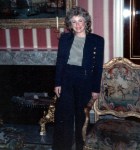



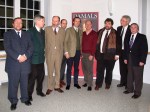
Christine Rosamond Benton would be sixty four years of age today if she had not drowned in 1994. Above is a photograph of my sister at a Getty residence in New York where Christine spent the night. Did she stay at the Getty apartment at the Pierre Hotel, where our kin, Elizabeth Rosemond Taylor, lived?
A couple of years ago I tried to enter the Johanna Pfirt de Rougemont contest, but was ignored. The Rosamond family allegedly has roots in Rougemont Switzerland. A week ago I discovered who Johanna is after spending ten years looking at her genealogy. I have a great book to author about the family that owned Europe and European Culture. Rudolph von Habsburg was a great Patron of the Art that J. Paul Getty emulated. Rudolph was Citizen Cane, and a Renaissance Man who I believe was ‘The Wolf’ in Davinci’s illustration. I have found ‘The Rose Line’
“Rosebud!”
My late sister, and those that surrounded her artistic success, got greedy. They wanted to control the Art of the World. They kept the honest and poor artist, at bay, he forever the one to cry “Wolf!”.
The wolf has arrived at many doors. Our President has launched a executive plan to save homes that are underwater. I just want to save the Eugene Library, and the murals within!
Jon Presco
Copyright 2011
http://ferrette.mvnet.at/eng-ferrette/menue/about.htm
EUROPE BIGGEST WORRY FOR US
The biggest vulnerability for the United States and the world economy remains exposure to the European crisis.
World leaders clearly are worried. World Bank President Robert Zoellick last Tuesday warned there was “not a lot of room for error” .
President Barack Obama last Thursday telephoned German Chancellor Angela Merkel to discuss the situation in Europe, the latest of a series of such consultations.
Most financial institutions have insulated themselves from any direct damage from a possible Greek default, but there remains the worry that the euro-zone debt crisis would spread to Italyand Spain causing financial contagion of the kind that followed the collapse of investment bank Lehman Brothers in 2008.
Lawrence Chazen, Getty, Newsom
Jon Presco <braskewitz yahoo.com>
2004-06-22 16:53:12 GMT
Lawrence Chazen is a partner of SF Supervisor Gavin Newsom a long
time friend of the Getty family who wants to be President of the
United States. Chazen was a partner of my sister in her first
gallery in Carmel. He tried to become special executor of
Christine’s estate, his attorney, Robin Beare, villifying my niece,
the heir. Chazen was my late father’s private lender. The accounts
of my sister’s drowning are false.
Jon Presco
ENTREPRENEURIAL PARTNERS
Members of Gavin Newsom’s wine, restaurant, bar, resort and real
estate partnerships since 1991:
Kevin & Bronwyn Brunner, John Burton, Casey and Michelle Cadwell,
Bob and Barbara Callan, Frank Caufield, Donna Chazen, Lawrence
Chazen, Joe & Victoria Cotchett, Michael & Hilary Decesare, Philip
DeLimur, Don Dianda, Gretchen Dianda, Edward Everett, Richard
Freemon, James Fuller, Stanlee Gatti, Robert Gerry, Andrew Getty,
Ann Getty, Anna Getty, Chris Getty, Gordon Getty, Mark Getty, Peter
Getty, Ronald Getty, Tara Getty, William “Billy” Getty, Robert
Goldberg, Florianne Gordon, Stu Gordon, Gordon Goletto, David
Goodman, Arthur Groza, Richard & Martha Guggenhime, Tony and Anthony
Guilfoyle, Shelly Guyer, James & Shea Halligan, Bob & Jill Hamer,
Erin Howard, Thomas Huntington, Isolep Enterprises (Paul and Nancy
Pelosi family personal investment company), Peter Jacobi, Gaye
Jenkins, Jeffrey Kanbar, Chad Kawai, David Lamonde, John Larson, Rob
Lavoie, Leavitt/Weaver interior designers, Marc Leland, Maryon
Davies Lewis, Anne McCutcheon, Chris McCutcheon, Ross McGowan, Rich
McNally, Robert & Carole McNeil, Paul Mohun, Robert Mohun, Jeff
Morin, Sara Moughan, Terry Moughan, Brian Mueth, Bob Naify, Marshall
Naify, John Nees, Barbara Newsom, Brennan Newsom, Catherine & David
Newsom, Gavin Newsom, Patrick Newsom,
Tessa Newsom, William Newsom, John O’Hara, Jack Owsley, Pacific
Design, Matt Pelosi, Robynne Piggott, James Samuel Powers, Elizabeth
Rice, Jeremy Scherer, Paul Scherer, Gary Schnitzer, Steve & Theresa
Selover, Steve Siino, Trevor Traina, Chris Vietor, Francesca Vietor,
Kenneth Weeman, Nicki West, Justin & Aridne Williams, Kevin
Williams, Thomas & Kiyoko Woodhouse.
June 4 – 2010, St. Blasien-Schwarzwald
The competition “Grenzen fließen” is over.
The prizes were handed over by Michael Salvator Archduke Habsburg-Lorraine, by President Kinsky and by the initiator of the competition Peter Heinrich Wessenberg
1st Award Dr. Peter Graf Coreth, Austria, Fratres
2nd Price Marc Glotz, Alsace, Flaxlanden
3rd Price Prof. Kerstin Odendahl, Dr. Hans Martin Tschudi, Dr. Joachim Beck
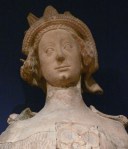
The society Joan of Ferrette (SJF) aims to implement the international, cultural and historical competition “Grenzen fließen” (flowing borders). The medieval figure Joan of Ferrette is a symbol of the special dynamics of our European consciousness.
The routes through medieval Europe by Joan had nothing in common with travelling nowadays. There were completely different borders and different conditions of life. Everything was different from whatever we can imagine today. The SJF therefore encourages the reflection on people living along borders or in areas with constantly changing borders in the middle of Europe. Since we do not find any similarities with the historical circumstances, we expect references to a modern and humane Europe without any limitations caused by politics and administration in the visible relics of the past.
The members of the society are historians, eminent scientists and persons involved in cross-border cultural cooperation. In 2010 the president of the society will award prizes to the best historical works on the subject “Grenzen fließen”.
>>top_______________________________________________
Who was Joan of Ferrette?
The death of Ulrich III of Ferrette in Basel on 11 March 1324 marks a decisive turning point in the history of the Haute-Alsace. The heritage which he bequeaths to his two daughters encompasses the Sundgau, the south of Vosges, the gateway to Burgundy and the northern fringe of the Jura. Considering his advantage, Leopold I reacts to the news of the death of Ulrich III quickly. He sends his younger unmarried brother Albert to Joan of Montbéliard, the widow of Ulrich III, so that he can win the hand of Joan, the oldest daughter of Ulrich III. The negotiations are successful and on March 17 she affixes her seal in Thann to the agreement with Albert. So Albert obtains the only compact political unit in Alsace for the Habsburgs domain. In addition, the children of Albert and Joan of Ferrette are the only ones who continue the Habsburg lineage since none of his brothers have any descendants. Joan died in Scheibbs (Lower Austria) and is buried together with her husband in the “Kartause Gaming” near Scheibbs.
The Society Joan of Ferrette, together with the Committee of the pan European Union of Alsace, has chosen the city of Ferrette in Alsace for the presentation of the Competition “Grenzen fließen” (flowing borders). Its purpose is to gather eminent historians of the Upper Rhine region and persons involved in cross-border cultural
Mitglieder der paneuropäischen Union, Sektionen im Elsass, Vorarlberg, Rheinland-Pfalz
Philippe Nuss (Generalsekretär PEU – Elsass)
Baron Antoine de Reinach (PEU – Elsass)
Christian Graf d’Andlau-Hombourg (Präsident PEU – Elsass)
Joél Anselm (Vereinskassier PEU – Elsass)
Henri de Grossouvre (Generaldelegierter PEU – Elsass)
Peter Hagen (Landesobmann PEU – Vorarlberg)
Eric Maulin (PEU – Elsass)
Werner Euskirchen (Landesvorsitzender, PEU – Rheinland-Pfalz)
Herr Hudlet (PEU – Rheinland-Pfalz)
This same book gives Sergeant James Rosemond’s earliest ancestor as Erhart de
Rougement. I am told that the correct pronunciation of this name makes the
`ouge’ sound like a slurred `s’, and the ending `t’ is pronounced like a `d’.
Because of this his son’s name was recorded as Hans Rosemond. Erhart de
Rougemont was supposedly born sometime before 1495, and owned a house, which is
referred to as “the house called Rebleuten-Zunft in Basle in the Freistrasse”.
The book mentions that research by Peter Rosemond of Holland shows a record that
indicates that prior to living in Basle, the family resided in Holland up to
1338, and they descended from a state Rosemont near Belfort in France, where
there is a nearby village called Rougemont. Erhart’s son, Hans Rosemond, became
a citizen of Basle in 1534 and there is a coat of arms registered in Basle about
the same time. The book has a picture of this coat of arms, and I have a
beautiful color picture of it I received from a descendant of the Irish Rosamond
family, Mary Jane Loya, posted on my web page at
http://freepages.genealogy.rootsweb.com/~rosamondgenealogy/
Hans Rosemond had a son Fred Rosemond who was born about 1552. Fred Rosemond was
a weaver, a member of the town council and a Captain in the local militia. Fred
Rosemond had a son he apparently named after his father, Hans Rosemond, b. abt
1581. This Hans Rosemond, like his father, was a weaver. You will note if you go
to my web site and look at the coat of arms, that the key feature of the shield
is a large weavers hook.
http://groups.yahoo.com/group/Christine_Rosamond/message/385
The Descendants of Johann Jacob Rosenmann
Most researchers believe that the descendants of Johann Jacob Rosenmann are not related to the other Rosamond families listed above. Following his arrival in Philadelphia in the late 1600s his sons began using the surname Rosamond. He and his sons then migrated down to the area around Rowan County, NC and have spread from there into Tennessee and some of the other surrounding states. However, the area from which this Johann Jacob Rosenmann originated, the Palatinate, is only about 100 miles north of Belfort, France where Sergeant Rosemond’s ancestors are believed to have originated. The relationship, or non-relationship, of this family line to those above needs to be proved one way or another. DNA analysis is the only answer.
A famous descendant of this line of the Rosamond family is the artist Christine Rosamond who signed her paintings simply as Rosamond. Christine was actually born Christine Rosamond Presco. Her mother’s maiden name was Rosemary Rosamond, the daughter of the writer Royal Rosamond.
This James Rosemond’s ancestry in Switzerland traces back to an Erhart de Rougemont who purchased a home in Basle, Switzerland in 1495. It appears that Erhart was a member of the de Rougemont family that lived in Belfort, France. Belfort is about 50 miles from Basle. The members of the de Rougemont family in Belfort were minor nobles and can be traced back to the 12th century.
http://www.familytreedna.com/public/rosamond/default.aspx
The northern U.S. and Canadian branches of the family are said to be descended from Sergeant Rosemond’s son whose given name is not known. This son supposedly never left Ireland, although one researcher has claimed that this son’s given name was William, and that William came to the colonies for five years and then returned to Ireland. What is known is that this son of Sergeant Rosemond with no known given name had a son named James who was born in County Leitrim, Ireland. This James Rosamond, the grandson of the elusive Sergeant Rosemond, had a number of sons who migrated to the United States and southern Canada. At least one of these descendants, another James Rosamond, lived in Lanark County in Ontario, Canada and founded the Rosamond Woolen Mill there. Records of the Canadian James Rosamond show that he is descended from Rosamonds in County Leitrim.
The most famous descendant of this branch of the Rosemond family, and arguably the Rosamond family as a whole, is the actress Elizabeth Rosemond Taylor whose grandmother was Elizabeth Mary Rosemond from Guernsey County, Ohio.
Historians have traditionally blamed Rudolf’s preoccupation with the arts, occult sciences, and other personal interests as the reason for the political disasters of his reign.[2] More recently historians have re-evaluated this view and see his patronage of the arts and occult sciences as a triumph and key part of the Renaissance, while his political failures are seen as a legitimate attempt to create a unified Christian empire, which was undermined by the realities of religious, political and intellectual disintegrations of the time.[2]
Engraving by Aegidius Sadeler (1603)
Although raised in his uncle’s Catholic court in Spain, Rudolf was tolerant of Protestantism and other religions including Judaism.[3] He largely withdrew from Catholic observances, even in death denying last sacramental rites. He had little attachment to Protestants either, except as counter-weight to repressive Papal policies.[2] He put his primary support behind conciliarists, irenicists and humanists.[2] When the papacy instigated the Counter-Reformation, using agents sent to his court, Rudolf backed those who he thought were the most neutral in the debate, not taking a side or trying to effect restraint, thus leading to political chaos and threatening to provoke civil war.[2]
Patron of arts
Rudolf moved the Habsburg capital from Vienna to Prague in 1583. Rudolf loved collecting paintings, and was often reported to sit and stare in rapture at a new work for hours on end.[3] He spared no expense in acquiring great past masterworks, such as those of Dürer and Brueghel. He was also patron to some of the best contemporary artists, who mainly produced new works in the Northern Mannerist style, such as Bartholomeus Spranger, Hans von Aachen, Giambologna, Giuseppe Arcimboldo, Aegidius Sadeler, Roelant Savery, and Adrian de Vries, as well as commissioning works from Italians like Veronese. Rudolf’s collections were the most impressive in the Europe of his day, and the greatest collection of Northern Mannerist art ever assembled.[2]
Rudolf’s love of collecting went far beyond paintings and sculptures. He commissioned decorative objects of all kinds and in particular mechanical moving devices. Ceremonial swords and musical instruments, clocks, water works, astrolabes, compasses, telescopes and other scientific instruments, were all produced for him by some of the best craftsmen in Europe.
He patronized natural philosophers such as the botanist Charles de l’Ecluse, and the astronomers Tycho Brahe and Johannes Kepler both attended his court. Tycho Brahe developed the Rudolfine tables (finished by Kepler, after Brahe’s death), the first comprehensive table of data of the movements of the stars. As mentioned before, Rudolf also attracted some of the best scientific instrument makers of the time, such as Jost Buergi, Erasmus Habermel and Hans Christoph Schissler. They had direct contact with the court astronomers and, through the financial support of the court, they were economically independent to develop scientific instruments and manufacturing techniques.[7]
Rudolf painted as Vertumnus, Roman God of the seasons, by Giuseppe Arcimboldo (1590-1). Rudolf greatly appreciated the work.
The poetess Elizabeth Jane Weston, a writer of neo-Latin poetry, was also part of his court and wrote numerous odes to him.
Rudolf kept a menagerie of exotic animals, botanical gardens, and Europe’s most extensive “cabinet of curiosities”[3] (Kunstkammer) incorporating “the three kingdoms of nature and the works of man”. It was housed at Prague Castle, where between 1587 and 1605 he built the northern wing to house his growing collections.[8]
By 1597, the collection occupied three rooms of the incomplete northern wing. When building was completed in 1605, the collection was moved to the dedicated Kunstkammer. Naturalia (minerals and gemstones) were arranged in a 37 cabinet display that had three vaulted chambers in front, each about 5.5 meters wide by 3 meters high and 60 meters long, connected to a main chamber 33 meters long. Large uncut gemstones were held in strong boxes.
Rudolph’s Kunstkammer was not a typical “cabinet of curiosities” – a haphazard collection of unrelated specimens. Rather, the Rudolfine Kunstkammer was systematically arranged in an encyclopaedic fashion. In addition, Rudolf II employed his polyglot court physician, Anselmus Boetius de Boodt (c. 1550-1632), to curate the collection. De Boodt was an avid mineral collector. He travelled widely on collecting trips to the mining regions of Germany, Bohemia and Silesia, often accompanied by his Bohemian naturalist friend, Thaddaeus Hagecius. Between 1607 and 1611, de Boodt catalogued the Kunstkammer, and in 1609 he published Gemmarum et Lapidum, one of the finest mineralogical treatises of the 17th century.
As was customary at the time, the collection was private, but friends of the Emperor, artists, and professional scholars were allowed to study it. The collection became an invaluable research tool during the flowering of 17th-century European philosophy, the “Age of Reason”.
Rudolf’s successors did not appreciate the collection and the Kunstkammer gradually fell into disarray. Some 50 years after its establishment, most of the collection was packed into wooden crates and moved to Vienna. The collection remaining at Prague was looted during the last year of the Thirty Years War, by Swedish troops who sacked Prague Castle on 26 July 1648, also taking the best of the paintings, many of which later passed to the Orléans Collection after the death of Christina of Sweden. In 1782, the remainder of the collection was sold piecemeal to private parties by Joseph II, who was a lover of the Arts rather than the Sciences. One of the surviving items from the Kunstkammer is a “fine chair” looted by the Swedes in 1648 and now owned by the Earl of Radnor at Longford Castle, United Kingdom;[9] others survive in museums.
 Rosamond Press
Leave a comment