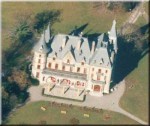

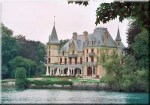
Above is the castle once belonging to the Banker Abraham Denis de Rougemont, who was a Jew. Denis de Rougemont descends from a banking family. I do not know how Abraham came by the name de Rougemont.
Jon The Bohemian
Paneuropa, Rougemont & Otto Habsburg
Otto von Habsburg is the President of Paneuropa, he taking over from
Count Richard N of Coudenhove-Kalergi who worked with Denis de
Rougemont to create the United States of Europe.
Jon Presco
http://www.ellopos.net/politics/eu_rougemont.html
“The formation of a United States of Europe appears to have been one
of the most consistently-stated goals of the Priory of Sion and
those associated with it during the twentieth century. According to
Holy Blood, Holy Grail, “The Prieure de Sion [sought] a United
States of Europe partly as a bulwark against the Soviet imperium…
a self-contained and neutral power bloc capable of holding the
balance of power between the Soviet Union and the United States.”
The idea of a united Europe was also, as I have mentioned, popular
among the French Resistance. It was espoused by people such as the
national literary hero of the French, André Malraux, who advocated
a “European New Deal” allied against the U.S.S.R. Also in 1942,
Winston Churchill was quoted as saying, “I trust that the European
family may act united as one under a Council of Europe. I look
forward to a United States of Europe.” Organizations such as Pan
Europa, founded by Count Richard Coudenhove-Kalergi, began to pop up
in the 1940s. Pan Europa included Jean Cocteau’s friend and fellow
poet Paul Valery, and is currently directed by Otto von Hapsburg.
They employ a Celtic cross as their insignia.
Other groups that were interested in seeing European unity were the
Western intelligence agencies, especially British and American
intelligence, who sought to build a pro-European network amongst
militant Catholic and right-wing political groups. When the O.S.S.
(Office of Strategic Strategies), precursor of the CIA, was under
the control of William Donovan, they attempted to infiltrate the
Vatican and put priests in top positions on their payroll. They made
use of Father Felix Morlion, founder of Pro Deo (For God), a
European Catholic intelligence agency which the O.S.S. funded and
installed first in New York, then in the Vatican itself. They also
made use of the Society of Jesuits, which has been involved in
Catholic espionage for years.
In 1948, the same year that the Congress of Europe met at the Hague,
the O.S.S. became the Central Intelligence Agency. Immediately the
CIA began funding European political parties, particularly the
Christian Democrats, in an attempt to manipulate European
governments and pull them to the right. The following year, the ACUE
(American Committee on a United Europe) was formed, and William
Donovan was made its chairman. Allen Dulles, former head of the
O.S.S. in Switzerland, friend of the Von Moltke cousins and future
head of the CIA, was Vice-President. The Director of the Council on
Foreign Relations, and the future coordinator of the Trilateral
Commission, George S. Franklin, was the Secretary. They even had
another CIA employee, Thomas Braden, as their Executive Director. It
was because of these men that the decision was made for the US State
Department to fund the European movement. Following this, Joseph
Retinger proceeded to collaborate with Prince Bernhard of the
Netherlands and others to create the now infamous globalist think
tank, the Bilderberg Group.
Meanwhile, the CIA busied itself funding organizations and
newspapers all over Europe that were pro-Catholic and anti-
Communist. A major recipient was Italy’s Christian Democrat party,
which had been started by the father of future Pope Paul VI, who was
also on their payroll. He had been working as a spy and liaison for
the OSS, then later the CIA, since WWII. It has also been said that
Pope John Paul II has been receiving weekly intelligence briefings
from the CIA since 1978, although it is unknown whether that
continues to occur given the Pope’s current state of deterioration.
http://www.dragonkeypress.com/articles/article_2004_10_26_3541.html
The Priory of Sion also appears to see in the United States of
Europe an apocalyptic scenario, although they declare themselves to
be working for the establishment of Christ’s kingdom on Earth.
Priory of Sion member Paul le Coeur wrote in his book The Age of
Aquarius (4): “Let us try to understand what our mission consists
of. Let us try to fulfill it by preparing knights of the Apocalypse
whose head will be Christ when he returns!” A one-time spokesman for
the Priory, Jean-Luc Chaumeil, even wrote a book about the Priory
called Templars of the Apocalypse. One can certainly see their point
of view. For one thing, the kings of a future European empire would
be blood descendants of Christ, David, and the patriarchs of the
Bible, quite fitting for the administrators of God’s kingdom. And if
a strong European empire actually managed to fend off the threats to
Western organization once and for all, it would indeed seem like
Heaven on Earth.
Born on November 17, 1894 in Tokyo, Count Richard N of
Coudenhove-Kalergi is a personality out of the commun run which is
unfortunately known today only among those which are interested of
close with the development of the political union of Europe.
This lack of official recognition is regrettable because, of 1922
until its death in 1972, it fought for the unit and the freedom of
our continent and was, between the two wars, in the heart of all the
initiatives taken in favour of the union and peace in Europe.
Wire of a diplomat austro-Hungarian and a Japanese woman, it as of
childhood was convinced that it is the European spirit, more than
the only convergence of material interests, which can work Europe.
Coudenhove-Kalergi launched its first call to the unit of Europe in
October 1922. The following year, it proposes the first modern
project of linked Europe, exposed in its book Side-europa. Nowadays
still, this prophetic and mobilizing work (republished in French in
1997) fascine by its topicality.
For Coudenhove-Kalergi, Europe is a fraternity of men dividing of
the common visions. Heiress of a rich person passed, Europe can
survive only if it is linked by preserving the characteristics of
all her people and in their granting the undeniable right to
preserve them. The rejection of very prejudged nationalist, the
defense of freedom and the consolidation of peace are, with the
reconciliation of France and Germany, the angular stones of the
European unit.
Translated into many languages, this call was a resounding success:
the causes of the European crises reviewed, of the concrete
solutions are outlined, and, especially, the union of Europe is
there, for the first time, presented like one plausible and
desirable following day, and not like a Utopia of a remote golden
age. Moreover, it raises the fundamental question of dimensions
spiritual and intellectual of the union of the old continent.
The message was perceived as of the inter-war period by considerable
personalities among which Konrad Adenauer, Robert Schuman, Alcide de
Gasperi and Winston Churchill. These other and statesmen, well like
Aristide Briand, Gustav Stresemann, Charles of Gaulle or Carlo
Sforza, as well as eminent thinkers like Denis de Rougemont, Alexis
Leger, Carl Burckhardt, El Salvador de Madariaga or Benedetto Croce,
found in the ideas paneuropéennes and the frequentation of
Coudenhove-Kalergi the sources of their European engagement.
If the person of Richard Coudenhove-Kalergi were somewhat forgotten,
its intellectual heritage, forms part of our spiritual and cultural
present for a long time to him and forms what one could call the
true “European asset”.
It is Coudenhove-Kalergi which launched the idea in particular to
join together German coal and the French ore (1923), of which the
result, in 1950, was the creation of the first European Coal and
Steel Community (ECSC).
It is him which inspired in Aristide Briand his project of European
union, presented in 1929 front the Company of the Nations in Geneva,
project not concretized because of the degradation of the relations
between the States. It is still him which proposed to adopt the Ode
with the Joy of Schiller on the music of the 9 E symphony of
Beethoven as a European anthem (1929). It is also him which
suggested the one day celebration of Europe in May (1930) and the
creation of a European postage stamp (1947).
Coudenhove-Kalergi was the inspirer of Churchill which launched its
resounding call to the unit of Europe in September 1946 in Zurich.
In 1947, Coudenhove-Kalergi founded in Gstaad the European
Parliamentary Union which, after the Congress of Europe in the Hague
in 1948, led to the creation of the Council of Europe and the
European Parliament.
After the Second World War, various European, private or official
organizations, were born. Their founders, by, took as a starting
point near or by far the the ideas of Coudenhove-Kalergi.
http://www.paneuropa.org/ch/html/richard_n__coudenhove-kalergi.html
http://www.paneuropa.org/~es/fundador.html
http://www.info-
europe.fr/europe.web/seb.dir/seb03.dir/precurseurs.htm
Precursors
Aristide BRIAND
Louise WEISS
Richard de Coudenhove-kalergi
Gustav STRESEMANN
Winston CHURCHILL
Denis of ROUGEMONT
European construction plunges its roots in the shock of the two
world wars and in the pacifist dash of the inter-war period, the
whole on bottom of a certain awakening of the decline of Europe vis-
a-vis in the United States. During this period, the problems and the
main current tendencies are stated: opposition between federalism
and sovereignty of the States nations, between economics and
politics, importance of the Franco-German core, outline of Europe at
two speeds, formulation of the fundamental objectives which are the
safeguard of peace and the maintenance of a certain economic
prosperity…
• Ideological movements and institutional attempts of the
Twenties
First manifestations of the pacifist movement
Before even the signature of the Treaty of Versailles, which puts an
end to the First World War on June 28, 1919, a vast pacifist
movement takes form. Deeply marked by the particularly fatal combat,
the pacifist movement intends to bring closer the European States in
order to ensure peace on the continent. Outstanding figure of this
movement, Louise Weiss , a intellectual Frenchwoman, publishes as
from January 1918 a weekly magazine entitled new Europe which
preaches peace and the agreement between the European States.
The Paneuropa movement: the United States of Europe
In November 1922, the Austrian Richard Coudenhove-Kalergi publishes
the proclamation Paneuropa, ein Vorschlag in which it supports the
idea of a union paneuropéenne which would make its place world to
the old continent. He continues in this line and publishes in 1923 a
deliver-proclamation entitled Side-Europa . Coudenhove-Kalergi ,
unquestionable that the Franco-German reconciliation is necessary to
the maintenance of peace, suggests joining together German coal and
the French ore with an aim of creating an iron and steel industry
paneuropéenne, idea which will inspire to Robert Schuman the
creation of the European Coal and Steel Community (ECSC) in 1950.
Developing this idea, Coudenhove-Kalergi considers, in the long
term, a customs union which would make possible the constitution of
the United States d’ Europe , left confederation European respecting
the sovereignty of the States but equipped with institutions and a
citizenship communes, a European currency and a military alliance.
In this objective, it undertakes to make known its project with the
leading classes, businessmen or members of Parliament, through the
Paneuropa movement and the monthly review of the same name, that it
creates in 1924. National committees constitute themselves in the
Central European countries and Eastern as in Austria, Germany behind
Gustav Stresemann and Czechoslovakia with the Foreign Minister
Edouard Bénès. The first Congress of the Union paneuropéenne in
Vienna in October 1926 brings together representatives of the
governments of each Member State to respect the principle of the
equal representation of the nations. The French are represented by
the president of the council Edouard Herriot, Louis Loucheur former
Minister of Industry, Gaston Riou an intellectual, who publishes in
1928 the Europe work, my fatherland and the Foreign Minister
Aristide Briand who will be a honorary president of the Movement in
1927.
Industrial Europe
Politician and industrial, French Louis Loucheur proposes, in 1925,
the creation of an economic league around the couple Franco-German,
first steps of the United States d’ Europe, and able to compete with
the Anglo-Saxons. In 1927, it preaches the establishment of sectoral
European agreements: metallurgy, chemistry, coal…
The initiative of Squinter is followed project of Emile Mayrisch, a
Luxembourg steelmaker. With the instar of Gustav Stresemann , the
German Foreign Minister, Mayrisch preach the bringing together
between the French and German companies in order to stabilize peace
between the two countries. In 1926, it creates L ‘ Agreement
international of the steel which aims at eliminating the
overproduction by founding quotas by country. It gathers
industrialists German, French, Luxembourg, Belgian, then
Czechoslovakian and Austrian. Worried more by the economy that by
the policy, Mayrisch is in favour of a co-operation in a quite
precise field in the idea that this spirit of co-operation gains
then other fields. This technique of the “small steps” will be
implemented by Jean Monnet during the creation of ECSC in 1950.
Other proposals for an economic co-operation are born: economic and
customs union of the French economist Charles Gide, banks central
European coupled with an arbitration on the competition of German
engineer Dannie Heineman…
The SDN: a platform for Europe
Created in 1919 pennies the impulse of American President Woodrow
Wilson, the Company of the Nations is an institutional response to
the pacifist ideal of reconciliation. However, the SDN, installed in
Geneva, fact appears of club of the European winners: neither the
United States, after the refusal of the American Senate to ratify
the Peace treaties in November 1919, nor Germany takes part in it.
The SDN concentrates then primarily on European problems. Place of
confrontations and platform of ideas, it takes part, consequently,
with the construction of the European idea and plebiscite the
relaxation, the disarmament and the organization of a collective
security. At the time of the 5 2nd General meeting of the SDN in
1924, Aristide Briand , who represents France as a French Foreign
Minister, supports the ratification by France of a Protocol on the
arbitration, safety and disarmament. With this occasion, Louise
Weiss who is present in Geneva, allots to him the nickname
of “Pilgrim of Peace”. Nevertheless, because of its weakness, the
SDN will disappoint the partisans of peace and the European co-
operation.
The first Franco-German bringing together
The largest projections will be done under the angle of the Franco-
German bringing together. Briand , one of the principal instigators,
preaches, indeed, a European construction centered on the co-
operation between the two countries, in opposition to the universal
vocation of the SDN. October 16, 1925, Briand signs with Stresemann
the Treaty of Locarno which guarantees the borders between France,
Germany and Belgium and establishes a pact of mutual assistance.
This treaty makes it possible to break the insulation of Germany on
the international level and to integrate it into the SDN in 1926.
The same year, the efforts of the two men are crowned by décernement
Nobel Prize of peace.
In 1929, Briand , supported by Stresemann , proposes to the assembly
of the SDN the first official project of European union, which would
carry in priority on the economic field and would preserve official
sovereignty. In a memorandum of 1930 written by Alexis Leger,
secretary-general of the Quay of Orsay, the project is specified. He
envisages the creation of a Common Market, objective which will be
taken again by the Treaty of Rome in 1957. This economic co-
operation is significant with the eyes of Stresemann because it must
allow the rationalization of the European economy. But the evocation
of a “federal bond” does not fill with enthusiasm the European
States, in particular Winston Churchill , then British Chancellor of
the Exchequer, which remains reserved with respect to this proposal
for a union. The project is buried after the death of Briand in
1932. Seule Louise Weiss continues the project of Briand by creating
the New school of the peace in 1930, which organizes debates on the
SDN and the projects of European union.
• Toughening of the movement and weakening in the Thirties
The new order: human Europe
The financial crisis of 1929 which begins with the American purse
from Wall Street marks the European consciences. The new Order , a
movement created by the French intellectual Alexandre Marc in 1930,
rejects the anarchy generated by this crisis. This movement is based
on the concept of the personalism which dissociates individualism by
the fact that the person is considered as an integral part of a
community. The personalism led to a federal design of the political
organization in which the communities (communities, areas.), while
being dependent between them, are fully autonomous. On the basis of
this ideology, Marc hopes to bring closer the European populations
between them in order to give a human dimension to Europe. It is
what comes out from Young Europe , published in 1933.
The Swiss intellectual Denis de Rougemont also belongs to the new
Order. He collaborates in the review of the same name and the Esprit
review of Emmanuel Mounier since 1931. Although influenced by
Coudenhove-Kalergi which it meets in Vienna in 1928, the project of
Rougemont exceeds the simple federalism since it stresses the
general transformation of the company and the human reports/ratios.
The federalism must, according to him, to leave the men. Like
Alexandre Marc, Denis de Rougemont rejects philosophies creating of
false worships like the State nation.
First steps of the war or the deceleration of the European movement
The European movement knows a business slowdown at the end of the
years 1920. The death of Briand and Stresemann puts an end to the
Franco-German bringing together and justifies the abandonment of
their project of European union. The financial crisis of 1929 also
carries a crushing argument to the attempts at co-operation in the
medium of the businesses. Lastly, the rise of Fascisms in Italy and
Germany calls in question the pacifist ideal put at evil by
confrontation with the political reality of the international order.
In the heart of the war, the European idea re-appears despite
everything, in the mediums of resistance.
• Clandestinity and maturation of the European idea during the
Second World war
The European movement in Resistance
The European idea is very present within the Resistance, which
stresses the democratic character of future plain Europe. Two
documents mark this rebirth of the European idea. The Proclamation
of Ventotene, entitled For free and linked Europe, is written in
1941, essentially by resistant Italian Altiero Spinelli assisted by
his companion Ernesto Rossi. The second text, the human scale, of
the French Socialist Leon Blum circulates in clandestinity since
1941 and will be published only in the end of the war. The two
publications evoke the interdependence between the European people
and the need for limiting official sovereignty. The authors are
convinced that a European federation would guarantee peace on the
old continent, in particular with creation of a common military
force. The noncommunist European forces meet in Geneva in 1944 and
work out a project of declaration of European resistances. This
text, registered in the line of works of Spinelli and Blum, evokes
the need for exceeding official sovereignty and for creating a
federal union in order to preserve peace.
Denis de Rougemont (1906-1985)
The man, his actions:
Saint-John Perse said of him “In his extreme complexity of European,
it appears on our Western face like most representative of what
could be in comparison with the history, a scientific figuration of
Homo Europeanus.”
Denis de Rougemont is born into 1906 from a Swiss Protestant family.
Initially attracted by chemistry, it is diverted some after the vat
to enter to the Faculty of Arts of Neuchâtel. It continues its
studies in Vienna, in 1927 and 1928, where it becomes acquainted
with Richard de Coudenhove-Kalergi it reads again for him French
translations of Paneurope. It writes then articles which enable him
to be pointed out, in particular a violent one lampoon on the
misdeeds of the state education , in 1930. It is then destined for
Paris to deal with Protestant publisher: the editions I am useful .
Those go bankrupt in 1933.
Thereafter, Denis de Rougemont collaborates in two reviews
personalists: the new Order , review of the movement of the same
name created by Alexandre Marc in 1931, and the review Spirit ,
created at the same time by Emmanuel Mounier. In addition, Denis de
Rougemont animates, of 1930 to 1938, the French movement of the new
Order. The approach “personalist” of the federalism exceeds the
simple development of a federal Constitution: it stresses the
general transformation of the company and the human reports/ratios.
Thus, the “personal revolution” has as a finality the man rather
than the capacity and denounces the modern State-nation and the
illusion of the Company of the Nations. The federalism must start
from in bottom, the men and not the institutions. It develops this
logical relation nobody-policy-federalism in Politique of the
person , published in 1934.
In 1940, Denis de Rougemont is mobilized in the Swiss army.
Following the invasion of Paris by the German troops, it publishes
an article denouncing the hitlerism in Gazette of Lausanne . It
takes part then in the creation of the League of Gothard. This
organization of political nature poses like principle the primacy of
the person and the spirit, the personal liability like essential
condition for freedom and the federalism like antithesis of
totalitarianism. Its articles displeasing in Germany, it is sent to
the United States by the Swiss authorities for a cultural mission.
It remains there until 1946.
With his return in Europe, Denis de Rougemont adheres to the
European Union federalists (UEF), created in December 1946. At the
time of the first Congress of the UEF in Montreux in 1947, the
meeting of a congress gathering all the European movements is
proposed. This one takes place, in December 1948, in the Hague.
Denis de Rougemont takes part in his preparation within the cultural
commission. He writes a relationship with the assistance of
Alexandre Marc and Kenneth Lindsay, in which the creation of a Court
of the humans right and of a European Center of the culture is
proposed. This last would have the role “of promoting the feeling of
the European unity”. According to Denis de Rougemont, the European
cultural unit, which is a fact, is the most solid base to build a
federal union in Europe. It also decides in favour of Europe of the
areas and shows the strategic importance, for Europe, of the
experiments of transborder co-operations.
In February 1949, a engineering and design department is made up in
order to set up the first European conference of the culture, which
takes place in December 1949. October 7, 1950, the European Center
of the culture opens its doors. It obtains results in various
fields: creation of the Association of the Institutes of European
Studies in 1951, gathering the first large schools dedicated to the
specific teaching of Europe (Bruges, Turin, Nancy…), creation of
the European Community of the Guilds and Clubs of the book in 1953,
creation of a European literary price the same year, creation of a
pool of news services, creation of European current events, creation
of a service of press in three languages in 1956 and finally,
creation of the European Foundation of the culture on December 16,
1954.
Wishing to sensitize a large audience, Denis de Rougemont launches,
in 1961, a “European civic Education Campaign”. It consists of the
organization of training courses for the teachers of the first and
the second degree in all Western Europe. In ten years, more than 32
training courses are organized. However, following financial
problems, this initiative, recovery initially, in 1975, jointly by
the Council of Europe and the European Economic Community (the EEC),
are abandoned.
In 1963, in Geneva, Denis de Rougemont melts the university
institute of European Studies, divided into three sections:
Political history and culture, Economy and Sciences. Bearing from
now on the name of Institute European of the University of Geneva,
it exempts a multi-field teaching. From 1978, Rougemont ceases its
functions of professor and director at the Institute. There remains
President of the European Arts centre all the same. It dies on
December 6, 1985.
* Saint-John Perse, “Rougemont the Westerner”, Denis de Rougemont,
the Writer, the European , studies and testimonys published for the
seventieth anniversary of Denis de Rougemont, by Andre Reszler and
Henri Schwamm, Neuchâtel, 1976, p.1
Its ideas:
“It is true that Europe is demolishing itself: it never was
threatened, more divided in front of the danger, more distressed and
skeptic at the same time. But it is not less true than for the first
time in all its long history, consciously Europe is being done. Such
is the contradictory situation in which we are committed. It depends
on us partly that the hope is right of despair but it is necessary
to go quickly and to know well where one goes “(Extracted complete
Works , III, Ecrits on Europe , vol.I, 1948-1961)
“It is high time to define the human aiming which must govern this
action, the vocation of our European Community” (idem)
“For which real ends do we want these means of culture and this
education of a common conscience of Europe?
Europe from time immemorial opened in the whole world. With wrong or
rightly, by idealism or ignorance, under the terms of its faith or
in sights imperialists, it always conceived its civilization like a
whole of universal values. It is not a question for us to oppose a
European nation to the great nations of the East and West, nor to
want a European culture synthetic, valid for us only and closed on
itself. Our ambition is to contribute to the Union of our countries
which will be the only means of a rebirth of their culture in the
independence of the mind “(Conclusions of the report presented at
the Conference of Lausanne, extract of complete Works )
“Europe must be and become more and more the place of the world
where the human person can still make hear her voice” (Extracted
complete Works , III, Ecrits on Europe, Vol.I, 1948-1961)
Bibliography:
Denis de Rougemont, Twenty-eight centuries of Europe , Payot, Paris,
1961
Denis de Rougemont, Written over Europe , the Difference, Paris,
1994
Denis de Rougemont European , European Foundation Jean Monnet,
Research center, Lausanne, 1991, 458 p.
Institutional proposals Partisan of the co-operation between States,
Winston Churchill, become British Prime Minister, supports the
Franco-British Declaration d’union of 1940 which envisage bodies of
co-operation in the fields of defense, the foreign politics,
finances and l economy, and this so d’éviter in France to sign
l’armistice. Following this failure, Churchill writes, in 1942, a
memorandum on the d’Europe United States. Noting that l’Europe was
with the c?ur of two world wars, it proposes to cure this
interetatic violence by a union between the European people. In
September 1946, Churchill takes up this idea in the made speech with
l university of Zurich, in which it recognizes in l’Europe a common
heritage which could be used as a basis for d’ creation; ” a
European family in a called regional construction the United States
d’Europe “. If the British proposals did not n’aboutissent with
concrete achievements, the project supported by the Belgian Minister
for the Foreign Affairs, Paul-Henri Spaak, conduit with the creation
of the Benelux countries. Economic and financial union between
Belgium, the Netherlands and Luxembourg, l’idée of the Benelux
countries is launched in 1942 and the treaty signed during the war,
in London in 1944. The revival, after war The speech of Churchill
starts again the initiatives of European construction. It creates
with Coudenhove-Kalergi United Europe Movement in 1947, in which
Coudenhove-Kalergi will not finally take part. On its side, this
last constitutes l’Union parliamentary European in 1947, with an aim
d’élaborer a constitution for l’Europe. It asks members of
Parliament of 13 European countries to vote for or counters a
European Federation within the framework of the United Nations. Its
proposal meets a great success. But, its position is criticized by
Denis de Rougemont, in favour d’un integral federalism resting on a
cultural European unit. At the beginning of the years 1950,
Coudenhove-Kalergi will approach the ideas of General de Gaulle and
will give his preference to a Union of the nations. De Rougemont
prepares, as for him, with Alexandre Marc, a report/ratio for the
Congress of the Hague in 1948 in which they propose creation d’une
European Cour of the rights of l’homme and a European Center of the
culture. The proposals of Denis de Rougemont will not remain died
letter, with the creation of the European Center of the culture, the
European literary price and the European Foundation of the culture.
http://www.info-
europe.fr/europe.web/seb.dir/seb03.dir/precurseurs.htm
http://www.chez.com/cdrougemont/denis.htm
Thinker, writer, philosophical, Swiss essayist (1906-1985)
“Our destiny does not mark us final seal with the birth. Each human
being has freedom to act to modify data in which it believes
confronted being in an irremediable way.”
The future is our business
Biography
________________________________________
Denis de Rougemont is born in Couvet, in the Jura neuchâtelois
(Swiss), September 8, 1906, of George de Rougemont, Pasteur, and
Anne Sophie, born Bouvet. The family of Rougemont is probably
originating in the Franche-Comté; she was established in Neuchâtel
as of XIVème century. In 1784, it received a “Recognition of old
nobility” of the King Frederic II (Neuchâtel was then a Prussia
Principality). The members of the family of Rougemont also belonged
to the Council of State of Neuchâtel.
Denis de Rougemont attends the primary school with Couvet of 1912 to
1918. This experiment will inspire later (1929) the Misdeeds of the
State education to him . From 1918 to 1925, Denis attends the Latin
College, then the gymnasium of Neuchâtel (science section). In 1923,
Denis writes a first article on “Montherlant and the morals of the
football”, published in the literary Week of Geneva.
From 1925 to 1927, Denis follows the courses of the University of
Neuchâtel, in Faculty of Arts; he attends the courses of psychology
and the seminar of Jean Piaget on genetic epistemology, and the
course of max Nierdermann on the linguistics of Ferdinand de
Saussure. In 1930, the end of its studies is sanctioned by an Arts
degree (French, German, history, psychology, philosophy).
The same year, Denis de Rougemont is established in Paris, where it
ensures the literary direction of the Editions I Am useful (it is
they which will publish Kierkegaard, Karl Barth, Nicolas Berdiaeff,
Ortega…). He engages in the movements personalists, where he meets
then collaborates with in particular G Marcel, E Mounier, A. Marc,
A. Dandieu, R. Aron.
Denis de Rougemont (1906 – 1985)
The “Prince of the European cultural Community” in which Saint-John
PERSE saw “a scientific figuration of Homo europeanus”, was born in
Couvet (Neufchatel, CH) in a family of French origin installed in
Switzerland since XIVème century.
Graduate of the universities of Neufchatel, Geneva, and Vienna, he
was the pupil of Jean Piaget. It began a career from writer in 1927
and contributed to various magazines of French literature.
In 1931, it came to Paris where, editor with the Editions “I Am
useful”, it published Ortega y Gasset, Kierkegaard, Berdiaeff, and
the theologist Karl Barth. It rejoigna the group of the personalists
animated by the philosopher Emmanuel Mounier. At this time, he
became active member of the European Movement. He published its
first Political work “of the person ” in 1934, followed by “the Love
and the Occident” (1939).
http://www.erm.lu/epm/id220.htm
Origin of the Paneuropa Union
The Paneuropa Union is currently headed by Otto Habsburg and was
founded in 1923 by Richard Nikolaus Count Coudenhove-Kalergi. It is
credited with some influence over the creation of what is now the
European Union. Paneuropa is, unsurprisingly, more active in Austria
and the former Austro-Hungarian states. It is very anti-Communist
and Christian Democratic in political orientation, with a strong
Catholic influence. The famous 1989 ‘picnic’ on the
Austrian/Hungarian border was organized by Paneuropa.
http://www.1uptravel.com/flag/flags/eur-pan.html
 Rosamond Press
Leave a comment