






The Day of Atonement will fall on my birthday this year. An amazing star shower is expected, like the one that appear the eve I was born,
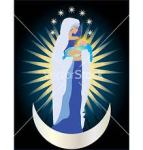
October 8, 1946. For my birthday, I want just a kiss. I long to be with Rena Christiansen again. In 1972 I did a painting of her wearing a thalo blue mantle filled with stars. There was a crescent moon crowning her, as she gazed at the setting sun.
For the next thee days I will conduct the Chemical Wedding of the Rose Cross and Distaff.
Jon Presco
Copyright 2011
The Apothecary’s Rose dates back much further in history than the Renaissance, however. Believed to have come from ancient Persia, not much is known about the rose prior to the 7th century when Islam swept through the area and zealots destroyed much of the texts of that time. Persian legends maintain that the rose’s red coloration came about because a nightengale so dearly loved the white rose, it grasped it tightly and the thorns pierced its breast; its blood turned the white rose red. Hence, the rose was called The Red Damask.
The rose came to Europe, depending upon whose text you read, either in the 12th or 13th century. Everyone agrees, however, it came via noble knights returning from the Crusades.
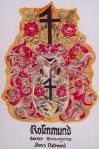
One story, the English side and by far the more colorful, says that the rose was returned to King Louis VII after the Second Crusade in Syria. Since England, in those days, also included Normandy, Brittany and Aquitaine, the rose made its way to King Henry II. (Henry II, as you may remember, was the first to implement the jury system in adjudication.) Henry had married Queen Eleanor of Aquitaine, but had done so probably out of need to solidify the kingdom. As it sometimes happens, Henry had a mistress named Jane Clifford, later renamed (according to legend) The Fair Rosamond. Queen Eleanor got wind of this affair, concocted a poison to give her husband’s mistress, and disguised the deadly potion with the oil of the Apothecary’s Rose and R. alba. After Rosamond’s death, so the legend goes, a new rose sprouted outside the castle — one of both red and white stripes — called Rosa mundi. To this day, R. mundi, a genetic “sport” of the Apothecary’s Rose, will sometimes revert to its original heritage
The Spindle and Distaff of the Annunciation
Mary the mother of Jesus is using a spindle to make scarlet thread for the veil
that conceals the Holy of Holies in the Temple.
Hannah gave her son Samuel the Nazarite her ancient family distaff to use as his
prophetic staff.
I have found a lineage (distaff) of Nazarite women that includes, Anna, the
mother of Mary.
My grandmother, Mary Magdalene Rosamond made hats and clothes for a living. My
mother, Rosemary, made most of her clothes, as did my sister, Christine Rosamond
Presco.
The distaff is also called ‘the rock’. For this reason I believe Jesus built his
church – not upon Peter ‘the rock’ – but upon his sister, Mary Magdalene, the
Holy Distaff of the Scarlet Wool.
I have come to part the scarlet veil and reveal the Kingdom of Truth!
Repent!
John the Nazarite
Copyright 2010
The term distaff is also used as an adjective and is used as a descriptor for
the female branch of a family[2](e.g., the “distaff side” of a person’s family
refer’s to the person’s mother and her blood relatives). This term developed in
the English speaking communities where a distaff spinning tool was used often to
symbolize domestic life. The term distaff has fallen largely into disuse in
recent times, although its antonyms of sword and spear to describe a male
grouping are even more obscure.
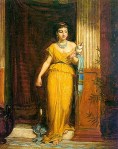
Mary, looking as young and fresh as in the Roman fresco, is seated in the house
of St. John at Ephesus, in a courtyard much like the first one. In the
background is a chapel with altar, lamp, a vase of lilies, and a drawn curtain,
which gives access to a little sanctuary. Behind Mater, and out of her reach,
are the distaff and work basket of the earlier picture. She is seated as before,
except that she is in the act of completing an altar cloth whose finished length
is rolled up on a stool before her. In her left hand she holds a spindle
attached to the final thread of the woven cloth. In her right hand she holds a
small pair of scissors, with which she is cutting that thread. Her head is
raised and she looks up with a joyful air, as if saying, “It is finished.”
Jesus – “As in the time of Noah, as in the days of Sodom and Gomorrah, the
warnings, countless warnings given through those chosen by Heaven to act as
mediators for God to bring a prophecy to mankind…scoffers laugh, deride the
prophets, and man has learned nothing from his past history. I promise you, your
world, the earth, shall not be destroyed in the universe, but mankind shall be
removed from your planet. Many shall die in the great flame of the Ball of
Redemption.
The Rapture”Man shall be working out in the field. One shall be taken. Man shall
say, “Where has he gone? He has disappeared without warning.’ A woman shall work
at the spindle…two at the spindle. One shall be taken, and where has she gone?
The mystery unfolds. It is in the plan of the Eternal Father that many shall be
taken from among you. The mystery shall befound man. “I promise in those days
that those who remain shall meet with Me to establish My Kingdom of peace and
joy upon your earth.” (1-31-76)
The annunciation at the well is rarely depicted in western medieval art,
although Mary may be shown with a basket of wool or a spindle or engaged in
spinning when the angel appears. Read more:
In her left hand she holds a spindle of scarlet yarn (5) which depicts the task
she was assigned of preparing the purple and scarlet material to be used in
making the veil for the Temple in Jerusalem. Her right hand is raised in a
gesture of acceptance in response to Gabriel’s message (6). Her posture
expresses willing cooperation with God’s plan of salvation. The three stars on
her garments (7) represent that she was a Virgin before, during, and after the
birth of Christ.
http://devotionsandprayers.blogspot.com/2009/03/annunciation.html.
The act of spinning or weaving represents the temporal and the developing, the
incremental and the cyclic, and is analogous to the growth of the child in the
womb. One wonders whether, in her study of art history, Pauline Perdreau
examined any of the thousands of Byzantine icons of the Annunciation in which
Mary is holding a spindle from which a scarlet thread passes across her body.
The spinning of red thread obviously suggests the development of the arterial
system in embryonic life, especially when, as in some icons, the unborn infant
is dimly seen through his mother’s flesh.
In the Apocrypha, the young Mary is described as living in the Temple and
weaving the Temple veil, and in the liturgical hymns for the feast of the Sacred
Heart, the piercing of the heart of Jesus is equated with the rending of that
veil on Good Friday. As the author of Hebrews reminds us: “Through the blood of
Jesus we have the right to enter the sanctuary, by a new way which he has opened
for us, a living opening through the curtain, that is to say, his body.”ii
The “curtain” is, among other things, the veil of the new Holy of Holies to
which generations of mystics have found their way through the wound made by the
lance at that moment the Society of the Sacred Heart regards as the kairos of
its own mystical conception.
A veil, not only a symbol of wrapping, of hiddenness, and of mystery, is, like
the seven veils of Ishtar, related to the orbits of the planets and the
structure of the cosmos, whose meaning is gradually un-veiled only through time
and space and history. The climactic moment of the Incarnation occurs when God
is veiled in the flesh woven by woman; surely the prime example of
concealment/manifestation.
Many of the Journal’s readers have been familiar since childhood with the
symbolically charged objects surrounding the young Mater Admirabilis: the
distaffiii and the spindleiv; the lilyv of purity, innocence, youthful
freshness, suggesting the Immaculate Conception of this child and the virgin
birth of the Child to come; the book of the Scriptures, source of revelation,
including the Messianic prophecies, surely the subject of this elected young
woman’s profound meditation; the work basket, another example, both in its woven
form and in its contents, of woman’s work of fashioning from the raw materials
of nature fabrics and textures which protect, enhance, and enrich human life.vi
In the later painting one can observe the significant changes in the symbolic
structure; these modifications assure us that the artist held a continuing and
consistent view of the archetypal quality of the “woman’s work” of spinning and
weaving.
Mary, looking as young and fresh as in the Roman fresco, is seated in the house
of St. John at Ephesus, in a courtyard much like the first one. In the
background is a chapel with altar, lamp, a vase of lilies, and a drawn curtain,
which gives access to a little sanctuary. Behind Mater, and out of her reach,
are the distaff and work basket of the earlier picture. She is seated as before,
except that she is in the act of completing an altar cloth whose finished length
is rolled up on a stool before her. In her left hand she holds a spindle
attached to the final thread of the woven cloth. In her right hand she holds a
small pair of scissors, with which she is cutting that thread. Her head is
raised and she looks up with a joyful air, as if saying, “It is finished.”
The study of this aspect of the Mater tradition might bring many who have loved
the earlier picture, as it probably brought Pauline Perdrau, full circle. The
significant detail of he Atropos shears marks this work as a commentary on
aging, retirement, diminishment, and death. The young Mater’s work, interrupted
by a moment of profound recollection, could be interpreted as the spinning of
the thread to be woven into the Temple veil, a symbolic pre-enactment of the
spinning and weaving of the body, including the heart, of Jesus. The aged mary,
instead, fashions an altar cloth for the infant church. The light, rather than
the dawn of the Roman fresco, whose rosy flush presages the coming of the Sun of
Justice, is the sanctuary lamp denoting the Eucharistic presence. There could
hardly be a clearer indication that the little Madonna of the Lily of Pauline’s
noviceship days has become the fully mature Mother of the Church and is involved
in the weaving of salvation history.
http://www.rscj.org/spirituality/thosebeforeus/mater_in_her_old_age.html
http://www.larsdatter.com/spinning.htm
http://en.wikipedia.org/wiki/Distaff
As a noun, a distaff (also called a rock[1]) is a tool used in spinning. It is
designed to hold the unspun fibers, keeping them untangled and thus easing the
spinning process. It is most commonly used to hold flax, and sometimes wool, but
can be used for any type of fiber. Fiber is wrapped around the distaff, and tied
in place with a piece of ribbon or string. The word comes from dis in Low
German, meaning a bunch of flax, connected with staff. As an adjective the term
distaff is used to describe the female side of a family.
The term distaff is also used as an adjective and is used as a descriptor for
the female branch of a family[2](e.g., the “distaff side” of a person’s family
refer’s to the person’s mother and her blood relatives). This term developed in
the English speaking communities where a distaff spinning tool was used often to
symbolize domestic life. The term distaff has fallen largely into disuse in
recent times, although its antonyms of sword and spear to describe a male
grouping are even more obscure.
One still-recognized use of the term is in horse racing, in which races limited
to female horses are referred to as distaff races. From 1984 until 2007 at the
American Breeders’ Cup World Championships, the major race for fillies and mares
is the Breeders’ Cup Distaff (beginning in 2008, the event is referred to as the
Breeders’ Cup Ladies’ Classic). It is commonly regarded as the female analog to
the better-known Breeders’ Cup Classic, though female horses are not barred from
entering that race.
 Rosamond Press
Leave a comment