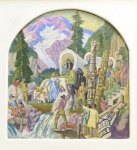

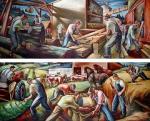


Yesterday I talked with my sister Victoria about our niece, Drew Benton. Her father suffered a stroke a week ago, and may not be able to render more of his famous murals. We wondered if Drew would pick up the gauntlet when alas Garth lays down his brush.
I am seeking a legal opinion on whether it is moral and legal for murals rendered for public consumption, can be sold into private hands, especailly when the monies paid to the artist for his, or her efforts, was paid for by a Federal Program with express purpose of being enjoyed by the public in a public place. Until a legal decision can be reached, and or, a Federral Law passed to protect the moral intergrity of the Artist, and said Government Program, I highly suggest this pending sale be postponed. Morris’s murals represent the real history of other family members, John Fremont ‘The Pather Finder’ and his wife, Jessie Benton-Fremont who helped author the first journals of the Willameet Valley.
Garth Benton is the cousin of Thomas Hart Benton who was Jackson Pollock’s mentor. Senator Thomas Hart Benton was the Administrator of the Oregon Territory and sent Fremont to secure Orego from the British who had desings on it.
I am going to found an originzation of people who will oversee and preserve public murals that are imprissoned in vacant buildings waiting to be sold to the highest bidder, like a slave.
Our Founding Father’s founded a nation of thirteen states, that were colonized and improved upon by British and Dutch sujects of a king. The other thirty seven states were founded by Pioneers like my kinfolk who built a thousand cities without the help of any king, and any of his subjects! Kings and millionaire bankers have come to own much the world’s art. The Tea Party Fakeriots want to give them billions so they own that much more!
Oh sure, they will let us come see their art, but only if we have hat in hand, and are bowing at the knees!
Jon Presco
California Art Preservation Act
From Wikipedia, the free encyclopedia
The California Art Preservation Act is a 1979 California lawthat provides legal protection for artists’ moral rights. The law is currently codified at California Civil Code§987. The law has since been amended in part. The California Art Preservation Act was the first major law to specifically address artists’ rights in the United States.
Portions of the law may overlap with the provisions of the Visual Artists Rights Act, in which case the California law is preempted.
Content
The Art Preservation Act provides for civil penalties and injunctive relief for the intentional or grossly negligentdestruction or mutilation of a work of fine art, defined in the statuteas any original painting, sculpture, or drawing that is of “of recognized quality.” Fine art, as used in the law, does not include works prepared for commercial use by the purchaser.
The Act also provides artists the right to claim authorship and disavow modifications to works of fine art.
The rightsgranted under the act subsist for the life of the author plus 50 years.
See also
Kent Twitchell won the largest settlement ever under Visual Artists Rights Act (VARA) and CAPA for $1.1 million dollars against the US Government and 12 other defendants. His mural of Ed Ruscha was painted over without his knowledge or consent.
Visual Artists Rights Act
From Wikipedia, the free encyclopedia
Jump to: navigation, search
For other meanings of VARA, see Vara (disambiguation).
The Visual Artists Rights Act of 1990 (VARA), 17 U.S.C. § 106A, is a United Stateslaw protecting artist rights.
VARA was the first federal copyright legislation to grant protection to moral rights. Under VARA, works of art that meet certain requirements afford their authors additional rights in the works, regardless of any subsequent physical ownership of the work itself, or regardless of who holds the copyright to the work. For instance, a painter may insist on proper attribution of his painting and in some instances may sue the owner of the physical painting for destroying the painting even if the owner of the painting lawfully owned it.
While federal law had not acknowledged moral rights prior to this act, some state legislatures and judicial decisions created limited moral rights protection. The Berne Conventionrequired protection of these rights by signatory states, and it was in response that the U.S. Congress passed the VARA.
Contents
[hide]
1 Exclusive rights under VARA
1.1 Covered works
2 Application and effect
3 Examples of works
4 External links
5 References
[edit] Exclusive rights under VARA
VARA exclusively grants authors of works that fall under the protection of the Act the following rights
right to claim authorship
right to prevent the use of one’s name on any work the author did not create
right to prevent use of one’s name on any work that has been distorted, mutilated, or modified in a way that would be prejudicial to the author’s honor or reputation
right to prevent distortion, mutilation, or modification that would prejudice the author’s honor or reputation
Additionally, authors of works of “recognized stature” may prohibit intentional or grossly negligent destruction of a work. Exceptions to VARA require a waiver from the author in writing. To date, “recognized stature” has managed to elude a precise definition. VARA allows authors to waive their rights, something generally not permitted in France and many European countries whose laws were the originators of the moral rights of artists concept.[1]
In most instances, the rights granted under VARA persist for the life of the author (or the last surviving author, for creators of joint works).
[edit] Covered works
VARA provides its protection only to paintings, drawings, prints, sculptures, still photographic imagesproduced for exhibition only, and existing in single copies or in limited editions of 200 or fewer copies, signed and numbered by the artist. The requirements for protection do not implicate aesthetic taste or value.
[edit] Application and effect
VARA’s application is limited to visual works that fall within a narrowly defined category. However, for works that do fall within the category of protected works, VARA imposes substantial restrictions on any modification or removal of those works. Purchasers of the works must obtain written waivers from the author if they wish to exercise any of the exclusive rights under VARA.
This has particularly been an issue for those that commission public sculptures. Absent a waiver, artists could effectively veto decisions to remove their structures from their benefactor’s land. In a 2006 decision involving public sculptures that were removed from the park for which they were created, the United States Court of Appeals for the First Circuitruled that VARA does not protect location as a component of site-specific work. VARA covered works can be moved as long as the move does not constitute “destruction, distortion, or mutilation.”[2]
[edit] Examples of works
Tilted Arc, a well-known artwork by Richard Serra, was dimantled without his approval prior to the enactment of VARA.
Kent Twitchell’s Ed Ruscha muralwas painted over without his approval. Twitchell won the largest settlement ever under VARA for $1.1 million against the U.S. government and 12 defendants.
[edit] External links
1. Text of Visual Artists Rights Act of 1990
2. One attorney’s analysis of the Visual Artists Rights Act of 1990
3. Waiver of Moral Rights in Visual Artworks. U.S. Copyright Office. Retrieved 2005-07-01.
4. RayMing Chang, Revisiting the Visual Artists Rights Act of 1990: A Follow-up Survey About Awareness and Waiver, 13 TEX. INTELL. PROP. L.J. 129 (2005): This article analyzes the history of VARA and presents empirical data about the Visual Artists Rights Act of 1990 (VARA) from an exhaustive survey that the author conducted in 2003.
5. RARIN – Rights and Reproductions Information Network for Museum Professionals
6. Example of a recent VARA case for mutilation of public sculpture.
7. WSJ article on VARA at 20 years.
[edit] References
1. ^Robert J. Sherman. Note: THE VISUAL ARTISTS RIGHTS ACT OF 1990: AMERICAN ARTISTS BURNED AGAIN. 17 Cardozo L. Rev. 373 (1995)
2. ^ See Phillips v. Pembroke Real Estate, Inc., 459 F.3d 128 (1st Circuit 2006).
Carl A. Morris (1911 – 1993)[1] was an American artist. Morris was born in Yorba Linda, Californiaand he studied at the Chicago Art Institute and in Paris and Vienna. He opened the Spokane Art Centerthrough the Federal Art Projectduring the Great Depression. He met his wife, sculptor Hilda Grossman(Deutsch) when he recruited her as a teacher for the center. Other notable teachers at the center include Guy Anderson and Clyfford Still. Moving to Seattle in 1940, they met Mark Tobeyand became lifelong friends. In 1941, he was commissioned to paint murals for the Eugene, Oregonpost office. The Morrises settled in Portland, Oregonand established important and influential artistic careers. They often visited New York to see friends such as Mark Rothko, Robert Motherwell, Joseph Campbell and Lionel Trillingbut declined to relocate, wanting to avoid what they saw as a climate of commercialism and artistic distraction. Morris is known today for his strong Abstract Impressionistpaintings, and has been called one of Oregon’s most important artists.[citation needed]
His work can be seen in collections throughout the U.S., including those of the Portland Art Museum, the Tacoma Art Museum, the Jordan Schnitzer Museum of Art, Reed College, the Boise Art Museum, and the San Francisco Museum of Modern Art.[1]
[edit] References
1. ^ a b Carl Morris biography
Carl Morris, Paintings 1939-1992. Exhibition catalog. Essay by Barry Johnson. Portland: Portland Art Museum, 1993.
This article needs additional citations for verification. Please help improve this article by adding citations to reliable sources. Unsourced material may be challenged and removed. (August 2007)
[edit] External links
The Eugene Post Office Murals
The Federal Art Project (FAP) was the visual arts arm of the Great Depression-era New Deal Works Progress Administration Federal One program in the United States. It operated from August 29, 1935, until June 30, 1943. Reputed to have created more than 200,000 separate works, FAP artists created posters, murals and paintings. Some works still stand among the most-significant pieces of public art in the country.[1]
The program made no distinction between representational and nonrepresentational art. Abstraction had not yet gained favor in the 1930s and 1940s and, thus, was virtually unsalable. As a result, the program supported such iconic artists as Jackson Pollock before their work could earn them income.[2]
The FAP’s primary goals were to employ out-of-work artists and to provide art for non-federal government buildings: schools, hospitals, libraries, etc. The work was divided into art production, art instruction and art research. The primary output of the art-research group was the Index of American Design, a mammoth and comprehensive study of American material culture.
The FAP was one of a short-lived series of Depression-era visual-arts programs, which included the Section of Painting and Sculpture and the Public Works of Art Project (both of which, unlike the WPA-operated FAP, were operated by the U.S. Department of the Treasury).

 Rosamond Press
Leave a comment