

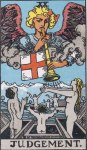
For a decade I have waited in vain for some preacher, some teacher, perhaps a rabbi, to come forth and remind you, that Jesus’ kingdom is not of this world, so what need of we the Christian Coalition, and evangelical politicians? Have I been elected to repeat his words? If so, why? Has Judgement Day arrived?
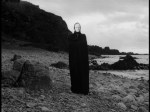
In 1987 three Seers said I died on these beautiful rocks by the sea. I died at McClure’s Beach on Point Reyes, in 1968. I was twenty years old. For two months I have wanted to go where I go now. I will not live forever in this realm.
Jon the Nazarite
Jesus answered, “My kingdom is not of this world. If my kingdom were of this world, my servants would have been fighting, that I might not be delivered over to the Jews. But my kingdom is not from the world.”
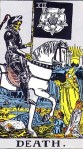
The rose on the banner is drawn in the manner of the Rosicrucian symbol. Examples of this same symbol can be found in Waite’s The Secret Tradition in Freemasonry(pp 227, 248, 550). In the background of the card, along the near shoreline there appear to be three black crosses. These may represent tombstones in keeping with the Death theme, but may also hint at the Cross, the second element of the “Rosy Cross” symbol. In The Real History of the Rosicrucians and The Brotherhood of the Rosy Cross, Waite depicts the Rosicrucians as an occult “church within the church” of Christianity.
Into the cloth of Rosicrucianism, Waite weaves the Knights Templar, Alchemy, Kabballah, Levi, Papus, Masonry, and the Golden Dawn. The three founders of the Hermetic Order of the Golden Dawn were members of the Societas Rosicruciana in Anglia. The Higher or Inner Order of the Golden Dawn was known as Rosae Rubeae et Aureae Crucis. When the Golden Dawn broke up and Waite formed his own version of the society, he called it the Fellowship of the Rosy Cross.
The rose is not a symbol commonly associated with the Templars; however, on the Gothic Cathedrals that they helped to design, there was a large rosette over the ogive archway. In the Adeptus Minor initiation of the Hermetic Order of the Golden Dawn, the initiate is introduced to the “Vault of the Adept.” This is a reconstruction of the tomb in which the mythical Christian Rosenkreutz was buried for 120 years, and from which he arose. On the ceiling of the “Vault” was a stylized white rose (same sort of rose as seen on the Death card but with 22 petals). It would be the first thing seen when the lid was removed from the coffin and the resurrected mystic opened his eyes. So its presence on the Death card may symbolize a note of optimism – there is a rebirth following the Death represented here. Waite may be suggesting that this is not the Death that comes at the end of life, but the Mystical Death.
The apron of the Templar orders shows a Skull and Crossbones as seen on the reins of Death’s horse. The historical Knights Templars didn’t wear black armor but Waite says (A New Encyclopedia of FreemasonryVol 1, p 114): “There are grades of Christican Chivalry which connect with Black, and in particular the Order of the Temple.” The “battle banner” of the Templars was divided into a black and white half by a vertical stripe. The banner on the Waite-Smith Death card is solid black, so the match with the Templar banner is questionable – but suggestive, nonetheless.
The cross on the chest of the Death figure is made deliberately hard to see, perhaps to obscure the reference of the Templars. The Templars wore a red cross on white, their sergeants-at-arms wore red on Brown/Black. The representation on the Death card is closer to the uniform of the Teutonic Knights, an early offshoot from the Templars who wore a black mantle with a white cross. The Hierus, one of the officers in the Golden Dawn ceremonies, wore a black mantle with a white cross (Regardie p 349) – but the cross is over the heart, not centered.
The advanced Masonic grade of Knight Commander of the Temple has the cross as one of its symbols (Waite The Secret Tradition in Freemasonryp 287) and the Sovereign Grand Inspector-General, a grade from the Masonic order of Teutonic Knights (Ibid. p 287) wears a Teutonic cross on the chest (Ibid. p 269),
1. There are also higher Masonic orders associated with Rosicrucianism. In the grade of the Red Cross of Rome and Constantine (Waite “The Secret Tradition in Freemasonry” p 239), the cubic stone (i.e., the ‘perfect ashlar’ suggested in the High Priestess throne and the cubic Chariot) now becomes the Rose, seen on Death’s banner. The initiation for the grade of Sovereign Prince Rose-Croix of Heredom includes a ceremony of Death: “Death must be tasted in its bitterness” (Waite The Secret Tradition in Freemasonry, pp 237 and 320).
2. The Templars had a fleet of ships, so the ship in the background may be another veiled reference. The Templar ships were probably merchant ships typical of the Mediterranean rather than the “Viking” style ship on the card. On the other hand, the Teutonic Knights ruled areas along the Baltic Sea and might well have had ships like those shown on the card. So Waite might also be making veiled reference to all of the warrior monks, not just the Knights Templar.
Mythopoetic approach
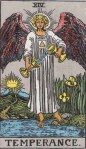
In most modern tarot decks, Temperance stands between Death and The Devil. He or she (traditions vary) guides the souls of the dead to judgment.
In some traditions, Temperance does the judging. In those schools, the cups in Temperance’s hands are the functional equivalent of scales, and Temperance, like Maat, an Egyptian goddess of wisdom, judges the soul’s worth before passing it on to the beasts of the underworld. In some stories, Maat both judges the souls against a feather and protects the scale from being tipped by Set. If the soul is heavier than a feather, it will be fed to the eater of souls.
In other traditions, Temperance is the remixing of life, accepting the dead into the underworld, into the blessed lands, and deciding what to send back into the fray. Every atom in our bodies has passed through thousands of forms, and will pass through thousands more. Temperance reminds us of our connection to the greater forces.
Others say that the vessels in the Angel’s hands represent the Golden Crucible of Taoism; the vessel that contains eternal life. Others say it is representative of the head feeding the stomach; unification of the physical and spiritual needs.
Temperance is associated through its cross sum (the sum of the digits) with The Hierophant. The Hierophant (ideally) brings the lessons of the other world into this one in an understandable form; Temperance (among other things) judges how well we have mastered the wisdom of the other worlds.
Even though this card is well lit by a setting sun, it is an underworld card. Observe, for example, the lilies in the background. Lilies grow in Hades, and the lily represents the goddess Iris, another messenger goddess who transcends the individual realms. The Easter Lily sometimes represents the death of Christ on the Cross, and the three days He spent in the underworld before the Resurrection.
The red wings of the Angel represent blood, life, and that which transcends the death of the individual.
In the Rider-Waite-Smith deck, the Sun in the background conceals a crown. That crown is the ego, who has died and is at the cusp of the adventures of the night.
Some Jungians say that Temperance represents the unconscious, which can guide us, they contend, to a deeper understanding of ourselves. The one foot on the land, the other in the water, represents the unification of the external and internal, conscious and unconscious, realms.
Under these approaches, when Temperance appears, it is a warning or invitation to be prepared for a confrontation with the deepest questions of who we are, who we think we are, and who we will become.
As the Fool leaves the garden of the Sun, he feels that he is near the end of his journey, ready to take a final step. But something is keeping him from doing this, holding him back. He gazes up, hoping to find guidance from the Sun; instead he sees above him a fiery angel, beautiful and terrible.
“You are right,” the Angelic figure confirms, “you have only one last step on your journey, one final step to completion. But you cannot take that step until you lay your past to rest.”
The Fool is perturbed. “Lay it to rest? I thought I’d left it behind, all of it!”
“There is no way to leave the past behind,” The Angel observes. “Each step wears down the shoe just a bit, and so shapes the next step you take, and the next and the next. Your past is always under your feet. You cannot hide from it, run from it, or rid yourself of it. But you can call it up, and come to terms with it. Are you willing to do that?”
The Angel hands the Fool a small trumpet. The Fool is hesitant, but he knows that the Angel is right. There are certain memories he has a hard time looking back on as they make him feel guilty, ashamed, angry. He knows that he’s never come to terms with what happened and he must if he wants to make that final transition.
He blows the trumpet and it cracks open the Earth. From under the Fool’s feet, the spirits of his past selves rise up, including those less than admirable past selves that he’s tried to forget.
For the first time, he faces them. They are, he sees, nothing to fear. They were him once-upon-a-time, but not now. Even as he realizes this, he finds himself forgiving those past selves for the wrongs they did that left him feeling bad. He senses, in turn, that they forgive him for ignoring the lessons they had to teach him. As he reaches an understanding with them, they start to rise up and float away, vanishing into the sky. Though they remain as experiences and memories, they no longer have any power over him. He is free of ill-feelings, reborn, and living in the present.
Having left the tree from where he hung, the Fool moves carefully through a fallow field, head still clearing from visions. The air is cold and wintry, the trees bare. He knows he has started on his spiritual journey in earnest, but feels strangely empty and profoundly sad, as if he has lost something.
Before him he sees, rising with the sun, a skeleton in black armor mounted on a white horse. He recognizes it as Death. As it stops before him, he humbly asks, “Have I died?” And the Skeleton answers, “Yes, in a way. You sacrificed your old world, your old self. Both are gone, dead.”
The Fool cannot keep from weeping. “Forgive me,” he says, embarrassed by his tears.
“There is nothing to forgive,” Death replies. “Mourning is natural and you must deal with your loss before you can accept anything new. Keep in mind, however, that old leaves must wither and fly away from a tree’s branches, leaving them bare, before new green leaves can appear.”
As Death rides away, the Fool sees the truth in those words. He, too, feels like a skeleton, all that he was stripped away. This, he understands, is how all great transformations start, by removing everything down to bare bone or soil so that something new has room to grow.
 Rosamond Press
Leave a comment