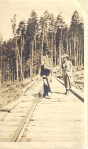


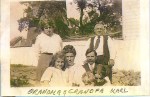


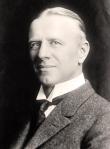


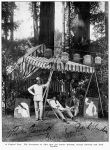
The President of Cal-Barrel, was Frederick Jacob Koster, who was a member of the Bohemian Club, as was Joaquin Miller, and George Stirling, seen in a traditional tent at the Grove Gathering. When Rosemary would show us the family photos, she would say this about our kin gathered in the redwoods of the Oakland Hills.
“Those are you Bohunk kin.”
Why Rosemary would say this, knowing the Prescos came from Bohemia in 1882, is puzzling. Was she once told they were Bohemian Bohos?
My father and I own the same facial features Will Stuttmeister does, who has a long face.
Jon Presco
Copyright 2011
http://www.espritpark.com/Community/dogpatchHistory.aspx
http://foundsf.org/index.php?title=Staking_Out_Potrero_Hill
http://pier70sf.org/dogpatch/DogHistSig.htm
Bohemian Grove is a 2,700-acre (1,100 ha) campground located at 20601 Bohemian Avenue, in Monte Rio, California, belonging to a private San Francisco-based men’s art club known as the Bohemian Club. In mid-July each year, Bohemian Grove hosts a two-week, three-weekend encampment of some of the most powerful men in the world.[1][2
http://freepages.genealogy.rootsweb.ancestry.com/~npmelton/sfbkost.htm
Socially he has connection with the Pacific Union, Bohemian, Olympic, San Francisco Commercial Commonwealth and Woodside Country Clubs and the Meadow Club of Tamalpais. Through his own exertions Mr. Koster has risen to the top, winning gratifying success as well as the high esteem and good-will of his fellowmen. Prompted by humanitarian instincts, he has steadily broadened his field of usefulness and his far-reaching labors have been productive of much good.
LOCAL HISTORIAN JERRY ROHDE IS planning to use a dozen or so of Shuster’s old aerials in the geographical history he’s writing of Humboldt County, including one of California Barrel Company’s operations. Cal-Barrel, cutting mostly spruce, was the biggest employer in Arcata back in the 1940s
Bohemian GroveFrom Wikipedia
Bohemian Grove is a 2,700-acre (1,100 ha) campground located at 20601 Bohemian Avenue, in Monte Rio, California, belonging to a private San Francisco-based men’s art club known as the Bohemian Club. In mid-July each year, Bohemian Grove hosts a two-week, three-weekend encampment of some of the most powerful men in the world.[1][2]
Summer, 1967 at Owls Nest Camp with two future U.S. presidents. Around the table, left to right: Preston Hotchkis, Ronald Reagan, Harvey Hancock (standing), Richard M. Nixon, Glenn Seaborg, Jack Sparks, (unidentified individual), (unidentified individual), and Edwin W. Pauley. Retrieved July 15, 2009.Contents [hide]
The Bohemian Club’s all-male membership includes artists, particularly musicians, as well as many prominent business leaders, government officials (including many former U.S. presidents), senior media executives, and people of power.[3][4] Members may invite guests to the Grove although those guests are subject to a screening procedure. A guest’s first glimpse of the Grove typically is during the “Spring Jinks” in June, preceding the main July encampment. Bohemian club members can schedule private day-use events at the Grove any time it is not being used for Club-wide purposes, and are allowed at these times to bring spouses, family and friends, though female and minor guests must be off the property by 9 or 10 p.m.[5]
After 40 years of membership the men earn “Old Guard” status, giving them reserved seating at the Grove’s daily talks, as well as other perquisites.
The Club motto is “Weaving Spiders Come Not Here,” which implies that outside concerns and business deals are to be left outside. When gathered in groups, Bohemians usually adhere to the injunction, though discussion of business often occurs between pairs of members.[2] Important political and business deals have been developed at the Grove.[5] The Grove is particularly famous for a Manhattan Project planning meeting that took place there in September 1942, which subsequently led to the atomic bomb. Those attending this meeting, apart from Ernest Lawrence and military officials, included the president of Harvard and representatives of Standard Oil and General Electric. Grove members take particular pride in this event and often relate the story to new attendees.[2]
[edit] History
In the 1870s, Henry “Harry” Edwards was an actor with the California Theatre Stock Company, a founding Bohemian and the head entomologist at the California Academy of Sciences.The tradition of a summer encampment was established six years after the Bohemian Club was formed in 1872.[2] Henry “Harry” Edwards, a well-loved founding member, announced that he was relocating to New York City to further his career. On June 29, 1878, somewhat fewer than 100 Bohemians gathered in the Redwoods in Marin County near Taylorville (present-day Samuel P. Taylor State Park) for an evening sendoff party in Edwards’ honor.[6] Freely flowing liquor and some Japanese lanterns put a glow on the festivities, and club members retired at a late hour to the modest comfort of blankets laid on the dense mat of Redwood needles. This festive gathering was repeated the next year without Edwards, and became the club’s yearly encampment.[7] By 1882 the members of the Club camped together at various locations in both Marin and Sonoma County, including the present-day Muir Woods and a redwood grove that once stood near Duncans Mills, several miles down the Russian River from the current location. From 1893 Bohemians rented the current location, and in 1899 purchased it from Melvin Cyrus Meeker who had developed a successful logging operation in the area.[2] Gradually over the next decades, members of the Club purchased land surrounding the original location to the perimeter of the basin in which it resides.[2]
Writer and journalist William Henry Irwin said of the Grove,
You come upon it suddenly. One step and its glory is over you. There is no perspective; you cannot get far enough away from one of the trees to see it as a whole. There they stand, a world of height above you, their pinnacles hidden by their topmost fringes of branches or lost in the sky.[8]
Not long after the Club’s establishment by newspaper journalists, it was commandeered by prominent San Francisco-based businessmen, who provided the financial resources necessary to acquire further land and facilities at the Grove. However, they still retained the “bohemians”—the artists and musicians—who continued to entertain international members and guests.[2]
[edit] Membership and operationThe Bohemian Club is a private club; only active members of the Club (known as “Bohos” or “Grovers”[9]) and their guests may visit the Grove. These guests have been known to include politicians and notable figures from countries outside the U.S.[2] Particularly during the midsummer encampment, the number of guests is strictly limited due to the small size of the facilities. Nevertheless, up to 2,900 members and guests have been reported as attending some of the annual encampments.[citation needed]
The membership list has included every Republican and some Democratic U.S. presidents since 1923, many cabinet officials, directors and CEOs of large corporations including major financial institutions. Major military contractors, oil companies, banks (including the Federal Reserve), utilities (including nuclear power) and national media (broadcast and print) have high-ranking officials as club members or guests.[10]
[edit] Camp valetsCamp valets are responsible for the operation of the individual camps. The “head” valets are akin to a general manager’s position at a resort, club, restaurant, or hotel. Service staff include female workers whose presence at the Grove is limited to daylight hours and to central areas close to the main gate. Male workers may be housed at the Grove within the boundaries of the camp to which they are assigned or in peripheral service areas. High-status workers stay in small private quarters but most workers are housed in rustic bunkhouses.[2]
[edit] FacilitiesThe main encampment area consists of 160 acres (0.65 km2) of old-growth redwood trees over 1,000 years old, with some trees exceeding 300 feet (90 m) in height.[11]
The primary activities taking place at the Grove are varied and expansive entertainment, such as a grand main stage and a smaller, more intimate stage. Thus, the majority of common facilities are entertainment venues, interspersed among the giant redwoods.
A Bohemian tent in the 1900s, sheltering Porter Garnett, George Sterling and Jack LondonThere are also sleeping quarters, or “camps” scattered throughout the grove, of which it is reported there were a total of 118 as of 2007. These camps, which are frequently patrilineal, are the principal means through which high-level business and political contacts and friendships are formed.[2]
The pre-eminent camps are:[2][12]
Hill Billies (Big Business/Banking/Politics/Universities/Media/Texas Business);
Mandalay (Big Business/Defense Contractors/Politics/U.S. Presidents);
Cave Man (Think Tanks/Oil Companies/Banking/Defense Contractors/Universities/Media);
Stowaway (Rockefeller Family Members/Oil Companies/Banking/Think Tanks);
Uplifters (Corporate Executives/Big Business);
Owls Nest (U.S. Presidents/Military/Defense Contractors);
Hideaway (Foundations/Military/Defense Contractors);
Isle of Aves (Military/Defense Contractors);
Lost Angels (Banking/Defense Contractors/Media);
Silverado squatters (Big Business/Defense Contractors);
Sempervirens (California-based Corporations);
Hillside (Military—Joint Chiefs of Staff);
Members of the Bohemian Club were titled ‘Bohos’ and ‘Grovers’.


 Rosamond Press
Leave a comment