
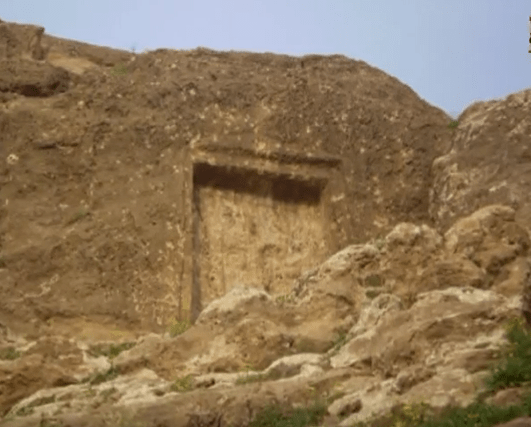
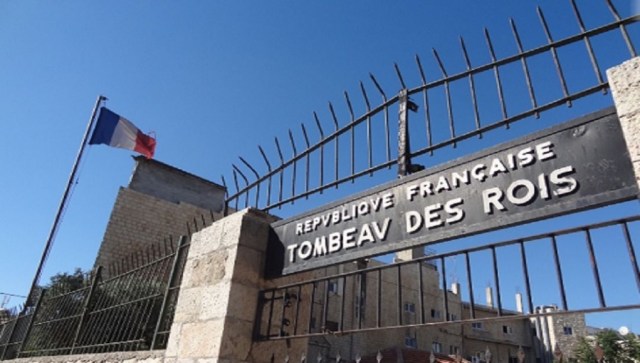
This morning I awoke with the overwhelming feeling I am ‘A Fighter of Loss Causes’: first Oakland, where I was born, and now the Kurds, who are being murdered by Erdogan. Wasn’t Jesus a fighter of lost causes, before he joined the parade of Kaiser Von Trump on his way to Jerusalem? God likes odds like this. Consider Gideon. I have found another gate atop a rock!
Jon ‘The Nazarite’
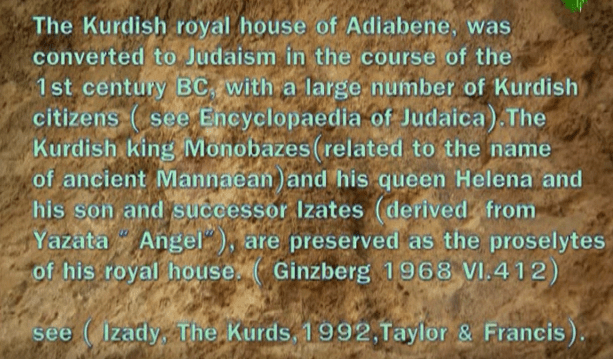
Monobaz II or Monobaz bar Monobaz was the son of Helena of Adiabene and Monobaz I. Like his younger brother Izates bar Monobaz and his mother, Monobaz became a convert to Judaism. He ruled as king of Adiabene after the death of his brother Izates around 55 CE. The date of his death is unknown but he is known to have been alive and on the throne during the First Jewish-Roman War, when he gave aid to the Jewish rebels against the Roman Empire. The Talmud relates that Monobaz “dissipated all his own hoards and the hordes of his fathers in years of scarcity. His bothers and his father’s household came in a delegation to him and said, ‘Your father saved money and added to the treasures of his fathers, and you are squandering them.’ He replied, ‘My fathers stored up below and I am storing up above… My fathers stored in a place which can be tampered with, but I have stored in a place which cannot be tampered with… My fathers gathered treasures of money and I have gathered treasures of souls…'[1] King Monobaz also donated handsome gifts to the Temple in Jerusalem. “King Monobaz had all the handles of all the vessels used on Yom Kippur made of gold… He also made of gold the base of the vessels, the rims of the vessels, the handles of the vessels, and the handles of the knives…[2]
Monobazus and Kenedaeos
Queen Helen became a Nazirite convert around 30 AD, and she likely met the historical Jesus, who probably returned at that time to Galilee to lead a nascent anti-Roman, Nazirite-Zealot movement with his brother James the Just alongside as the “opposition high priest.” Helen’s sons, King Izates of Adiabene and his brother Monobazus, also became Nazirites. The timing suggests they were cooperating with Jesus’ family if not serving as political-military advisors. Another later Monobazus, and his brother King Kenedaeos, Helen’s grandsons, were killed at the Battle of Beth Horon in 66 AD, fighting against Romans at the beginning of the Great Revolt, where a Jewish rebel force destroyed a Roman army.25/ Eisenman reports that Helen’s grandsonsled the initial assault at the start of the battle.
Eisenman’s discussion of the “MMT” Scroll in connection with Helen’s family (i.e., “MMT as a Jamesian Letter to ‘The Great King of the People Beyond the Euphrates’”) suggests Parthian collusion in courting the interest of anti-Roman Jews in the early first-century AD. In this essay, Eisenman addresses Hippolytus’ version of Josephus’ account of the Essenes, referring to them as “Sicarii,” meaning not only “assassin” but also “the circumciser.” As such, as Eisenman reveals, Sicarii was as an alternate word for “Christian” and “Zealot.”26/ It was used in connection with the brothers of James the Just. Antioch, where Acts says Jewish Christians “were first called Christians,” was adjacent to the Carrhae battlefield (there were four different cities named after Antiochus in the Middle East in those days, just as there were several named after Alexander). As Eisenman points out, this city Antioch was in Osroene, in “the area of Haran, the putative kingdom given Izates by his father [Agbarus],” and it was also known as Edessa-by-Callirhoe.27/ A Parthian client and buffer state, the Kingdom of Adiabene abuts this region and may have included Edessa Osroene at this time. What was important to the Jews was that ancient Haran of Carrhae was regarded as the original home of Abraham. In other words, Jewish Christians were firmly associated with, ensconced in, “a center of national reaction against Hellenism.”28/
In the First Apocalypse of James, we find James casually described as a disciple prior to the crucifixion, and Jesus tells James to pass a letter to Thaddeus (as Eisenman suggests, probably one and the same person with Thomas Judas, Jude, Christ’s brother, possibly his twin) for delivery to King Abgar of Edessa before his crucifixion. As Jeffrey Butz points out (agreeing with Eisenman), Jesus then conveys nothing at all to his followers: “there is no discussion of assigning any final mission to the Twelve as he does at the conclusion of Matthew and Luke.”29/ Instead, James is the one who gives instructions to the others, in complete contradiction of the pro-Roman New Testament.
In the Second Apocalypse of James, James relates the secret information (presumably the same information sent to the pro-Parthian King Abgar) to a Jewish Christian priest called “Mariem” among the “Naassenes.” Butz identifies this priest as Mariamne, probably the Magdalene, and the “Naassenes” as the Nazoreans, the Nazarenes.30 The more significant implications of this Apocalypse put James at or near the same level as Jesus in importance to the group’s leadership, but it also shows Thomas as ambassador to a kingdom connected intimately to the Parthians. One has to see such traveling missionaries, Jesus’ brothers in particular, as organizers of pro-Parthian opposition to Rome.
The evidence for such an anti-Hellenizing mission has been lost in 2000 years of focus on the religious aspects of pro-Roman Christianity, and the real political, anti-Roman essence of “Christian” missionary work has been lost. The Kitos War is an example of what could happen with proto-Christian missionary work. As Eisenman points out, the revolts of the Kitos War broke out “as if on signal” all over the Eastern Mare Nostrum when Trajan got close to Babylon.31/
Here, finally, worth noting is that, just prior to the Battle of Beth Horon, the Romans had been engaged in a long war with the Parthians from 54 to 63 AD. When Vespasian later threatened Jerusalem, the Zealot leader John of Gischala sent a message to Jews in Babylon to ask the Parthians to attack the Romans again in supporting the rebels.32/
This is the original point I want to make explicitly that others do not: Jesus is historically (as opposed to religiously) significant because of this Parthian aim to stir up trouble, once again, for the Romans and the Herods. Although there is no direct link connecting Jesus to Parthian collusion in fomenting rebellion, or to the Parthians themselves aside from the tradition of the Magi, there is a mountain of circumstantial evidence connecting his family to such activity and to the East. The answer to the original question, “Why is there a tradition that Magi bearing riches came from the East to honor Jesus Christ?” is this: The tradition reflects the actual case that the Parthians recruited Jesus as a proxy, as their client “king of the Jews.”
The fighting in Afrin is creating problems for the United States. The transfer of personnel from the Kurdish-led, American-backed militia known as the Syrian Democratic Forces, or S.D.F., is a blow to Washington’s effort to stamp out the last vestiges of the Islamic State, also known as ISIS.
On the diplomatic front, the Americans have insisted that although they are allied with the S.D.F. in eastern Syria, they have no affiliation with the group in the northwest and will not aid any of its operations there. But with its Kurdish coalition allies now streaming to join the defenders in Afrin, that posture will be increasingly difficult to maintain. As a result, in Afrin, the Trump administration is finding itself awkwardly on the opposite side from Turkey.
The S.D.F. said in a statement on Tuesday that it had made a “painful decision” to move the fighters from Deir al-Zour to Afrin, citing “the failure of the international community” to pressure Turkey and “stop its madness within our Syrian borders.”
The role in Afrin of the Kurdish militia known as the People’s Protection Units, or Y.P.G., which is the main component of the S.D.F., has raised tensions with Turkey, which considers the militia an extension of a separatist group that is active in Turkey and is listed as a terrorist group by both Ankara and Washington.
For six weeks, Turkey has mounted a campaign to wrest control of Afrin from the Y.P.G., an offensive that has displaced some 10,000 people and killed several hundred civilians and 41 Turkish soldiers. Mr. Erdogan said this week that 159 Syrians belonging to the Free Syrian Army, which is fighting alongside Turkish armed forces, had also died.
The Y.P.G. has responded with cross-border shelling, leading to civilian deaths in Turkey.
Adding to the complications, the Y.P.G., which has carved out a zone of de facto autonomy from the Syrian government within Afrin and in a larger swath of northeastern Syria, last week allowed some pro-government militias to enter its territory to help the fight against Turkey.
The essence of the matter can be expressed in one sentence. The United States has found the Kurds to be effective allies in Syria fighting the jihadists; Turkey accuses the Kurds of carrying out terrorist attacks against its citizens. In recent weeks the latter consideration appears to be outweighing the former as far as Turkey is concerned, and President Recep Tayyip Erdogan has mounted a military strike against the Kurdish autonomous region in northern Syria, known as Rojava.
Turkey is in a strangely equivocal position. Erdogan has long railed against the virtual alliance between the US and the Kurdish People’s Protection Units (the YPG) in fighting Islamic State (IS). At the same time, he is none too enamoured of the virtual alliance between Russia and Iran in the Syrian civil conflict. Iran’s mushrooming influence in Syria, and even more so in Iraq, does not accord with Erdogan’s Sunni ambitions for the region.
Not so long ago vast swaths of Syria had been overrun not only by IS, but also by a number of rebel fighting groups, and up in the north-east by the doughty Kurdish Peshmerga forces who, in alliance with US air support, proved themselves by far the most effective combatants against IS. Over eight long years of civil conflict Syria’s President Bashar al-Assad, with the invaluable military support of Russia and Iran, has won back some 70 percent of the country, but some 25 percent of what had been Syria is currently a semi-autonomous Kurdish region, and this area has suddenly become a major political cause célèbre.
As far as the Kurds are concerned, back in September 2017 the world’s attention focused almost exclusively on the independence referendum held by the Kurdistan Regional Government (KRG) in north-eastern Iraq – a referendum very soon rendered ineffective by the Iraqi government and internal squabbles, despite the 92 percent popular vote in favor. Almost no attention was paid to the fact that, at nearly the same time, a different Kurdish election was taking place in neighboring Syria.
The two million Kurds in Syria, accounting for 15 percent of the population before the civil war, had aspired for some time to a degree of autonomy. The internal uprising in 2011 against Assad’s regime gave them their opportunity. As the civil war inside Syria descended into a maelstrom of at least six separate conflicts, up in the north the Syrian Kurds were battling IS, and successfully winning back large areas of Kurd-inhabited territory.
Today the Kurd-occupied region is formally known as the Democratic Federation of Northern Syria (DFNS), ruled under a new federal and democratic constitution – the “Charter of the Social Contract”. This provides for all citizens to enjoy gender equality, freedom of religion and property rights. In the poll organized in September 2017 voters elected leaders for about 3,700 “communes” spread across the regions of northern Syria where Kurdish groups have established autonomous rule. This was to be followed in January 2018 by elections for a People’s Parliament and Congress, but these have recently been postponed.
The reaction of the Assad regime has been astonishing – a virtual volte-face.

 Rosamond Press
Leave a comment