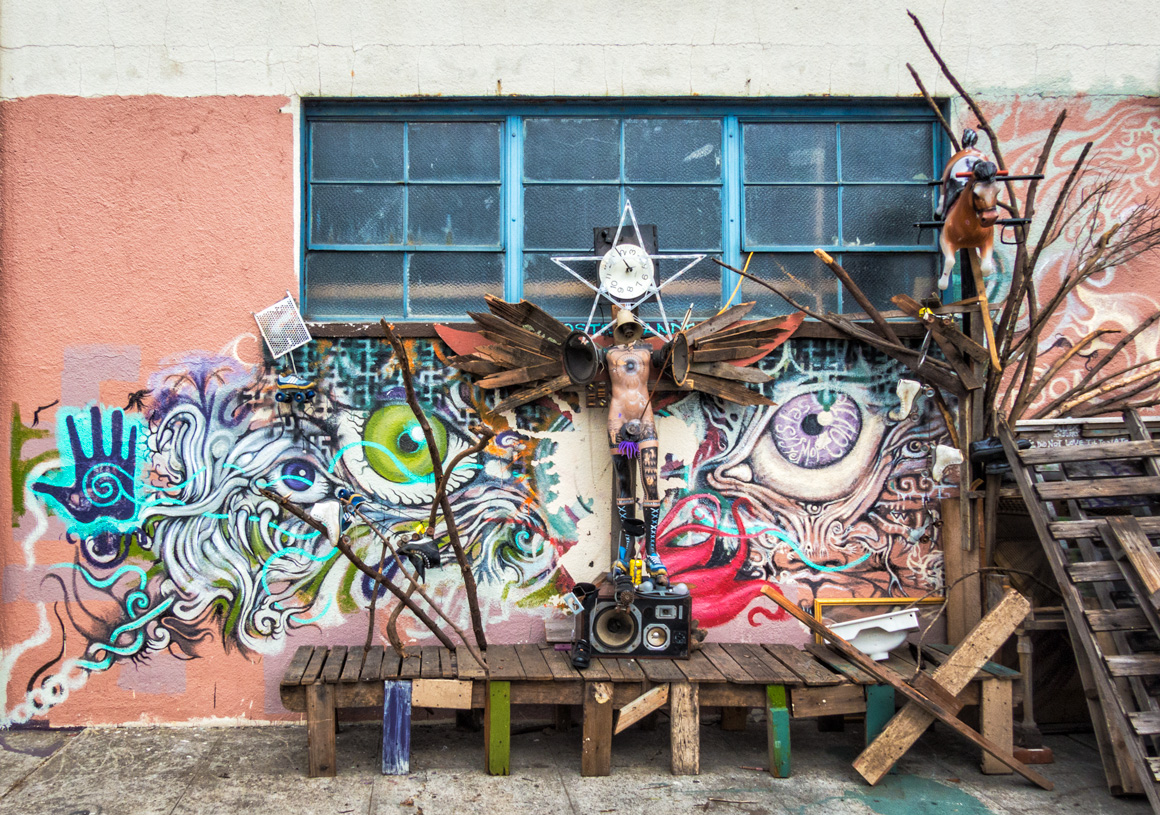



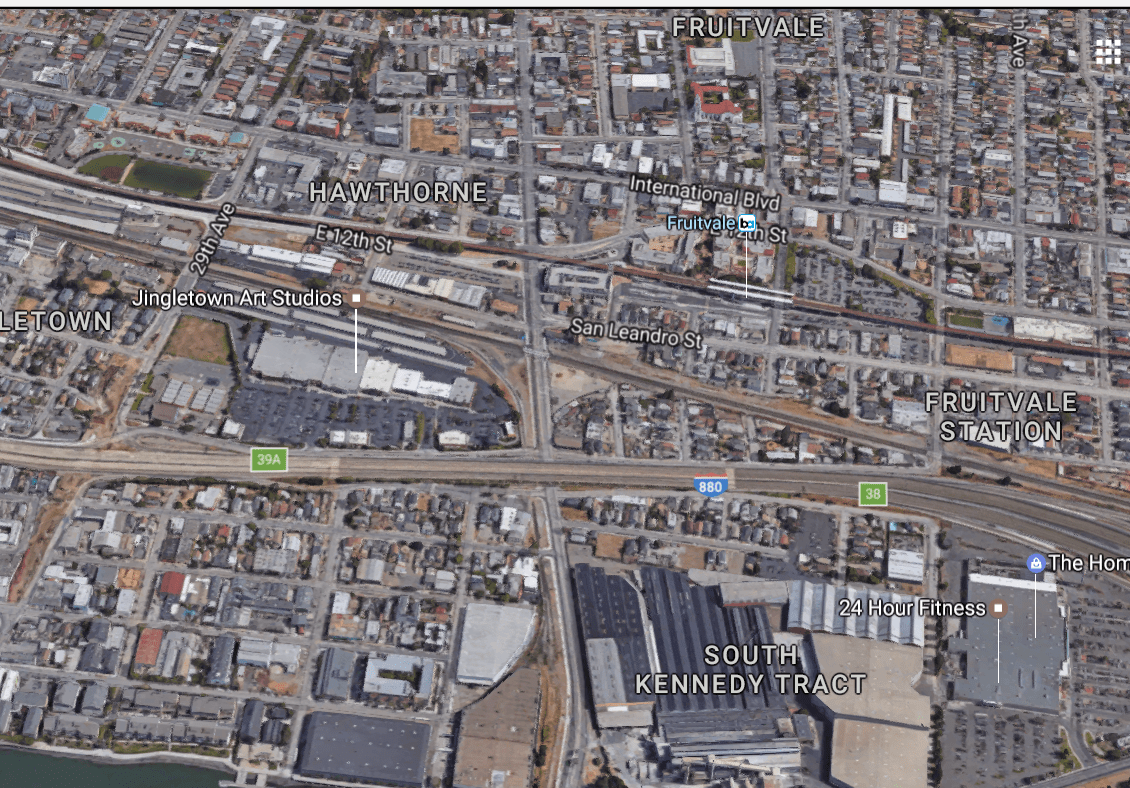
I predict that out of the ashes of the Ghost Ship, will rise an even better Bohemia in Fruitvale where my grandparents lived, and where other kindred moved after the great San Francisco Earthquake and Fire. I will point out The areas where artists have founded a creative colony.
Jon Presco
“Will Bohemia arise in Oakland,” was the question asked in an article in the Oakland Tribune on April 22, 1917. The reporter told of the formation of an artist’s club of the East Bay with a membership of more than 30 painters, sculptors and art students including Selden Gile, William H. Clapp and William A. Gaw (1891-1973). Many of the things that made the area seem so desirable to “The Six” were mentioned in that review, such as the picturesque waterfront and the sunny rolling hills above the Bay. Oakland was depicted as “…a Bohemia where kindred spirits meet with art and the great adventures that stimulate art to color its atmosphere.”
For almost 10 years, 1917 to 1927, until Selden Gile moved to Belvedere,[2] his cabin on Chabot Road in Oakland was the weekly meeting place for “The Six.” The “Chow House,” as it was called, had electricity but no toilet or bath.
http://www.tfaoi.com/aa/2aa/2aa660.htm


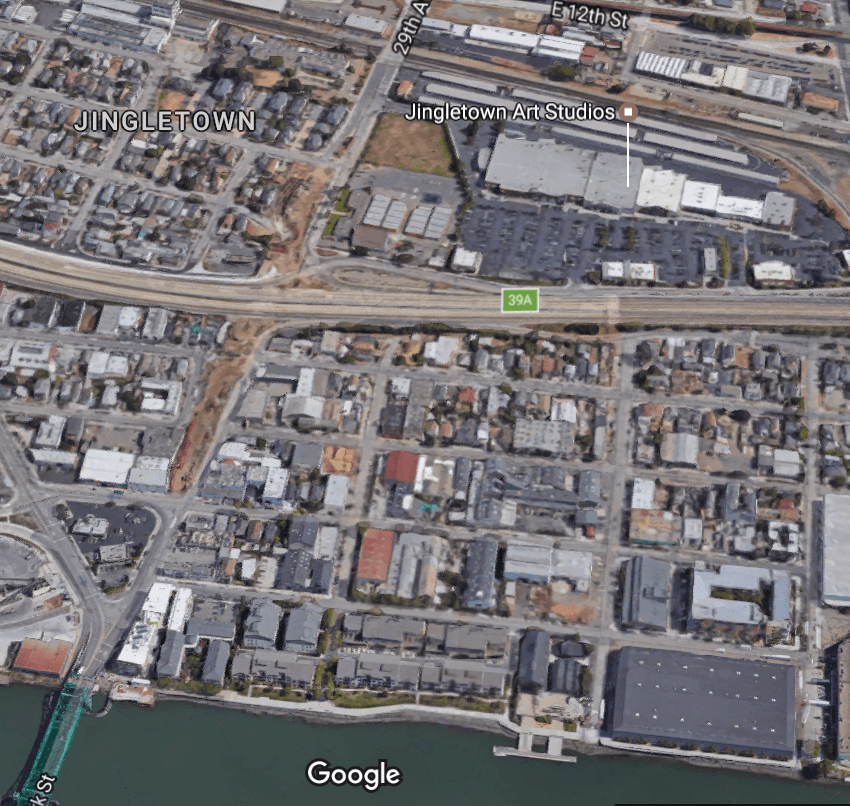


But if you look more closely at the beautiful aerial view of the remade Oakland waterfront, you might notice that there’s a tiny finger of low-rise property amid the shiny new apartment blocks. A 2006 design document describes that little area as “private land — not part of project.” You have to actually go down and visit the area, which runs along Fifth Avenue between the estuary and the Nimitz Freeway, to find a small community of artists and artisans there. Unlike the dream sketched out by the Brooklyn Basin promoters, this community actually exists and has for some time.
Residents wonder how much longer their good fortune—the affordable digs, the bohemian atmosphere, their intimate view of the estuary’s weirdly juxtaposed natural splendor and bruised industrial waterscape—can last.
Zack Parkes is a musician who recently rented a cottage in the neighborhood. He loves it. “It’s as pure down here as it get,” he said. “This place really hasn’t been changed and altered. I think it still embodies a lot of the tradition of what makes Oakland Oakland.”
He said he also wonders how thousands of new residents are going to fit into an area that has limited access. “You can’t move the water,” he said. “You can’t move the train tracks. It’s going to be tough to fit everyone in between.”
Robert Schultz has lived in the Fifth Avenue community since the late 1970s. He said the neighborhood has successfully resisted development efforts before, but this time he thinks things are different.
“We’re just art types down here,” Schultz said. “We can fight as hard as we want with sticks and stones, but they’ve got the big guns. The government does what they want to do when they want to do it.”
Here’s a gallery of the Fifth Avenue community and some of its residents:
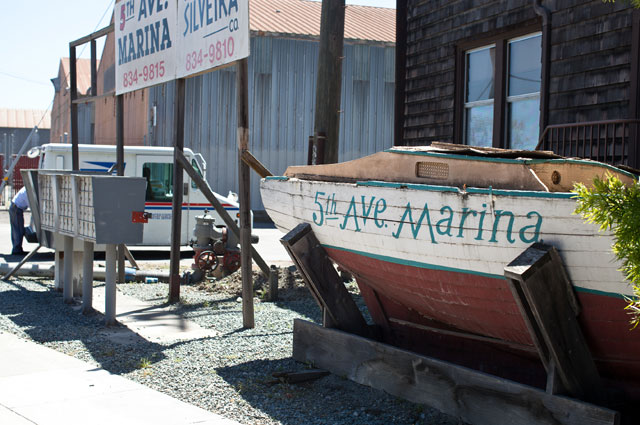 An artisan community of residents, businesses and boat owners lives at the end of Fifth Avenue in Oakland. The community would be virtually enclosed by the massive new Brooklyn Basin development. (Deborah Svoboda/KQED)
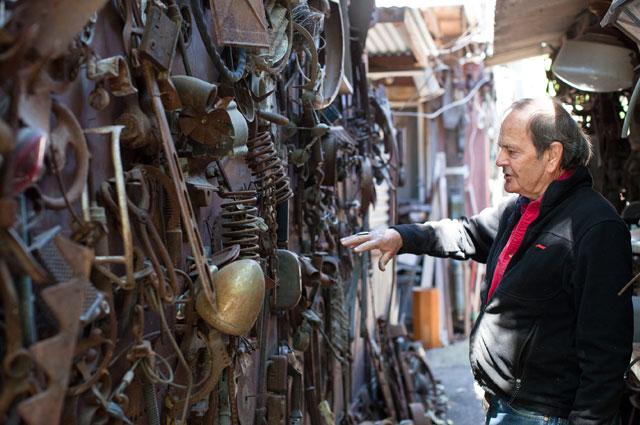 Residents of a small artists’ community on the Oakland waterfront, near Jack London Square, are pondering what their future holds as the city moves ahead with a massive new development in their backyard. Robert Schultz collects art — and whatever other artifacts come his way — and has lived in the Fifth Avenue community for about 34 years. (Deborah Svoboda/KQED)
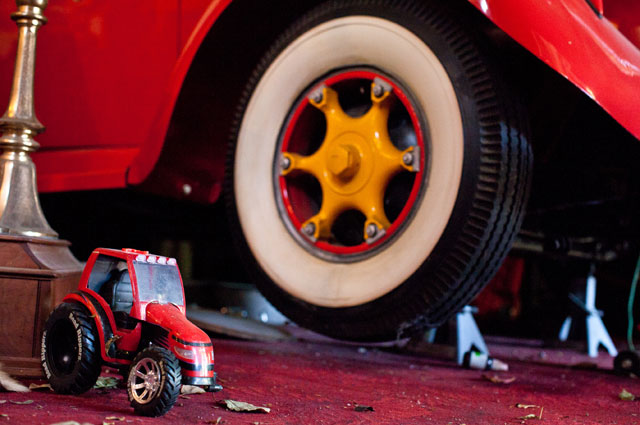
Here two pieces from Schultz’s collection sit side by side: a toy car and a vintage Studebaker. (Deborah Svoboda/KQED)
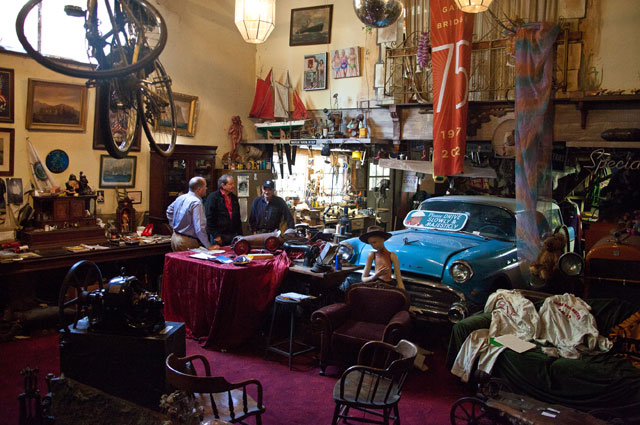 Schultz has lived in the Fifth Avenue community for about 34 years. He has rescued everything from trees to antiques and cars, and he sells some of it from his space and shop. Here Mike Hill (left) a military item collector, Schultz (center) and Jay Kline (right) talk about some of the stuff that Schultz has to offer. (Deborah Svoboda/KQED)
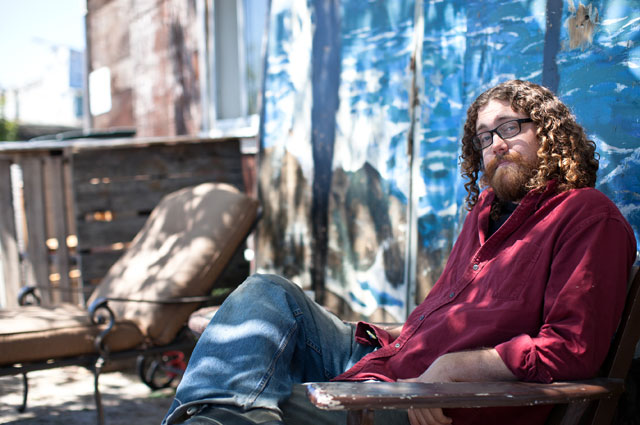 Musician Zach Parkes has had a recording studio and been a part of the community on Fifth Avenue for about six months. (Deborah Svoboda/KQED)
 Dawn Whitaker takes a few minutes to relax and watch the birds. She’s been a part of the Fith Avenue community for a couple of months. (Deborah Svoboda/KQED)
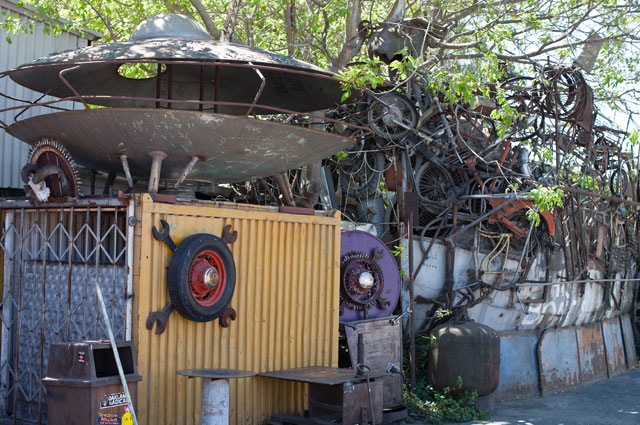 A spaceship that used to be a part of a playground at Lake Merritt now lives as part of a fence, with a bunch of other art, on Fifth Avenue. (Deborah Svoboda/KQED)
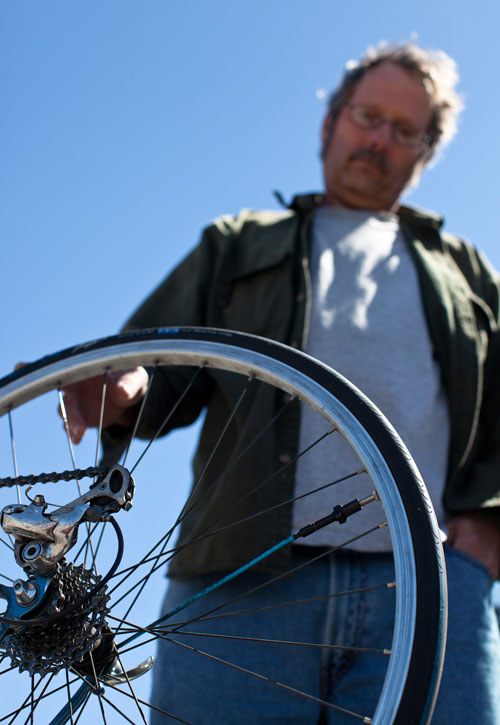 Kevin Manning has had an office overlooking the Fifth Avenue Marina for 22 years. He demonstrates one of his inventions, the “Pump-Hub,” which self-inflates bike tires as you ride. (Deborah Svoboda/KQED)
The Society of Six
by Terry St. John
The following essay was written in 1986 by Terry St. John, who was, at the time of writing of the essay, an artist and Associate Curator of Art, The Oakland Museum. This essay was written for, and included in, the book titled Plein Air Painters of California, The North, edited by Ruth Lilly Westphal and published by Westphal Publishing, Irvine, California, ISBN 0-9610520-1-5
We do not believe that painting is a language. Nor do we try to “say” things, but we do try to fix upon canvas the joy of vision. To express, to show…not to write hieroglyphics. We have no concern with stories, with lapse of time, nor with the probability of improbability or hereafter. In other words, we are not trying to illustrate a thought or write a catalogue, but to produce a joy through the use of the eyes. We have much to express, but nothing to say.
William H. Clapp[1
k
3. Laura Bride Powers, Oakland Tribune, 15 April 1923. This term was commonly used to describe Gile’s cottage, according to Louis Siegriest.
4. Louis Siegriest and Lundy Siegriest, “Louis Bassi Siegriest Reminiscences,” interview by Corinne L. Glib, 1954, University of California Regional Oral History Office, Bancroft Library, Berkeley, p. 76.
5. Louis Siegriest and Maurice Logan interview, Oakland, California, 13 January 1972.
6. Louis Siegriest and Lundy Siegriest, p. 77.
7. Rudolph Schmidt and Louis Siegriest interview, Oakland, California, 15 June 1972.
8. Louis Siegriest and Lundy Siegriest, pp. 80-81.
9. William H. Clapp to Fernand Ferret, 30 September 1940, Archives of California Art, The Oakland Museum. Also cited in Oakleaves, publication of the Oakland Public Library (6 May 1954).
10. J. Russell Harper, Painting in Canada: A History (Toronto, Ontario: University of Toronto Press, 1966), pp. 257 and 365.
11. Glenn Wessels to Laetitia Meyers, 7 April 1972, Archives of California Art, The Oakland Museum.
12. Schmidt and Siegriest interview.
13. Olympe Allegretti (August Gay’s sister), interview, 9 June 1972,
14. Ibid.
15. “Will Bohemia Rise in Oakland?” Oakland Tribune, 22 April 1917.
16. Schmidt and Siegriest interview.
17. Ibid.
18. Siegriest and Siegriest, p. 19.
19. Ibid., p. 20.
20. Siegriest and Siegriest, p. 19.
21. Selden Gile to Louis Siegriest, 29 November 1927, Archives of California Art, The Oakland Museum.
22. Siegriest and Siegriest, p. 20.
23. Louis Siegriest interview, Oakland, California, 23 July 1972.
24. Louis Siegriest, personal communication, Oakland, California, 13 June 1981.
25. Siegriest and Siegriest, pp. 80-81.
26. Mildred von Eichman, interview, Monterey, California, 23 June 1972.
27. Schmidt and Siegriest interview.
28. H. L. Dungan, Oakland Tribune, 3 May 1925. Gile, Gay, Siegriest and von Eichman were described as moving away from Impressionism, with the latter three labeled as “ultra moderns.”
29. Schmidt and Siegriest interview.
30. Louis Siegriest interview, 23 July 1972.
Essay courtesy of Westpahl Publishing, Irvine, California
Also in this magazine or available through the Internet: West Coast Art articles and essays — 20th Century — 20-21st Century; information on most artists listed in the essay via our Distinguished artists; 100 top-ranked California artists courtesy of AskArt.com, including many artists referenced in the above essay. The above four links lead to literally thousands of pictures of the paintings of California’s early artists, plus biographies, essays and much more.

 Rosamond Press
Leave a comment