

 For the reason Muslim terrorists have attacked the Arts and Journalism, my newspaper will publish the stories of sincere Crusaders. One of them was a woman given the name Swanhilde.
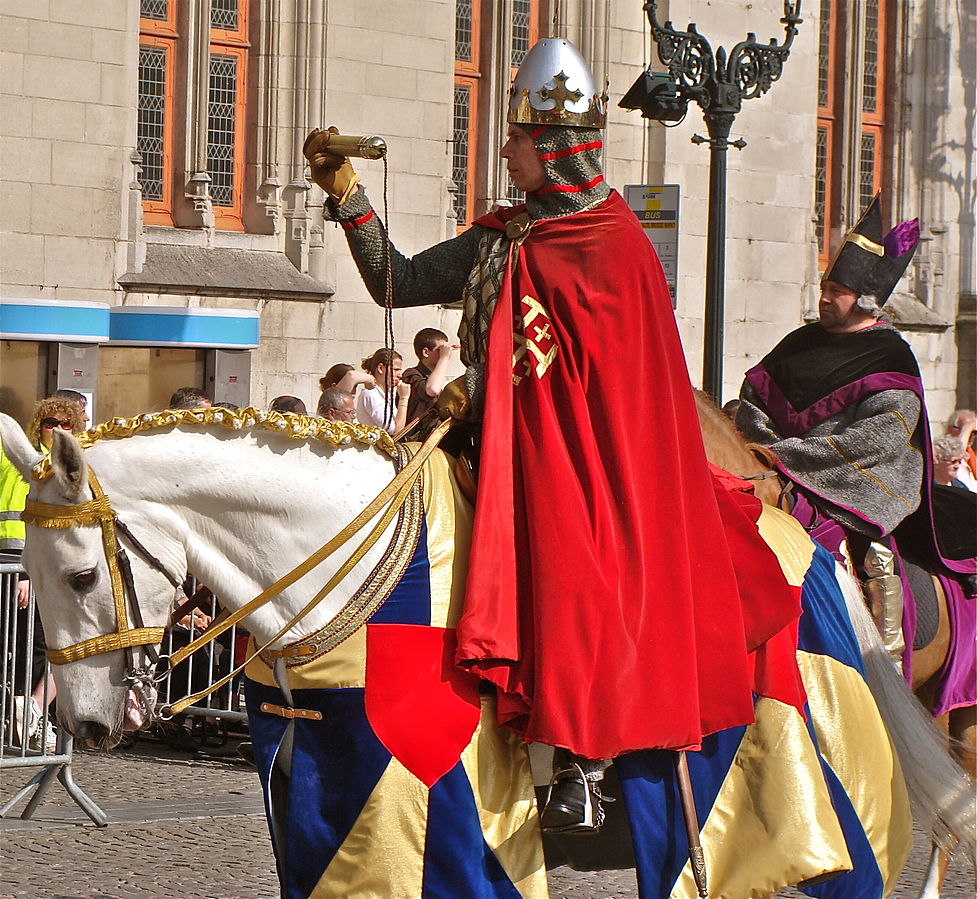
Thierry returns from Jerusalem with the Holy Blood.
On this site is a statue of Sibylla and her husband, Thierry, who went to the Holy Land to liberate to roots of the Christian-Judaic religion. Swanhilde means ‘Swan Battle’.
http://en.wikipedia.org/wiki/Thierry,_Count_of_Flanders
Jon Presco
Sibylla then accompanied her widower father to the crusader Kingdom of Jerusalem, where he married Melisende, the heiress of the kingdom, and became king himself in 1131. In 1139 she married Thierry, Count of Flanders, who had arrived on his first pilgrimage to the Holy Land.
Robert the Frisian made a pilgrimage to Jerusalem in 1086 and on the return trip home spent time assisting the Byzantine Emperor (Alexios I Komnenos) against the Seljuq Turks.[11] In one battle Robert and three of his companions rode ahead of the main army charging the forces under the command of Kerbogha, whose forces the Christians scattered completely.[12] Robert died 13 October 1093.[1]
Robert the Frisian
He was the younger son of Baldwin V of Flanders and Adèle, a daughter of King Robert II of France.[1] His elder brother, Baldwin, succeeded their father as Baldwin VI, Count of Flanders and his sister Matilda of Flanders had married William, then duke of Normandy and later King of England. His marriage to Gertrude of Saxony, dowager Countess of Holland in 1063 was not arranged by his father but nonetheless agreed to.[2] She was the widow of Floris I, Count of Holland, who already had three children including a daughter Bertha.[3] His nickname ‘the Frisian’ was obtained, apparently, when he acted as regent for his stepson Dirk V, Count of Holland[2] (Frisia being the name for Holland at the time).
On his deathbed in 1070, Robert’s brother Baldwin VI, Count of Flanders, left Flanders to his eldest son Arnulf III and Hainaut to the next oldest son Baldwin with the provision that if either preceded the other in death, he would inherit the other’s county as well.[4] Baldwin VI further entrusted his brother Robert with the safeguard of his son Arnulf III, who was still a minor, to which Robert gave his oath of homage and solemn promise to protect his nephew Arnulf.[4] Richilde, Arnulf’s mother and de jure Countess of Hainaut was to be regent until Arnulf came of age.[5]
After Baldwin VI’s death, however, Robert disputed the succession of Arnulf and entered Ghent with the intent of taking Flanders for himself.[6] Richilde appealed to King Philip I of France who summoned Robert to appear before him.[7] Robert refused and continued his war with Richilde at which point Philip I amassed an army which he brought to Flanders.[6] His army was accompanied by Norman troops, probably sent by Queen Matilda and led by William FitzOsborn.[a][5] William had an interest in marrying Richilde but he was killed in battle at Cassel,[5] which battle was joined on 22 February 1071.[5] In that engagement Robert’s forces were ultimately victorious but Robert himself was captured and his forces in turn captured the Countess Richilde.[7] Both were freed in exchange and the battle continued to its conclusion.[7] Among the dead was Arnulf III, killed by Gerbod the Fleming, 1st Earl of Chester who apparently fought for Robert.[8] As a result of the battle Robert claimed the countship of Flanders.[7] The Countess Richilde and her son Baldwin returned to Hainaut but continued to instigate hostilities against Robert.[7]
Count Robert eventually gained the friendship of King Philip I of France by offering him the hand in marriage of his stepdaughter, Bertha of Holland.[9] As a part of their negotiations Corbie, an important trade center on the border between Flanders and lesser France, was returned to royal control.[10] Unlike his father’s reign, under Count Robert, Flanders no longer had peaceful ties to Normandy and became a refuge for the Conqueror’s enemies, including his rebellious son, Robert Curthose in 1078.[b][9] In 1085 Robert the Frisian, along with his son-in-law Canute IV of Denmark, planned a naval attack on England, but after Cnut’s assassination the plan was never carried out.[9] Taking a considerable armed escort Robert the Frisian made a pilgrimage to Jerusalem in 1086 and on the return trip home spent time assisting the Byzantine Emperor (Alexios I Komnenos) against the Seljuq Turks.[11] In one battle Robert and three of his companions rode ahead of the main army charging the forces under the command of Kerbogha, whose forces the Christians scattered completely.[12] Robert died 13 October 1093.[1]
Kerbogha (Arabic: كربغا, Turkish: Kürboğa) was Atabeg of Mosul during the First Crusade and was renowned as a soldier. [1]
He was a Turk who owed his success to his military talent.[2] In 1098, when he heard that the Crusaders had besieged Antioch, he gathered his troops and marched to relieve the city. By the time he arrived, around June 5-9, the Crusaders had been in possession of the city since 3 June. They were not able to restock the city before Kerbogha, in turn, was besieging the Crusaders in the city.
During the siege, Peter the Hermit was sent as emissary to Kerbogha by the Christian princes in the city, to suggest that the parties settle all differences by duel. Presumably feeling his position secure, Kerbogha did not see this course of action as being in his interest and he declined.
During the siege, inside the city, Peter Bartholomew claimed to have discovered the Holy Lance through a vision. This discovery re-energized the Christian army. At the same time, disagreements and infighting broke out within the Atabeg’s army. Kerbogha’s mighty army was actually made up of levies from Baghdad and Persia, Palestine and Damascus, and the internal quarrels amongst the Emirs took precedence over any unity against the Franks. The only thing that united his allies was a common fear of Kerbogha’s real goal, the conquest of all their lands. If Antioch fell, he would be invincible.[3]
On 28 June, when Bohemond, the leader of the Christian army decided to attack, the Emirs decided to humble Kerbogha and they abandoned him at the critical moment. Kerbogha was taken by surprise because the information he had received was of a weak, disorganized Christian army. Instead, he found himself facing a motivated, unified Christian army so large that Kerbogha’s strategy of dividing his own forces was ineffective.[4] He had to retreat, and returned to Mosul a broken man.
http://en.wikipedia.org/wiki/Holy_Lance
Thierry of Alsace (Dietrich) (c. 1099 – January 17, 1168), in Flanders known as Diederik van den Elzas, was count of Flanders from 1128 to 1168. He was the youngest son of Duke Thierry II of Lorraine and Gertrude of Flanders (daughter of Robert I of Flanders). With a record of four campaigns in the Levant and Africa (including participation in the Second Crusade, the failed 1157–1158 siege of the Syrian city Shaizar, and the 1164 invasion of Egypt), he had a rare and distinguished record of commitment to crusading.
Third and Fourth Crusades[edit]
In 1156 Thierry had his eldest son married to Elizabeth of Vermandois, daughter and heiress of Raoul I of Vermandois. In 1156 he returned to the Holy Land, this time with his wife accompanying him. He participated in Baldwin III’s siege of Shaizar, but the fortress remained in Muslim hands when a dispute arose between Thierry and Raynald of Châtillon over who would possess it should it be captured. He returned to Flanders 1159 without Sibylla, who remained behind to become a nun at the convent of St. Lazarus in Bethany. Their son Philip had ruled the county in their absence, and he remained co-count after Thierry’s return. In 1164 Thierry returned once more to the Holy Land. He accompanied King Amalric I, another half-brother of Sibylla, to Antioch and Tripoli. He returned home in 1166, and adopted a date palm as his seal, with a crown of laurels on the reverse.
http://en.wikipedia.org/wiki/Thierry,_Count_of_Flanders
Sibylla of Anjou (c. 1112–1165) was a countess consort of Flanders. She was the daughter of Fulk V of Anjou and Ermengarde of Maine, and wife of William Clito and Thierry, Count of Flanders. She was the regent of Flanders in 1147-1149.
In 1123 Sibylla married William Clito, son of the Norman Robert Curthose and future Count of Flanders. Sibylla brought the County of Maine to this marriage, which was annulled in 1124 on grounds of consanguinity. The annulment was made by Pope Honorius II upon request from Henry I of England, William’s uncle; Fulk opposed it and did not consent until Honorius excommunicated him and placed an interdict over Anjou. Sibylla then accompanied her widower father to the crusader Kingdom of Jerusalem, where he married Melisende, the heiress of the kingdom, and became king himself in 1131. In 1139 she married Thierry, Count of Flanders, who had arrived on his first pilgrimage to the Holy Land.
She returned to Flanders with her new husband, and during his absence on the Second Crusade the pregnant Sibylla acted as regent of the county. Baldwin IV, Count of Hainaut took the opportunity to attack Flanders, but Sibylla led a counter-attack and pillaged Hainaut. In response Baldwin ravaged Artois. The archbishop of Reims intervened and a truce was signed, but Thierry took vengeance on Baldwin when he returned in 1149.
In 1157 she travelled with Thierry on his third pilgrimage, but after arriving in Jerusalem she separated from her husband and refused to return home with him. She became a nun at the Convent of Sts. Mary and Martha in Bethany, where her step-aunt, Ioveta of Bethany, was abbess. Ioveta and Sibylla supported Queen Melisende and held some influence over the church, and supported the election of Amalric of Nesle as Latin Patriarch of Jerusalem over a number of other candidates. Sibylla died in Bethany in 1165.
Descendants[edit]
Sibylla had six children with Thierry:
- Philip, Count of Flanders
- Matthew, Count of Boulogne, married Marie of Boulogne
- Margaret, Countess of Flanders and Hainaut, married Baldwin V, Count of Hainaut
- Gertrude, married Humbert III, Count of Savoy
-
Matilda
http://www.genealogieonline.nl/stamboom-familie-poort/I32818.php

 Rosamond Press
Leave a comment