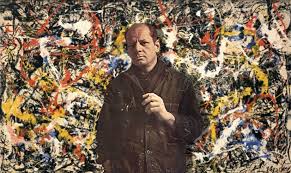
If you use Wikipedia you have noted that every citation of a famous person begins with a genealogy. By the age of seventeen, I knew how a artist’s biography should be written. One has to mention the artists that surrounded the famous artists, especially if they are kindred. Executor, Sydney Morris allowed in a legal document, Stacey Pierrot, to produce a biography of Christine Rosamond Benton, and a movie. She hired two ghost writers to this end. Pierrot knew she was competing with my biography. Neither Tom Snyder, or Julie Lynch, recorded the incredible fact we are kin to the famous artist, Thomas Hart Benton, who was mentor and friend of Jackson Pollack. Both men received funding from the WPA, to buy art supplies, and pay rent for a studio. Thanks to President Franklin Delano Roosevelt, many artists all over America received federal funding to render thousands of works of art. In 2006, one of Pollock’s paintings sold for $140 million, the highest amount ever paid for a work of art – at the time!
Below is a e-mail I received from my ex-daughter, Heather Hanson, whose lover, Bill Cornwell, would not allow Heather to perform her duties as my Trustee because he believed I was a “parasite” and told me so. Heather also called me a “parasite” and said I did not deserve SSI because I was not insane enough. She admonished me for not serving in Vietnam, like Bill’s father did, the ex-cop and drill sergeant, who vilified me in front of grandson. When I told Bill I was authoring a biography, he was surprised. Why didn’t Heather tell him this, before he met me and my family? Heather wanted him to believe I was utterly worthless, because she was after the money my uncle, Vincent Rice, left to his kindred. Being mentally ill, my ex-daughter had to believe she was more deserved on our windfall that we just got another installment of. Vincent was my art patron.
After dismissing Heather as my Trustee, I find out it is going to cost me thousands of dollars to get a new one. I sent her an e-mail asking her to stay on. What I got is another Kidnapping Note from another monster who keep taking the children in my family hostage. Pierrot, and her pack of Parasites, took Christine’s daughters hostage after convincing a powerful attorney they were ‘The Chosen Ones’ who could generated much wealth for my nieces. These outsiders destroyed this important Artistic Legacy that could have generated millions of dollars for the Heirs, if they had allowed me to work in peace. Instead, they tormented me beyond belief, they like vultures hovering over me, ready to snatch anything that looked like dollar signs.
The Cornwells are Tea Party Crazies. Bill could not sire a child, or grandchild. Bill’s father took my families inventory to see if we were fit for political action. He was proud of his family tree, that doesn’t amount to much. The Extreme-Right wants to abolish all the programs FDR installed, including Social Security.
Heather’s mother being a radical Berkley Hippie was overlooked because that would make Heather ‘The Immaculate Conception’ which she believes she is as you will one day read. Heather has no concept of history and what a natal family looks like. When her and her Bonehead Bubba came to Bullhead, they were on a political mission. I was just looking for a happy ending to my story ‘Capturing Beauty’.
Tom or Jack could have drunk Bill under the table. Jack was mentally ill. Linda was furious that her niece got knocked up by a goof, a drinker with no social skills. Linda had lined up some of old rich guys for my daughter who had been lusting after her for years as she floated off the yacht in her bikini. Heather said Linda was her father because she had money and was practical, while her mother wanted her to be a famous singer, or, actress.
Driving home in the rental, Heather says this about Linda who alas met my six year old grandson;
“I’m real pleased with Tyler. When you come back, bring me a granddaughter!”
I about puked! Then, Tyler says this with a laugh;
“Linda peed her pants and made a funny joke!”
I did not want any details. When I cleaned up the rental car I saw the backseat had a huge pee stain. This Gold Digger took a giant pee while sitting next to my grandchild. When I alas confronted Heather and Bill about it, Bill said this with a laugh;
“Maybe you peed in that seat!”
I asked my ex-daughter if Bill served in the Armed Forces of the United States;
“No! But, at least he wanted to!”
A “notarized letter” . My attorney suggested I sue Heather Hanson for breach of contract. This lush forsake a legal agreement made with a gifted member of a historic family.
Jon Presco
E-mail from Heather Hanson:
I will agree to that if you agree to the following.
a. You will sign a notarized letter stating you will not defame me or anyone I am close to on the Internet or any other form of media. This includes me, Bill, Linda, Flip, my mom, Matt and Katie and Tyler (Internet defamation is illegal and I will not tolerate it)
b. You will remove anything you have published in which you have negated me and others in my life.
c. You apologize for all the horrible things you have said.
d. You get help for what ever condition you have that causes you to be so paranoid, irrational, and abusive.
The Hollywood entertainment magnate David Geffen has sold a classic drip painting by Jackson Pollock for about $140 million, art experts with knowledge of the transaction said yesterday.

“No. 5, 1948,” a Jackson Pollock painting, has been sold for about $140 million, art experts with knowledge of the sale say.
The experts spoke on condition of anonymity, saying they did not want to be perceived as betraying the confidence of the seller or the buyer of the Pollock, “No. 5, 1948,” or jeopardize future business.
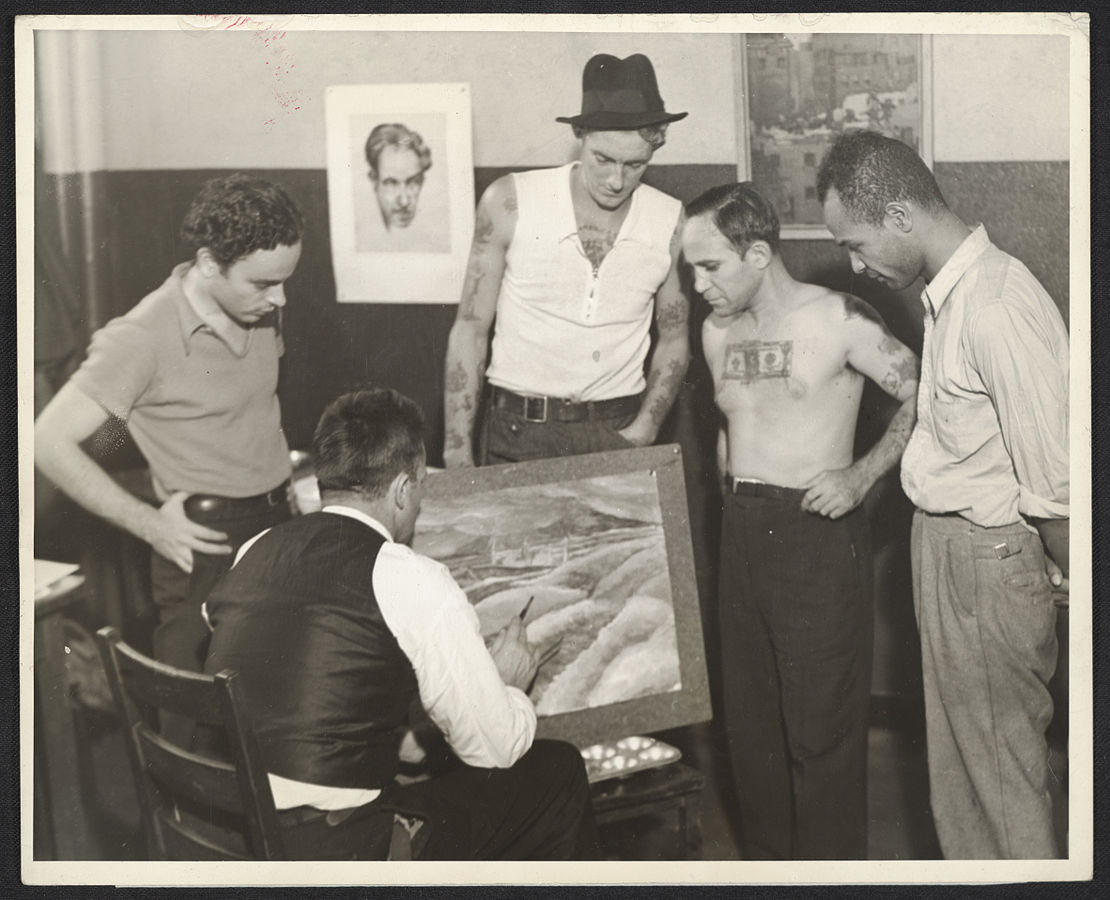
With the advent of the New Deal’s work-relief projects, Pollock and many of his contemporaries were able to work as artists on the federal payroll. Under government aegis, Pollock enrolled in the easel division of the Works Progress Administration’s Federal Art Project, which provided him with a source of income for nearly eight years and enabled him to devote himself to artistic development. Some of Pollock’s WPA paintings are now lost, but those that survive–together with other canvases, drawings and prints made during this period–illustrate his complex synthesis of source material and the gradual emergence of a deeply personal pictorial language.
<div
style="display:none;"> <img
src="//pixel.quantserve.com/pixel/p-Ud6J9WY3Ryurh.gif"
border="0" height="1" width="1"
alt="Quantcast"/> </div>
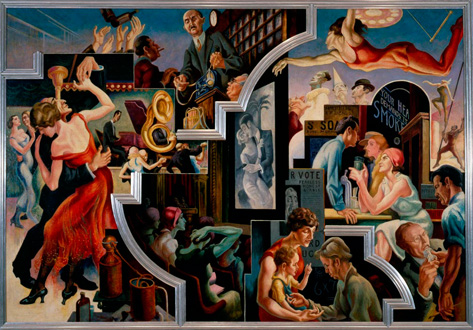
America Today was Benton’s first major mural commission and the most ambitious he ever executed in New York City. The exhibition will demonstrate how the work not only marked a turning point in Benton’s career as a painter—elevating his stature among his peers and critics—but in hindsight stands out even more as a singular achievement of American art of the period, one that, among other effects, served to legitimize modern mural painting as part of the Works Progress Administration’s Federal Arts Project in the 1930s.
http://www.nytimes.com/2006/11/02/arts/design/02drip.html?_r=0
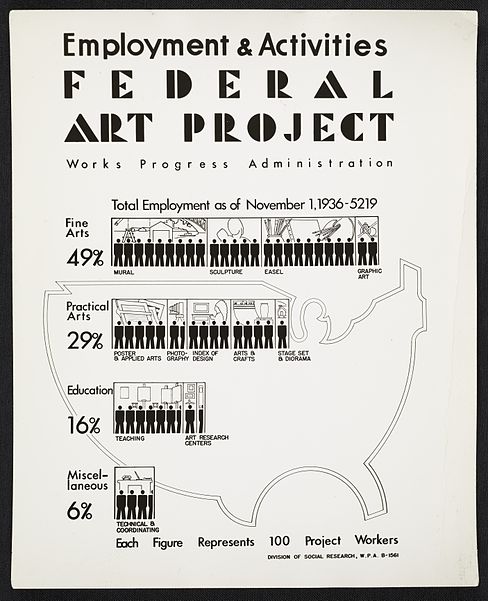
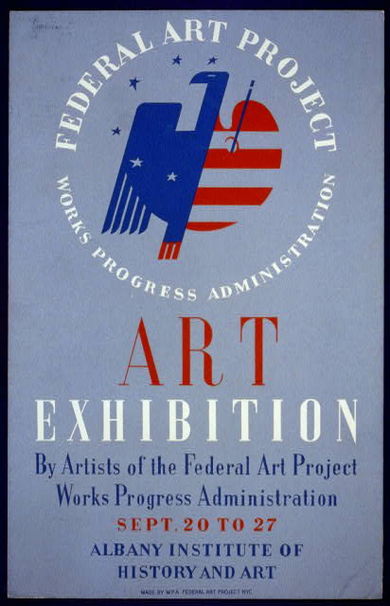
The Federal Art Project (FAP) was the visual arts arm of the Great Depression-era New Deal Works Progress Administration Federal One program in the United States. It operated from August 29, 1935, until June 30, 1943. Reputed to have created more than 200,000 separate works, FAP artists created posters, murals and paintings. Some works still stand among the most-significant pieces of public art in the country.[2]
The program made no distinction between representational and nonrepresentational art. Abstraction had not yet gained favor in the 1930s and 1940s and, thus, was virtually unsalable. As a result, the program supported such iconic artists as Jackson Pollock before their work could earn them income.[3]
The FAP’s primary goals were to employ out-of-work artists and to provide art for non-federal government buildings: schools, hospitals, libraries, etc. The work was divided into art production, art instruction and art research. The primary output of the art-research group was the Index of American Design, a mammoth and comprehensive study of American material culture.
The FAP was one of a short-lived series of Depression-era visual-arts programs, which included the Section of Painting and Sculpture and the Public Works of Art Project (both of which, unlike the WPA-operated FAP, were operated by the U.S. Department of the Treasury).
In 1930, following his older brother Charles Pollock, he moved to New York City, where they both studied under Thomas Hart Benton at the Art Students League. Benton’s rural American subject matter had little influence on Pollock’s work, but his rhythmic use of paint and his fierce independence were more lasting.[4] In the early 1930s Pollock spent a summer touring the Western United States together with Glen Rounds, a fellow art student, and Benton, their teacher.[8][9]
From 1938 to 1942, during the Great Depression, Pollock worked for the WPA Federal Art Project.[10]
Trying to deal with his established alcoholism, from 1938 through 1941 Pollock underwent Jungian psychotherapy with Dr. Joseph Henderson and later with Dr. Violet Staub de Laszlo in 1941-1942. Henderson engaged him through his art, encouraging Pollock to make drawings. Jungian concepts and archetypes were expressed in his paintings.[11][12] Recently historians have hypothesized that Pollock might have had bipolar disorder.[13]
http://en.wikipedia.org/wiki/Jackson_Pollock
http://rabbitsmoonstudio.blogspot.com/2013_12_01_archive.html
http://www.govloop.com/the-intriguing-relationship-of-thomas-hart-benton-jackson-pollock/
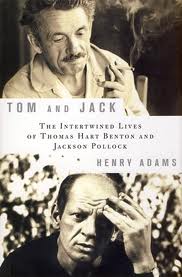
There has been a book on my reading list for the past few months – Tom and Jack: The Intertwined Lives of Thomas Hart Benton and Jackson Pollock. For a variety of reasons, I have always been fascinated by these two American artists. Benton symbolizes the American regionalist movement. Pollock abstract art. Benton was Pollock’s mentor – and Pollock ultimately fell in love with Benton’s wife, the drama! Even after Pollock rocketed to stardom and Benton fell off out of the art scene, they stayed in touch, and Benton ultimately became like a father to Pollock.
It’s interesting to take a brief look at these two artists upbringing. Benton’s upbringing is one of privilege and rebellion. His family was deeply rooted into politics, and Benton was being groomed to continue the family tradition. His father was a congressman, and Thomas Hart Benton was named after his uncle, who served as one of the first Senators from Missouri. With his pedigree and path defined before he could walk, Benton still rebelled, and through the unwavering support of his mother, he would pursue his passion to be an artist by studying in Paris, and then work and live in New York.
While living and working in New York, Benton would meet his protege, Jackson Pollock. Benton, to me, represents the quintessential American of his time. He was a pioneer, a rebellion, and paradoxically, through his art, he would ultimately attempt to preserve the American regionalist artistic tradition. As a nation was going through radical changes and reform during his time, his art would remind and depict American’s of everyday life. It’s an interesting study at how art is influenced by society, and vice versa. Above all, his life and the time he lived in fascinates me.
For all of Benton’s privilege, Jackson came from humble beginnings. His family moved often due to financial problems. Ultimately, Jackson found his way to New York City to study art, and built a rapport with Benton after studying under him for three years. In many regards, Pollock idolized Benton and treated him as a father figure. Under Benton’s influence, he would try and connect Pollock’s upbringing of growing up in the western United States to his art (regionalism!).
Benton provided Pollock the discipline and focus to hone in on his craft and God given talents. Jackson had a history of severe alcohol abuse, which turned into a life long struggle that led to his untimely death in car accident in 1956, just as his career was hitting a creative peak.
I have often thought about these two men and their careers in fascination. My mother is an art teacher, and sadly I inherited absolutely none of her artistic gifts. But most importantly, my mother taught me to appreciate the arts, think critically about my surroundings, and always look at art and life through new perspectives. In essence, the lessons of Jackson Pollock and Thomas Hart Benton can be applied to how we view mentorship, leadership and how we shape view and/or shape our networks.
There are a lot of angels to take and look to understand their relationship in a context applicable to the workplace. In their own right, both men were extremely similar, but channeled their creative energies in different artistic forms. For Benton and Pollock, the ultimate goal was to create meaningful art that they were passionate about. For Benton, this meant being at the forefront of the regionalist art movement, highlighting the power, might and everyday life of Americans through his murals.
For Jackson, this meant coming into his own and rebelling against traditional forms through his abstract art. In both worlds, the goal and essence of their work was to create meaningful, passionate, and engaging art. Their art called for a higher meaning, and required complete and utter dedication to meet their goal. When you look at either a piece of art by Jackson Pollock or Thomas Hart Benton, you see a passion and dedication to their art, with a certain kind of discipline and even a pain in their work. It’s the unwavering dedication to their craft that tied both men together, the product and the way their art looks, is only a fraction of what ties the two men together.
What we can learn from their relationship is that personal attainment and ambition is different for everyone. People are motivated for a variety of reasons and in a variety of different ways, at the workplace this is critical to understand. As long as a group is aligned to common goals, a common vision, and aligned strategically, everyone in an department, organization can lift everyone else up. For instance, Jackson Pollock would not have been Jackson Pollock that we know without Thomas Hart Benton. Their objectives and art differed, but they shared a deeply rooted passion for creating meaningful art in their own eyes.
The second lesson is the importance of providing avenues for growth. Growth is one of the most important areas for a manager and organization to provide. Identifying spots where employees can excel, and putting them into the positions, on the right projects and keeping employees engaged in their work is at the heart of management. Although their styles drastically differ, Benton provide Pollock with a certain kind of discipline, structure and attitude that Pollock needed to excel as an artist.
The last lesson to touch upon is how important it is to expand horizons, engage with differing thoughts and to always stay challenged. Jackson Pollock and Thomas Hart Benton eventually created remarkable pieces of art, classified in very, very different genres. For me, this is a reminder of how important it is to associate with people of different backgrounds, different life experiences, and learn anything you can from them, and above all, not to be afraid to share your story.
Impeachment mania, contrary to the claims of a few Republican leaders, is very strong within their party and among conservatives. Three fifths of both conservatives and Republicans favor impeaching Obama, led largely by those outside the party leadership but still popular, such as Sarah Palin. Some want impeachment over Obamacare. For others it is fear inspired by conspiracy theories, claiming gun control or immigrants or Benghazi are sinister plots.
Others frankly can’t tell you why they want impeachment, except they hate the man, their not very well concealed racism just below the surface. No president in over 60 years has been the target of such hatred. Clinton did not face heavily armed rallies publicly threatening to overthrow him, nor nearly as many death threats. One has to go back to Franklin Roosevelt to find worser examples.
https://www.youtube.com/watch?v=kP5MxaCSQsY
http://www.dailykos.com/story/2014/07/30/1317949/-When-the-Right-Wing-Tried-to-Overthrow-FDR#
This is one of the lesser known but important episodes in US history. The American Liberty League plotted to overthrow Franklin Roosevelt, sometimes referred to as the Business Plot. Some US businessmen were so opposed to the New Deal they planned to bring down Roosevelt by force using a private army and install a fascist government.
The list of plotters included some of the most prominent businessmen in the country. Irenee Du Pont of the Dupont family, one of the wealthiest in the nation, worth hundreds of millions, was a white supremacist and founder of the American Liberty League. Grayson Murphy was the treasurer for the League, Director of Goodyear, mining and rail companies, and on the boards of Bethlehem Steel and JP Morgan. William Doyle and Gerald McGuire were both leaders in the American Legion, one of the largest veterans’ organizations, one much further to the right than the VFW. John Davis and Al Smith were both former Democratic presidential candidates. John Raskob was an officer in Du Pont and the former Chairman of the Democratic Party. Robert Clark was a Wall Street banker and stockbroker who provided $15 million in funding for the plot. Alfred Sloan was the President, CEO, and Chairman of General Motors. He also owned Remington and would supplies arms for the coup as well as $300 million in funds.
The plot was exposed by General Smedley Butler, former Commandant of the US Marine Corps. Butler was approached by Gerald Maguire, who offered him command of an army of half a million World War I veterans from the American Legion. The plan was to hand an ultimatum to Roosevelt: pose as sick while a newly created office of the Secretary of General Affairs takes over and runs the country in his name.
What kind of a government did the League want? Gerald MacGuire was quite open that, “We need a fascist government in this country,” modeled on Mussolini’s fascist state, the French fascist group Croix de Feu, and Dutch fascists.
When Butler was offered command of this army, he refused and went to Roosevelt with the details of the plot. But Roosevelt feared the arrest of famous figures such as a Du Pont on treason charges would crash the Stock Market again. Roosevelt dealt with the coup by leaking the story to to the press. The plot was publicly exposed and could proceed no further.
The media had mixed reactions to news of the plot. The New York Times claimed it was all a hoax. Douglas MacArthur, allegedly named as the second choice for commanding the League’s army if Butler refused, called the claim a joke. Congress formed a special committee to investigate. The committee never summoned almost any of the plotters. Maguire was the only one to testify. Likely, the committee feared, much like Roosevelt, that public exposure of treason by leading elites might crash the economy again.
The committee published its report after a delay of four years. All of Butler’s claims were substantiated with extensive bank records, letters, and witnesses. But the committee issued no indictments for treason as they deserved. Again, trials and convictions of elites for treason would trigger economic panic. Most historians agree there was a plot. The evidence is clear. Where many disagree is how far the plot had gone. Historian Arthur Schlesinger argued it was a “cocktail plot,” talk that was still in the planning stages.
If the plot had gone forward, if they had found a commander who would not expose the plot, could it have succeeded? Between the world wars, the US Army only numbered 140,000, less than a third of the size of the League’s army. The US government was more decentralized in 1934. State governors controlled the militias and National Guard much more than today. It took time for governors to transfer control to the President.
But it is virtually certain Roosevelt would not back down. Rejecting the ultimatum leads to a second civil war, one likely more destructive than the first. While Roosevelt was the most popular president in US history, those opposed to him and his New Deal were a solid 35-40% of the nation. Many of them were fanatic, and some were violent. Groups like the KKK, German-American Bund, Silver Shirts, and Christian Front were fanatically anti Communist, seeing “reds” where there were none, and many also openly fascist. The League would unite all these with substantial financial backing and weaponry. The League’s leader Du Pont argued for uniting “all property owners” with the Ku Klux Klan.
We might find a model of what would happen in the Spanish Civil War at about the same time. In Spain there was a fascist coup aimed at a popular government that united the left and center. The Spanish Civil War killed from 600,000 to 1.2 million. The US population at the time was three times that of Spain. As in Spain, the great majority of the US population favored the democratic left government and would fight fiercely to hold onto it. Thus casualties from a second US civil war might have reached as high as 3.6 million.
How would this second civil war end? In Spain, the fascist party the Falange won. They won because other fascist governments aided them while most democracies stood by and let Spain’s popular government be destroyed by force. Germany sent weapons and bombers, who most infamously destroyed the city of Guernica. Italy sent weapons and troops. Both nations likely would send the same to the US.
In Spain, the civil war was so devastating they remained neutral during World War II. Spain stayed fascist until the 1970s. Over time Spanish youth grew increasingly cynical under fascist rule and the nation returned to democracy. We might see the same for the US, neutrality during World War WII, and fascist until the 1970s.
It is uncertain who would have been the de facto president. Du Pont was head of the League. Maguire may have been commander of the League’s army and thus de facto president. One central difference between the League and Spanish fascists is that Falangists were militarists but not racists. Moorish troops took the fascist side. The League believed in not just white supremacy but eugenics.
Eugenics was pure pseudo science, the claim that one could improve humanity by sterilizing supposed inferior peoples. Eugenics and forcible sterilization already was widely practiced in the US since 1907, in over 30 states, and had a huge influence on Nazi Germany. In most cases the targets were supposed mental defectives or criminals. But in North Carolina many poor Black women were targeted. As late as the 1970s, Native women were sterilized without their consent or knowledge.
With the League in power, one could see eugenics widely applied to anyone not white. US eugenics included both sterilization and “euthanasia.” Euthanasia is a euphemism for mass murder by gas chambers, which were proposed by eugenics advocates but never widely practiced. Minorities could either flee to avoid mass murder and sterilization, hide in remote areas, or if possible try to pass as white.
The US would be ethnically cleansed. For 40 years, the only remaining nonwhites in the US would either be unable to produce children or in hiding. Blacks might flee to the Caribbean, Latinos to Latin America, American Indians to either Canada or Mexico, Asians to Asia or Hawaii (which likely would no longer be part of the US), and Jews to any country that would take them, most likely Canada, Argentina, or Bolivia.
It is quite possible other powers may choose to take advantage of the Second US Civil War. The Soviets under Stalin may see a chance to take Alaska. Hawaii may be taken by Japanese fascists, or the British may take Hawaii as well as Puerto Rico and the Panama Canal to prevent other powers having them.
The most disturbing possibility of all is that the Holocaust may have come to America. Jews in Nazi Germany’s allies of Italy and Spain were not targeted in the beginning. But fascist Spain did draw up lists of Jews and watch them closely. In Italy, as the war continued and German influence became stronger, Jews were rounded up and sent to death camps much like in the rest of occupied Europe. The League leaders were anti Semites. Though the League issued a public declaration against anti semitism in 1936, in fact they allied with and funded a number of organizations that hated Jews, including the Southern Committee to Uphold the Constitution, the Sentinels of the Republic, and the Silver Shirts.
Except for nuclear war, this scenario is the most horrifying possibility in American history that luckily never came true. Even a Confederate victory in the Civil War leading to slavery continuing does not end in as high a death toll. The US population in 1940 was almost 132 million, about 116 million of them white. That means as many as 16 million nonwhites may be sterilized, executed, or have to flee, hide, or pass as white.
It is virtually impossible to guess how those numbers would break down. The chaos of a recent civil war might make it easier to flee and more difficult to be tracked down. Sterilization was much more widely practiced by eugenics advocates than execution, so mass deaths might not happen until later. or at all. The isolation of many rural Black, Latino, and Native communities might protect them, but it also might make it more difficult to hear of the coming atrocities in time to escape.
I often teach my students that this episode actually shows just how much of a difference one man can make. One man, Smedley Butler, prevented this by simply speaking out. It should make a fitting epitaph for him, “He saved America from fascism.” This episode should be taught as evidence of the worst side of America’s right wing and business leaders.

 Rosamond Press
Leave a comment