


Five years ago I concluded Jesus was born in a Sukkot booth, and not a manger. These booths were temporary shelters wherein the Exodus from slavery is celebrated. This is a return to the wilderness and humble roots. Jesus goes into the wilderness and is tempted, he offered kingdoms and gold. He turns his Advisary down, and begins his ministry, which is to restore the Jubilee.
When Cyrus, the king of Persia, allowed the Jews to return to the Promised Land, he encouraged them to set up Sukkot Booths and revive lost rituals that were once centered around the temple. The Jews title Cyrus ‘Messiah’ for instigating the second Exodus, and for allowing the building of a new Temple. However, I believe a sect of Jews continued to worship God from the ritual of the Sukkot Booth, and Jesus did build one in the wilderness.
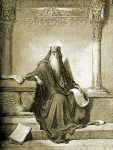
Before Jesus was born, the Persian Magi foretold via the stars, that he was coming ‘The Son of David’ who would have the wisdom of Solomon, who may have been King Cyrus. Jesus was ‘The Good Shepherd’ who appear in Ecclesiastes, along with the Son of David – Son of God!
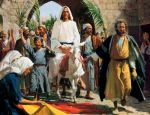
When Jesus enters Jerusalem on a donkey, the people recognize him as ‘The Son of David’ who was an unidentied king – who did not teach a tale of an afterlife, but taught;
“All is vanity!”
Meher Baba descends from the Persian Magi. He made it his mission to contact the Mast, the homeless mystics, whom he personally bathed. Consider Newt Gingrich appealing to the Lucky & Wealthy Evangelical heresy.
“Every dog has his day.”
Evangelical Vanity has brought our nation to the brink of ruin. It has corrupted our political system, and declared war on the poor.
On this day I found the AMERICAN TENTMAKERS OF AMERICA. This is both a Secular and Religious organization based upon the Jublilee and the lost cosmology of the Nazarites that made a home within for the Holy Spirit. the ATA will model itself after the Chautauqua Tents that my grandfather mention in his story ‘Camping On Anacapa’. Royal Rosamond took Lillian to visit the Dunites of Oxnard.
“It was a glorious summer morning at the Chautauqua at Ventura-by-the-sea.”
I offer a religious umbrella to the Occupy Tents. I founded a Nazarite Church in 1997. I am the Minister of that church.
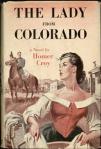
I see large ATA Tents in all major cities wherein the homeless work making white hand-stitched canvas tents for sale. There will be traveling ATA Tents wherein folks perform music, read poetry, and hold seminars on how to live a humble non-materialistic Arcadian Life, as promoted by Royal’s freinds, Homer Croy and Otto Rayburn.
Royal met with Croy about publishing his novel ‘Bound In This Clay’. Croy wrote ‘They Had To See Paris’ starring the humorist Will Rogers who championed the Poor, and demonized the Bankers during the Great Depression.
Let us raise our Tents in the Wilderness – and take back America from the false prophets. Let there be a New Dawn, and a revived pertinence in America!
Jon Presco
Whence comest thou, maiden?” said Connla.
“I come from the Plains of the Ever Living,” she said, “there where there is neither death nor sin. There we keep holiday alway, nor need we help from any in our joy. And in all our pleasure we have no strife. And because we have our homes in the round green hills, men call us the Hill Folk.”
On the journey he was interviewed on behalf of the Associated Press, which quoted him describing his trip as a “new crusade . . . to break down all religious barriers and destroy America’s materialism and amalgamate all creeds into a common element of love”.[46] His intention, according to the resulting article, was to convert thousands of Americans from sin. Describing Baba as “The Messiah,” the article also claims he listed miracles he had performed, and said that a person who becomes one with the truth can accomplish anything, but that it is a weakness to perform miracles only to show spiritual power. However, another description of the interview states that when Baba was asked about the miracles attributed to him, he replied “The only miracle for the Perfect Man to perform is to make others perfect too. I want to make the Americans realize the infinite state which I myself enjoy.”[47]
Hollywood and the “Dunites,” 1934
Meher Baba returned to Hollywood in 1934, avoiding publicity and instead working with a number of screenwriters and filmmakers on proposed film projects. During the earlier 1932 visit he had met a spiritual seeker named Sam Cohen, a Theosophist and resident of a loosely knit freethinkers’ community named “Moy Mell” nestled among the dunes on the beach at Oceano, California. The benefactor of this group of intellectuals, spiritual seekers, artists and social misfits was Chester Alan Arthur III, grandson of the 21st President, who went by the name of Gavin. For a time Gavin published a magazine called the Dune Forum, which included articles by such notables as Stuart Edward White (author of the spiritualist classic, The Unobstructed Universe), and photographic contributions by Ansel Adams and Edward Weston (whose dune photographs are well-known).
Gavin would frequently entertain the intellectual and artistic elite of America at his cabin in the dunes. Although accounts differ somewhat, it appears that Baba sent disciple Meredith Starr and his wife to Moy Mell in 1932, and that they stayed on for a period of time (this was approximately a year and a half before Meredith’s defection). When Baba returned to Hollywood in 1934, he agreed to visit the “Dunite” community. On the evening of Christmas day (accounts different as to the exact days), Baba arrived with eighteen of his followers, including Norina Matchabelli, wife of Georges Matchabelli, known for the popular perfume brand. Norina had previously arranged for a special cabin to be built for Baba, but he chose instead to stay in Gavin’s cabin. Gavin was not in Moy Mell at the time, and it was decided that he wouldn’t mind.
There was also a Theosophical center called the Temple of the People in nearby Halcyon, founded in 1904 with the intent of preparing for the arrival of the next incarnation of the Avatar, but there is no record of Baba visiting it.(21)
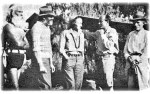
L-R: Sam Cohen, Meher Baba, Hugo Sellig, John Doggett
Baba and his group stayed overnight and spent the following day visiting with Sam Cohen and other Dunites, many of whom were eccentric characters and spiritual seekers who gave little importance to social convention. Hugo Seelig was a seeker of truth from an early age, who, after his father’s suicide, roamed the coast of California meeting other seekers and visiting places where they could be found. At Stanford University, he met a resident of Halcyon who told him about Oceano and the little dune colony there. When WWI broke out and America entered the war, Hugo went to live in the dunes and became part of the community, pursuing his writing.
‘Tis a glorious place, forsooth, that Connla holds among shortlived mortals awaiting the day of death. But now the folk of life, the ever-living ones, beg and bid thee come to Moy Mell, the Plain of Pleasure, for they have learnt to know thee, seeing thee in thy home among thy dear ones.
http://classiclit.about.com/library/bl-etexts/fairytale/bl-connla.htm
Even though there was no specification of Persian origin for the Magi of the Gospel, in the early centuries of Christian story and art they were assumed to be Persian. In paintings and mosaics they were dressed in Persian garb; one example is in the 6th century Basilica of San Vitale in Ravenna. Another example, cited by German writer Manfred Barthel, is the Church of the Nativity in Jerusalem, which was spared from destruction by Persian invaders in A.D. 614 because the church had a fresco of the Three Kings dressed in Persian dress. A sixth-century Syrian source, cited by Zoroastrian scholar Dariush Jahanian, names the Three Kings as “Hormizdah king of Persia, Yazdegerd King of Saba, and Perozadh King of Sheba,” but those names are all Persian, not Sabaean or Arab.
Prosperity theology has often been criticized by theologians, pastors, economists, and politicians. Evangelical theologians argue that the doctrine of prosperity is non-scriptural, or blatantly heretical. Secular commentators have alleged that leaders of the movement take advantage of their followers and promote unwise choices. After the financial crisis of 2007–2010, some economists speculated that the movement helped lead to the crisis. Advocates of the doctrine, however, argue that they are correctly interpreting scripture and allowing their congregations to obtain financial stability. They frequently draw attention to the movement’s diversity and its emphasis on minority empowerment.
The late-2000s financial crisis (often called the global recession, global financial crisis or the credit crunch) is considered by many economists to be the worst financial crisis since the Great Depression of the 1930s.[1] It resulted in the collapse of large financial institutions, the bailout of banks by national governments, and downturns in stock markets around the world.
In many areas, the housing market had also suffered, resulting in numerous evictions, foreclosures and prolonged unemployment. It contributed to the failure of key businesses, declines in consumer wealth estimated in the trillions of U.S. dollars, and a significant decline in economic activity, leading to a severe global economic recession in 2008.[2]
http://en.wikipedia.org/wiki/Prosperity_theology
Chautauqua ( /ʃəˈtɔːkwə/ shə-TAW-kwə) was an adult education movement in the United States, highly popular in the late 19th and early 20th centuries. Chautauqua assemblies expanded and spread throughout rural America until the mid-1920s. The Chautauqua brought entertainment and culture for the whole community, with speakers, teachers, musicians, entertainers, preachers and specialists of the day.
Circuit Chautauquas
“Circuit Chautauquas” (or colloquially, Tent Chautauquas) were an itinerant manifestation of the Chautauqua movement. The program would be presented in tents pitched “on a well-drained field near town.” After several days, the Chautauqua would fold its tents and move on. The method of organizing a series of touring Chautauquas is attributed to Keith Vawter, a Redpath Lyceum Bureau manager.[4] Among early Redpath comedians was Boob Brasfield.
Circuit Chautauqua began in 1904. In Vawter’s schema, each performer, or group, appeared on a particular day of the program. Thus “first day” talent would move on to other Chautauquas, followed by the “second day” performers, and so on, throughout the touring season. By the mid-1920s, when circuit Chautauquas were at their peak, they appeared in over 10,000 communities to audiences of more than 45 million; by about 1940 they had run their course.
Christian instruction, preaching and worship were a strong part of the Chautauqua experience. Although the Chautauqua movement was founded by Methodists, nondenominationalism was a Chautauqua principle from the beginning, and prominent Catholics like Catherine Doherty took part. In 1892, Lutheran Church theologian Theodore Emanuel Schmauk was one of the organizers of the Pennsylvania Chautauqua.
Early religious expression in Chautauqua was usually of a general nature, comparable to the later Moral Re-Armament movement. Later on, in the first half of the 20th century, Fundamentalism was the content of an increasing number of Chautauqua sermons and lectures.
However, the great number of Chautauquas, as well as the absence of any central authority over them, meant that religious patterns varied greatly among the different Chautauquas. Some were so religiously oriented that they were essentially church camps, while more secular Chautauquas resembled summer school and competed with vaudeville in theaters and circus tent shows with their animal acts and trapeze acrobats. People involved in the Chautauqua movement believed that both secular and spiritual knowledge both radiate from God and are both equally important.
Twilight at the Heights
By Joaquin Miller
THE BRAVE young city by the Balboa seas
Lies compassed about by the hosts of night—
Lies humming, low, like a hive of bees;
And the day lies dead. And its spirit’s flight
Is far to the west; while the golden bars 5
That bound it are broken to a dust of stars.
Come under my oaks, oh, drowsy dusk!
The wolf and the dog; dear incense hour
When Mother Earth hath a smell of musk,
And things of the spirit assert their power— 10
When candles are set to burn in the west—
Set head and foot to the day at rest.
Tentmaking, in general, refers to the activities of any Christian who, while functioning as a minister, receives little or no pay for his or her church work, and supports him or herself by additional, unrelated work. Specifically, tentmaking can also refer to a method of international Christian evangelism in which missionaries support themselves by working full time in the marketplace with their skills and education, instead of receiving financial support from a church. The term comes from the fact that the apostle Paul supported himself by making tents while living and preaching in Corinth (Acts 18:3).
More recently, William Carey (1761-1831), considered to be the father of modern evangelical Christian missions, was a tentmaker in India, working as a factory owner and university professor while fulfilling his mission duties. At the time, international mission work was a new and controversial idea in the church, and tentmaking was the only way for Carey to support his ministry. His example has led thousands of Christian missionaries to support themselves while ministering overseas.
Currently more and more laypersons and ministry professionals are spending time online via their blogs and using them to earn an income, both passive and active, through direct advertising sales, affiliate marketing, or promoting other products and services related to their work outside of ministry proper.
The adjective pastoral refers to the lifestyle of pastoralists, such as shepherds herding livestock around open areas of land according to seasons and the changing availability of water and pasturage. It also refers to a genre in literature, art or music that depicts such shepherd life in an idealized manner, for urban audiences. As a noun, a pastoral refers to a single work of such art, poetry, music or drama.
Sukkot (Hebrew: סוכות or סֻכּוֹת, sukkōt, or sukkos, Feast of Booths, Feast of Tabernacles) is a Biblical holiday celebrated on the 15th day of the month of Tishrei (late September to late October). It is one of the three biblically mandated festivals Shalosh regalim on which Hebrews were commanded to make a pilgrimage to the Temple in Jerusalem.
The holiday lasts seven days (eight in the diaspora). The first day is a sabbath-like yom tov when work is forbidden, followed by the intermediate Chol Hamoed and Shemini Atzeret. The Hebrew word sukkōt is the plural of sukkah, “booth or tabernacle”, which is a walled structure covered with skhakh (plant material such as leafy tree overgrowth or palm leaves). The sukkah is intended as a reminiscence of the type of fragile dwellings in which the Israelites dwelt during their 40 years of travel in the desert after the Exodus from slavery in Egypt. Throughout the holiday meals are eaten inside the sukkah and many sleep there as well. On each day of the holiday, members of the household recite a blessing over the lulav and etrog (Four species).[1]
According to Zechariah, in the messianic era Sukkot will become a universal festival and all nations will make pilgrimages annually to Jerusalem to celebrate the feast there.[2]
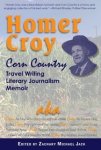
Homer Croy (March 11, 1883 – May 24, 1965), was an American author and occasional screenwriter who wrote a number of fiction and non-fiction books about life in the Midwestern United States. He also wrote several popular biographies, including books on humorist Will Rogers and film director D.W. Griffith.
Croy was born on a farm northwest of Maryville, Missouri, and published his first book, When to Lock the Stable, in 1914. His first successful book was West of the Water Tower published in 1923. It dealt with hypocrisy in a small town, “Junction City,” which was a thinly disguised version of Maryville; a sequel, R.F.D. #3, appeared the following year.
Croy’s most famous work was the novel They Had to See Paris (1926), about a rural couple from Missouri on a European trip. The book was filmed in 1929 as the first talking picture to star Will Rogers.
Croy had a long but intermittent association with the motion picture industry. Many of his novels and stories were adapted for the screen, and he also directed a series of short travelogue films in 1914-1915; he received screenwriting credits on a handful of feature films in the 1930s. In addition to his biography of D.W. Griffith, he also wrote about the film industry in his 1918 book How Motion Pictures Are Made and a 1932 novel Headed for Hollywood.
This is not the first time a return from captivity is connected to rejoicing on Sukkot. When King Cyrus of Persia defeats the Babylonians in 539 BCE, he permits the Jews to return from their exile to Jerusalem. Ezra the Scribe teaches the leaders of the returned community the laws and rituals forgotten in two generations of exile. “The whole community that returned from captivity made booths and dwelt in the booths…and there was great rejoicing” (Nechemia 8:17).
In Leviticus, God told Moses to command the people: “On the first day you shall take the product of hadar trees, branches of palm trees, boughs of leafy trees, and willows of the brook” (Lev. 23:40), and “You shall live in booths seven days; all citizens in Israel shall live in booths, in order that future generations may know that I made the Israelite people live in booths when I brought them out of the land of Egypt” (Lev. 23:42-43).
The sukkah walls can be constructed of any material (wood, canvas, aluminum siding, sheets). The walls can be free-standing or include the sides of a building or porch. The roof must be of organic material, known as skhakh, such as leafy tree overgrowth or palm fronds. It is customary to decorate the interior of the sukkah with hanging decorations, the Seven Species.
During the holiday, some Jews recite the ushpizin prayer which symbolises the welcoming of seven “exalted guests” into the sukkah. These ushpizin (Aramaic אושפיזין ‘guests’), represent the seven shepherds of Israel: Abraham, Isaac, Jacob, Moses, Aaron, Joseph and David. According to tradition, each night a different guest enters the sukkah followed by the other six. Each of the ushpizin has a unique lesson which teaches the parallels of the spiritual focus of the day on which they visit. A new tradition has arisen among some Jews to invite seven female counterparts to the above shepherds. A number of different lists exist which may include any of the following: Sarah, Rebecca, Rachel, Leah, Miriam, Deborah, Esther, Ruth, and Tamar among others.
Hakhel
Main article: Hakhel
In the days of the Temple in Jerusalem, all Jewish men, women, and children on pilgrimage to Jerusalem for the festival would gather in the Temple courtyard on the first day of Chol HaMoed Sukkot to hear the Jewish king read selections from the Torah. This ceremony, which was mandated in Deuteronomy 31:10-13, was held every seven years, in the year following the Shmita (Sabbatical) year. This ceremony was discontinued after the destruction of the Temple, but it has been revived in Israel on a smaller scale.[9]
[edit] Simchat Beit HaShoevah
During the Intermediate days of Sukkot, gatherings of music and dance, known as Simchat Beit HaShoeivah, take place. This commemorates the Water Libation Ceremony in which water was carried up the Jerusalem pilgrim road from the Pool of Siloam to the Temple in Jerusalem.
[edit] Hoshana Rabbah
The seventh day of Sukkot is known as Hoshana Rabbah, meaning the “Great Supplication”. This day is marked by a special service in which seven circuits are made by worshippers holding their Four species, reciting Psalm 118:25 with additional prayers. In addition, a bundle of five willow branches are beaten on the ground.
The main speaker in the book, identified by the name or title Qoheleth (usually translated as “teacher” or “preacher”), introduces himself as “son of David, king in Jerusalem.” The work consists of personal or autobiographic matter, at times expressed in aphorisms and maxims illuminated in terse paragraphs with reflections on the meaning of life and the best way of life. The work emphatically proclaims all the actions of man to be inherently “vain”, “futile”, “empty”, “meaningless”, “temporary”, “transitory”, “fleeting,” or “mere breath,” depending on translation, as the lives of both wise and foolish men end in death. While Qoheleth clearly endorses wisdom as a means for a well-lived earthly life, he is unable to ascribe eternal meaning to it. In light of this perceived senselessness, he suggests that one should enjoy the simple pleasures of daily life, such as eating, drinking, and taking enjoyment in one’s work, which are gifts from the hand of God.
According to the Talmud, however, the point of Qoheleth is to state that all is futile under the Sun. One should therefore put all one’s efforts towards that which is above the Sun. This is summed up in the second to last verse: “The end of the matter; all has been heard. Fear God, and keep His commandments; for that is the whole duty of everyone” (12:13).
The book is particularly notable for its iconic phrases, “the sun also rises,” “[there’s] nothing new under the sun” (‘nihil novi sub sole’ in the Latin Vulgate) and “he who increaseth knowledge, increaseth sorrow.”
http://en.wikipedia.org/wiki/Ecclesiastes
The Magi may have even been the first missionaries. It is possible that Jesus’ Great Commission at the end of Matthew is based on the missionaries Zarathustra sent out as there is little history of missionaries in Judaism or any ancient ethnic/tribal faith. Only Zarathustra’s Magi were sent to all nations to teach a better way of living. There had never been anything like the Magi in the ancient world.
R’ Nachman Krochmal suggests that the term “son of David” should be interpreted to mean “descendant of David”. He posits that it was written by a powerful lord during the Persian Era (possibly during the missing years of Jewish history). The term “king” would not be difficult; since the Persian Monarch was known as the King of Kings, a lesser lord may have called himself a king.[8]
The New Bible Dictionary writes the following:
Although the writer says that he was king over Israel (1:12), and speaks as though he were Solomon, he nowhere says that he is Solomon. The style of the Heb. is later than Solomon’s time. If Solomon was the author, the book underwent a later modernization of language. Otherwise a later writer may have taken up a comment on life that had been made by Solomon, ‘Vanity of vanities, all is vanity,’ and used this as a text to show why even a wise and wealthy king should say such a thing. We cannot tell at what date the book received its present form, since there are no clear historical allusions in it. About 200 [BCE] is commonly suggested.[9]
The Hebrew of Ecclesiastes was not common in the era of Solomon’s reign, and the book contains words borrowed from other languages. For example, the book contains several Aramaic and two Persian words.
Michael Coogan supports the statement that authorship was most probably later than the 5th century because it uses Persian “loan words” in the text. “Aramaisms” exist that indicate a period when Aramaic was the official language during the Persian empire.
The book of Ecclesiastes uses the expression ha-Elohim, “The God”, 32 times, although the Jewish Encyclopedia says that; “The Israelitish name for God is nowhere employed, nor does there appear to be any reference to Judaic matters; hence there seems to be a possibility that the book is an adaptation of a work in some other language”.[20]
A great portion of the book concerns itself with death. Qoheleth emphatically affirms human mortality, going so far as to say that the dead in sheol know nothing. He mentions no resurrection, which, some may argue, is to be expected seeing that it predates this theology. (This view has been disputed, as Solomon’s father, David, expressed a belief in the afterlife upon the death of Solomon’s older brother, claiming with certainty that he would see his deceased son again. However, belief in an afterlife, a continued existence in a shadowy realm like Sheol or Hades must not be confused with the belief in a resurrection from the dead of later Christian theology.[26]) In fact, it is the lack of consequences after death that lead Qoheleth to advocate enjoying life while you can.
The author of Ecclesiastes appears agnostic on the concept of an afterlife. Indeed, he writes “All go to one place; all are from the dust, and all turn to dust again. Who knows whether the human spirit goes upward and the spirit of animals goes downward to the earth?” (Ecclesiastes 3:20-21).
Wisdom of Solomon: “For the ungodly said, reasoning with themselves, but not aright, Our life is short and tedious, and in the death of a man there is no remedy: neither was there any man known to have returned from the grave” (Wisdom of Solomon 2:1)
Ecclesiastes: “And I gave my heart to seek and search out by wisdom concerning all things that are done under heaven: this sore travail hath God given to the sons of man to be exercised therewith” (Ecclesiastes 1:13). “All this have I proved by wisdom: I said, I will be wise; but it was far from me. That which is far off, and exceeding deep, who can find it out?” (Ecclesiastes 7:23).
Ben Sira: “Seek not out the things that are too hard for thee, neither search the things that are above thy strength. But what is commanded thee, think upon with reverence; for it is not needful for thee to see with thine eyes the things that are in secret. Be not curious in unnecessary matters: for more things are shewed unto thee than men understand” (Sirach 3:21).
Ezra 3:4-6
King James Version (KJV)
4They kept also the feast of tabernacles, as it is written, and offered the daily burnt offerings by number, according to the custom, as the duty of every day required;
5And afterward offered the continual burnt offering, both of the new moons, and of all the set feasts of the LORD that were consecrated, and of every one that willingly offered a freewill offering unto the LORD.
6From the first day of the seventh month began they to offer burnt offerings unto the LORD. But the foundation of the temple of the LORD was not yet laid.
The closing frame of Ecclesiastes again presents the Preacher, the messianic figure (12:9). The major messianic reference here is the “one shepherd” of verse 11. Most have interpreted the shepherd as God.[30] This lends credence to the entire book, which is the aim of the epilogue. The authority of God and his Messiah are borrowed for the book of Ecclesiastes. The shepherd is also identified with the Messiah by Perrin.[31] He shows that in the Hellenistic time of Ecclesiastes the “one shepherd” was a common messianic trope which is based on the Book of Ezekiel. In chapters 34 and 37, Ezekiel describes the Davidic Messiah as the “one shepherd”: this wording is the same used in Eccles 12:11, and it is unique to these three passages.
Pervasive throughout the Eastern Mediterranean and Western Asia until late antiquity and beyond, Greek mágos, “Magian” or “magician,” was influenced by (and eventually displaced) Greek goēs(γόης), the older word for a practitioner of magic, to include astrology, alchemy and other forms of esoteric knowledge. This association was in turn the product of the Hellenistic fascination for (Pseudo-)Zoroaster, who was perceived by the Greeks to be the “Chaldean” “founder” of the Magi and “inventor” of both astrology and magic. Among the skeptical thinkers of the period, the term ‘magian’ acquired a negative connotation and was associated with tricksters and conjurers. This pejorative meaning survives in the words “magic” and “magician”.

 Rosamond Press
Leave a comment