






I was deflowered by a beautiful woman, and found myself in a vast field of flowers! I was utterly on my own – I thought!
Anyone can be a Saint – even when one has become a great Sinner! This is the lesson given in the story of Jesus and Mary Magdalene, who may have not been a harlot – only compared to one.
Beautiful Fair Rosamond was called a harlot by a bishop who ordered her bones be evicted from the Godstow nunnery. Rosamond had become a nun.
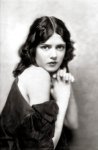
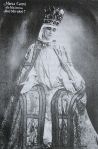
The actress, Rosamond Pinchot, played a nun in the movie ‘The Miracle’ that starred Maria Carmi (Princess Norina Matchabelli) who was a great follower of Avatar Meher Baba. She played a nun and the Virgin Mother. Consider Our Sweet Lady and the Swan Knights.
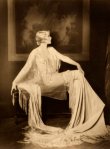
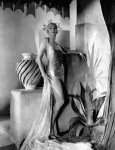
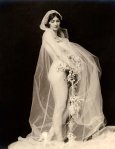
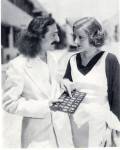
Rena Christiansen came to California to be worshipped as a Beautiful Goddess. Where else was she to go – India? She found her devotee. All is well in the world, and in the scheme of things the Adjusters are want to do! Meher Baba knew he was co-mingling with Sexy Hollywood Goddesses – the Divine Receptive!
Yesterday, CNN did a story titled “Elizabeth Taylor’s Life Up For Sale.”
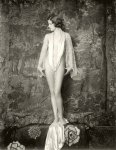
I am going to use Rena as my portrait of Rosamond Clifford.
Here is a fantastic site of Rosamond-like women.
Jon Presco
Capturing Beauty Copyright 2011
Rosamund Clifford: the “Fair Rosamund”
The abbey became the final burial place of the famed beauty Rosamund Clifford (died circa 1176), a long-term mistress of Henry II. Henry’s liaison with Rosamund became public knowledge in 1174; it ended when she retired to the nunnery at Godstow in 1176, shortly before her death.
Henry and the Clifford family paid for her tomb at Godstow in the choir of the convent’s church and an endowment for it to be tended by the nuns. It became a popular local shrine until 1191, two years after Henry’s death. Hugh of Lincoln, Bishop of Lincoln, while visiting Godstow, noticed Rosamund’s tomb right in front of the high altar. The tomb was laden with flowers and candles, demonstrating that the local people were still praying there. Calling Rosamund a harlot, the bishop ordered her remains removed from the church. This was part of the long-term campaign by the Roman Catholic Church to eradicate earlier Norse and Anglo-Saxon traditions of marriage amongst the nobility. Her tomb was moved outside of the abbey church itself to the cemetery at the nuns’ chapter house next to it, where it could still be visited until it was destroyed in the Dissolution of the Monasteries under Henry VIII.
The Miracle (German: Das Mirakel) was a 1911 play written by Karl Vollmöller and directed by Max Reinhardt, from which three movie versions were later adapted. The play first appeared as a spectacle-pantomime in Germany in 1911.
The play opened in London in 1912 and was revived on Broadway in 1924 after a tour of Detroit, Milwaukee and Dallas. The New York version, which opened January 16, 1924 at the Century Theatre was produced by Morris Gest, and starred Rosamond Pinchot as the Nun and Lady Diana Cooper and Maria Carmi alternating nightly in the role of the Madonna.[1] Max Reinhardt also directed the first film version which used an early sound-on-disc process to provide a limited soundtrack for the film. [2][3]
The Miracle re-told an old legend about a nun in the Middle Ages who runs away from her convent with a knight, and subsequently has several mystical adventures, eventually leading to her being accused of witchcraft. During her absence, the statue of the Virgin Mary in the convent’s chapel comes to life and takes the nun’s place in the convent, until her safe return. The play launched the career of Maria Carmi who went on to star in 25 silent films.
The play has its origins in a twelfth-century legend which Spanish writer José Zorrilla y Moral turned into a dramatic poem entitled Margarita La Tornera (Margarita the Gatekeeper). The poem differs from The Miracle in resetting the story in nineteenth-century Spain, as the 1959 film would do, and in not letting the reader know that the statue has taken the nun’s place in the convent until nearly the very end. Zorrilla’s poem was made into an opera by Spanish zarzuela composer Ruperto Chapí It was his last work before his death. The poem was also loosely adapted into a Spanish film, Milagro de amor, in 1946. [4]
Pinchot was born in New York City, the daughter of Amos Pinchot, a wealthy lawyer and a key figure in the Progressive Party and the niece of Pennsylvania Governor Gifford Pinchot. Mary Pinchot Meyer was her half sister, and her cousin was Edie Sedgwick.[1]
At the age of nineteen, Pinchot was discovered by Max Reinhardt while traveling on an ocean liner with her mother. Reinhardt cast her as a nun who runs away from a convent in the Broadway production of Karl Vollmoller’s The Miracle.[2] Pinchot’s appearance in the play caused a sensation and led to her receiving considerable attention from the press.[3] He later cast her in productions of William Shakespeare’s A Midsummer Night’s Dream and Franz Werfel’s The Eternal Road. She made her only film appearance in the 1935 adaptation of The Three Musketeers, as Queen Anne.
The Loveliest Woman in America, by Bibi Gaston, is the story of the beautiful Rosamond Pinchot. In her copious diaries- where Bibi Gaston’s draws from the intimate details of her grandmother- Rosamond writes about being a part of the upper crust of Manhattan, referring to it as the “on tops.” Gaston explains,” The Loveliest Woman in America is about our mothers, about our grandmothers, about tragedy and glamour and life and death. About letting go, about the men we love, about beauty, about diets, about buttermilk and lettuce! About making every moment count and living life to the fullest. Yes, all those thing. But mostly it is about me and you and how we make the most of our brief but beautiful lives.”
Princess Norina Matchabelli (3 March 1880 – 15 June 1957), born Norina Gilli in Florence, Italy, was co-founder of the perfume company Prince Matchabelli, a stage and screen actress, mime, mystic, publisher, and a devoted mandali of Indian spiritual teacher Meher Baba. Her stage name was Maria Carmi.
Most notably she played the Madonna in the original spectacle-pantomime play The Miracle written by Karl Vollmöller whom she married in 1904. Prince Georges V. Matchabelli or Giorgi Machabeli (Georgian: გიორგი მაჩაბელი) (July 23, 1885 – March 31, 1935) was a Georgian prince and diplomat, who fled Soviet Georgia and immigrated to the United States after the 1921 Bolshevik takeover of Georgia.
Matchabelli was a member of the noble family of Machabeli from Georgia, then part of Imperial Russia. He was one of the founding members of the Georgian Liberation Committee organized in Berlin in 1914. The Committee intended to garner the German support for Georgia’s struggle for independence from the Russian Empire.
In 1916 Matchabelli married Norina Gilli (born in Florence, Italy) who had become famous for her portrayal of “The Madonna” in Max Reinhardt’s unique 1911 pantomime spectacle play “The Miracle.” He briefly served as the ambassador of the Democratic Republic of Georgia to Italy. With the establishment of Soviet rule in Georgia in 1921, Matchabelli fled his homeland and immigrated with his wife Norina to the United States. The prince was an amateur chemist and in 1924 he and his wife, now known as Princess Norina Matchabelli, established the Prince Matchabelli Perfume Company. Norina designed the crown shaped perfume vial in the likeness of the Matchabelli crown and in 1926 the scent “Ave Maria” was named for her. The company became known for color-coded, crown-shaped bottles that housed such classics as Wind Song, Ave Maria, and Princess Norina. The Matchabellis divorced in 1933. [1]

 Rosamond Press
Leave a comment