Write your Senator and Congressman and demand investigation.
John Presco
Russian envoy Kirill Dmitriev: Putin propagandist or key to peace with Ukraine?
3 days agoShareSave
Paul Kirby,Europe digital editor and
BBC Monitoring
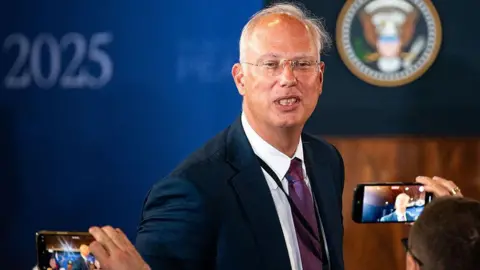
Kirill Dmitriev is a rare breed of Russian diplomat.
At 50 he is relatively young and he has a deep understanding of the US, having studied and worked there for several years.
He is also a man of commerce, as head of the Russian Direct Investment Fund, and a good fit for his opposite number in the Trump administration, special envoy Steve Witkoff.
Dmitriev now finds himself under the spotlight over a draft peace plan that emerged after he spent three days with Witkoff in Miami.
His team has refused to comment on its proposals, which read like a Putin wishlist, requiring Ukraine to cede territory under its control and slash the size of its military.
Ukraine’s Volodymyr Zelensky has been careful not to reject its terms, but says any deal must bring a “dignified peace, with terms that respect our independence, our sovereignty”.
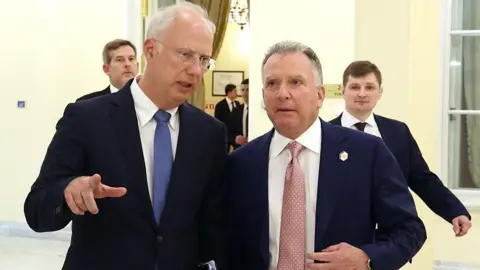
Putin’s special envoy understands modern Ukraine better than most in Moscow. He was brought up in Ukraine, and a friend claims that as a 15-year-old Dmitriev took part in pro-democracy protests in Kyiv before the fall of the Soviet Union.
He has been a fixture of US-Russian diplomatic initiatives pretty much since the start of Trump’s second presidency – and Steve Witkoff has been a regular counterpart.
“We are sure we are on the road to peace, and as peacemakers we need to make it happen,” Dmitriev told a conference in Saudi Arabia in late October.
The pair appear to have first crossed paths in February 2025 when Putin’s envoy played a role in securing the release of an American teacher from a Russian jail.
“There’s a gentleman from Russia, his name is Kirill, and he had a lot to do with this. He was important. He was an important interlocutor bridging the two sides,” Witkoff told reporters.
Days later, when US and Russian diplomats met in Saudi Arabia, in effect bringing an end to Russia’s diplomatic isolation in the West, Dmitriev took part in talks on economic relations and Witkoff was there too.
Zelensky to speak with Trump after US proposes Russia-Ukraine peace plan
Who was at the table at US-Russia talks in Saudi Arabia?
Dmitriev’s direct approach to Trump officials has not always paid off.
When Trump announced sanctions on Russia’s top two oil firms last month, US Treasury Secretary Scott Bessent labelled him a “Russian propagandist” for suggesting it would mean higher US fuel prices at the pump.
Unlike the majority of Putin’s entourage, the Russian leader’s envoy is comfortable in a US TV studio. He is careful to praise Trump’s diplomatic skills while giving Western viewers the Russian government narrative in their own language.
“I’m not a military guy… but the position of [the] Russian military is they only hit military targets,” he told CNN’s Jake Tapper recently, days after a kindergarten was bombed in the Ukrainian city of Kharkiv. “I’m just working to have dialogue and make sure that the conflict is ended as soon as possible.”
Dmitriev certainly is not a military guy, he’s a private investment specialist with an eye for a deal.
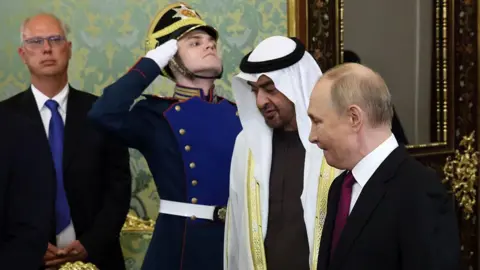
Witkoff may rate him, but in 2022 during Joe Biden’s presidency, the US Treasury called him a “known Putin ally” and imposed sanctions on the Russian Direct Investment Fund (RDIF) which he has run since 2011.
“While officially a sovereign wealth fund, RDIF is widely considered a slush fund for President Vladimir Putin and is emblematic of Russia’s broader kleptocracy,” it said.
Dmitriev’s attitude to the Biden years is pretty clear: under Biden there was no attempt to understand the Russian position, he argues, while Trump’s team stopped World War Three.
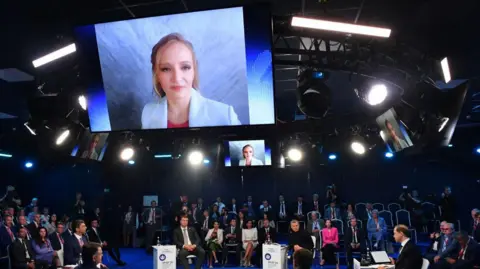
It is claimed that Dmitriev has accumulated a real estate fortune with his wife, TV presenter Natalia Popova.
Popova is a friend and colleague of Vladimir Putin’s daughter, Katerina Tikhonova – and deputy head of Tikhonova’s tech firm Innopraktika. Dmitriev is also widely seen as part of Tikhonova’s circle.
His rise to the top in Moscow is a far cry from his childhood in Kyiv, as the son of two scientists. Dmitriev’s father is a well known cell biologist in Ukraine and his mother a geneticist.
That scientific background may have influenced his move to use his Russian sovereign wealth fund to finance Russia’s Covid vaccine Sputnik V.
Dmitriev is believed to have first met Russia’s long-time leader at the start of his presidency in 2000, but he has not always agreed with his views.
While Putin saw the collapse of the Soviet Union as the “biggest geopolitical catastrophe of the century”, a friend claims Dmitriev joined an anti-Soviet student protest in Kyiv at the age of 15.
His relationship with the US began the same year, in 1990, when he took part in a student exchange programme in New Hampshire, where a local newspaper quoted him highlighting Ukraine’s national identity: “Ukraine had a long history as an independent nation before it became part of the Russian empire.”
What’s the significance of US sanctions on Russian oil?
He later returned to the US as a college student and wrote a thesis on privatisation in Ukraine while at Stanford University. In his thesis proposal he suggested the research would “prepare me better for making a contribution to the reform process in Ukraine”.
After earning an MBA at Harvard, he worked for McKinsey in Los Angeles, Prague and Moscow, and then joined the US-Russia Investment Fund, set up by the US to ease Russia’s transition to a market economy.
Dmitriev appeared critical of Putin’s crackdown on Russia’s oligarchs in 2003 in a column for the Vedomosti business paper. “The world is shrewd enough to know the difference between following the letter of the law and using the law as a tool of influence,” he wrote.
By 2007 he was back in Ukraine, in charge of Icon Private Equity, an investment fund with offices in Kyiv and Moscow.
Increasingly he lamented Ukraine’s political “instability” and suggested Russia was better placed to respond to the global financial crisis.
He was a regular guest on TV talk shows and in 2010 he warned Ukraine would face an “economic Holodomor” if it pursued a policy of isolation from Russia: a reference to the Ukrainian famine of the1930s brought on by the policies of Soviet dictator Joseph Stalin.
In 2011 he moved back to Russia to take charge of the newly-launched Russian Direct Investment Fund and remains there to this day.
The CIA declined to comment about concerns within the intelligence community about Dmitriev.
During the first Trump administration, Dmitriev established contacts with the president’s team to reset relations between Washington and Moscow.
In a 2017 meeting with Erik Prince, the former CEO of Blackwater and a Trump ally, Dmitriev discussed U.S.-Russia relations, according to a Department of Justice report published by Special Counsel Robert Mueller in 2019. Mueller’s team was investigating ties between the Trump team and Russia.
The meeting, which took place in the Seychelles, was one of the initial points of contact between Russia and the U.S. after Trump took office.
Prince did not immediately respond to a request for comment.
Trump officials’ meeting with Russian in Miami spurs questions about Ukraine proposal
By Erin Banco and Gram Slattery
November 22, 20258:44 PM PSTUpdated 19 hours ago
- Summary
- Companies
- Meeting with sanctioned Russian resulted in 28-point plan, sources say
- Witkoff, Kushner were at the meeting, sources say
- Plan has stirred confusion in Washington, Europe
WASHINGTON, Nov 22 (Reuters) – U.S. officials and lawmakers are increasingly concerned about a meeting last month in which representatives of the Trump administration met with Kirill Dmitriev, a Russian envoy who is under U.S. sanctions, to draft a plan to end the war in Ukraine, according to multiple sources familiar with the matter.
The meeting took place in Miami at the end of October and included special envoy Steve Witkoff, President Donald Trump’s son-in-law Jared Kushner and Dmitriev, who leads the Russian Direct Investment Fund, one of Russia’s largest sovereign wealth funds.
The Reuters Daily Briefing newsletter provides all the news you need to start your day. Sign up here.
Advertisement · Scroll to continue
A close ally of Russian President Vladimir Putin, Dmitriev has taken a leading role in talks with the U.S. about the war and has met with Witkoff several times this year. The Trump administration issued a special waiver to allow his entry, a senior U.S. official told Reuters.
MEETING RESULTED IN CONTROVERSIAL UKRAINE PEACE PLAN
Dmitriev and his fund were blacklisted by the U.S. government in 2022 following Russia’s full-scale invasion of Ukraine. The sanctions effectively bar American citizens and companies from dealing with them.
The meeting resulted in a 28-point plan for ending the war, two people familiar with the situation said. The plan, which was made public this week by Axios, came as a surprise to U.S. officials in various corners of the administration and has stirred confusion at embassies throughout Washington and in European capitals.
Advertisement · Scroll to continue
It has also prompted criticism from the Ukrainians and their allies for appearing heavily tilted toward Russian interests, with Ukrainian President Volodymyr Zelenskiy vowing on Friday that he would not betray Ukraine’s interests.
The document, which calls for major concessions from Ukraine, appears to run counter to the tougher stance the Trump administration has lately taken toward Moscow, including with sanctions on its energy sector.
It is unclear whether Dmitriev came to the meeting in Miami with certain Russian demands and whether those were incorporated into the peace plan.
Two people familiar with the meeting said Rustem Umerov, secretary of Ukraine’s National Security and Defense Council, was also in Miami early this week to discuss the plan with Witkoff.
One source familiar with the situation said Witkoff told Umerov about the plan during that visit and that the United States gave the plan to Ukraine via the Turkish government on Wednesday, before directly presenting it in Kyiv on Thursday.
PLAN SEEKS ‘BEST WIN-WIN,’ WHITE HOUSE SAYS
Umerov has described his role as “technical” and denied that he discussed the plan in substance with U.S. officials. He did not respond to a request for comment.
Witkoff, Kushner, Dmitriev and the Ukrainian embassy in Washington also did not respond to requests for comment.
White House spokeswoman Karoline Leavitt said in a statement that any peace plan “must offer security guarantees and deterrence for Ukraine, Europe and Russia” and offer economic incentives to both Ukraine and Russia.
“This plan was crafted to reflect the realities of the situation, and to find the best win-win scenario, where both parties gain more than they must give,” she said.
Trump said on Friday that he expected Zelenskiy to sign onto the plan by Thursday’s Thanksgiving holiday. The U.S. has warned Ukraine it could curb military assistance if it does not sign, Reuters has reported.
In an address on Friday night, Zelenskiy announced talks with Ukraine’s partners on steps to end the war.
“Our representatives know how to protect Ukraine’s national interests and what exactly is needed to prevent Russia from carrying out a third invasion, another blow to Ukraine,” he said.
Trump said on Saturday the proposal was not his final offer, signaling potential room for adjustments as Ukraine and its European allies stressed that the plan could serve as a foundation for negotiations but required significant changes.
SOME OFFICIALS CAUGHT OFF GUARD
Many senior officials inside the State Department and on the National Security Council were not briefed, the two people familiar with the plan said. Special Envoy for Ukraine Keith Kellogg, who had been working with the Ukrainians on negotiating an end to the war and plans to step down in January, was also cut out of the talks led by Witkoff and Dmitriev, they said.
One senior U.S. official said Secretary of State Marco Rubio was read in on the 28-point plan, but did not clarify when he was briefed.
“Secretary Rubio has been closely involved throughout the entire process of developing a plan to end the war in Ukraine. Any insinuation otherwise is completely false,” State Department Principal Deputy Spokesperson Tommy Pigott said in a statement. “That includes speaking with both sides of this conflict – many times – to facilitate the … exchange of ideas to establish a durable peace.”
Some U.S. officials and others consulted by Reuters disputed that characterization, with one official saying the plan contains material that the secretary of state has previously rejected.
Item 1 of 3 Head of the Russian Direct Investment Fund and Russian special presidential envoy for economic cooperation with foreign countries, Kirill Dmitriev, talks to U.S. President Donald Trump’s special envoy Steve Witkoff during a meeting in Saint Petersburg, Russia April 11, 2025. Sputnik/Vyacheslav Prokofyev/Pool via REUTERS/File Photo
[1/3]Head of the Russian Direct Investment Fund and Russian special presidential envoy for economic cooperation with foreign countries, Kirill Dmitriev, talks to U.S. President Donald Trump’s special envoy Steve Witkoff during a meeting in Saint Petersburg, Russia April 11, 2025. Sputnik/Vyacheslav… Purchase Licensing Rights, opens new tab Read more
The situation has sparked worries inside the administration and on Capitol Hill that Witkoff and Kushner skirted the interagency process and that the discussions with Dmitriev have resulted in a plan that favors Russian interests.
It includes demands that Russia has previously made – that Ukraine give up some of its territory in the eastern part of the country that it still controls, recognize Crimea as Russian and pledge not to join NATO.
“This so-called ‘peace plan’ has real problems, and I am highly skeptical it will achieve peace,” said Senator Roger Wicker of Mississippi, the Republican chairman of the Senate Armed Services Committee. “Ukraine should not be forced to give up its lands to one of the world’s most flagrant war criminals in Vladimir Putin.”
Senator Mike Rounds, a Republican, told reporters at a conference in Halifax, Nova Scotia, on Saturday that Rubio had called him and other senators and suggested that the plan was delivered by Russia to the U.S. and sent to Ukraine. “It is not our recommendation, it is not our plan,” Rounds said.
But Rubio later posted on social media that the proposal was authored by Washington. “It is based on input from the Russian side,” Rubio wrote on X. “But it is also based on previous and ongoing input from Ukraine.”
CONCERNS ABOUT DMITRIEV
The administration’s discussions with Dmitriev have also worried some inside the intelligence community, a U.S. official familiar with the matter said.
Dmitriev has previously used his role at RDIF, the sovereign wealth fund, to make inroads with various Western governments and businesses, even amid American sanctions.
The CIA declined to comment about concerns within the intelligence community about Dmitriev.
During the first Trump administration, Dmitriev established contacts with the president’s team to reset relations between Washington and Moscow.
In a 2017 meeting with Erik Prince, the former CEO of Blackwater and a Trump ally, Dmitriev discussed U.S.-Russia relations, according to a Department of Justice report published by Special Counsel Robert Mueller in 2019. Mueller’s team was investigating ties between the Trump team and Russia.
The meeting, which took place in the Seychelles, was one of the initial points of contact between Russia and the U.S. after Trump took office.
Prince did not immediately respond to a request for comment.
In a separate meeting with a friend of Kushner’s, Dmitriev drafted a reconciliation plan to strengthen ties between the U.S. and Russia, the report says.
The Mueller team said in its report that it did not establish that the Trump campaign coordinated with the Russians to influence the 2016 election.
Dmitriev also worked directly with Kushner during the first administration. During the pandemic, Dmitriev coordinated with Kushner on the delivery of ventilators to the U.S. The ventilators were provided by RDIF and caused concern among officials at the Treasury Department that the U.S. might be violating its own sanctions, according to a senior U.S. official.
In recent years, Dmitriev has appeared on various American television stations and at events such as the World Economic Forum in Davos to promote the strengthening of trade ties between the U.S. and Russia.
He pushed a similar message at the meeting in Miami, according to public readouts of the meeting.
His visit also included a sit-down with U.S. Representative Anna Luna, a Florida Republican. In the meeting, Dmitriev and Luna spoke about increasing trade ties between the U.S. and Russia. Luna’s office did not respond to requests for comment.
The meeting between the two was set earlier in the month amid statements by Luna that she had received Russia’s files on assassinated U.S. President John F. Kennedy.
In a video by RIA, one of Russia’s state news agencies, Luna is seen accepting a box of chocolates with Putin’s face inscribed on the front.
The images appear to show Luna and Dmitriev in a conference room at the Faena Hotel in Miami.
The Faena Hotel is owned by Access Industries, a company run by Len Blavatnik, according to the company’s website. Blavatnik, who was born in Ukraine and is a dual U.S.-British national, initially earned his money partnering with Viktor Vekselberg, a Russian billionaire sanctioned by the U.S. for his ties to Putin.
Blavatnik fully divested from all Russian assets following Russia’s 2022 invasion of Ukraine, according to his spokesperson.
Witkoff’s company, the Witkoff Group, does business with Blavatnik, including in Miami.
Additional reporting by Tom Balmforth in Kyiv and Andrea Shalal, Patricia Zengerle, Timothy Gardner and David Brunnstrom in Washington; Editing by Don Durfee, Diane Craft and Jacqueline Wong
Russian envoy Kirill Dmitriev: Putin propagandist or key to peace with Ukraine?
3 days agoShareSave
Paul Kirby,Europe digital editor and
BBC Monitoring
Kirill Dmitriev is a rare breed of Russian diplomat.
At 50 he is relatively young and he has a deep understanding of the US, having studied and worked there for several years.
He is also a man of commerce, as head of the Russian Direct Investment Fund, and a good fit for his opposite number in the Trump administration, special envoy Steve Witkoff.
Dmitriev now finds himself under the spotlight over a draft peace plan that emerged after he spent three days with Witkoff in Miami.
His team has refused to comment on its proposals, which read like a Putin wishlist, requiring Ukraine to cede territory under its control and slash the size of its military.
Ukraine’s Volodymyr Zelensky has been careful not to reject its terms, but says any deal must bring a “dignified peace, with terms that respect our independence, our sovereignty”.
Putin’s special envoy understands modern Ukraine better than most in Moscow. He was brought up in Ukraine, and a friend claims that as a 15-year-old Dmitriev took part in pro-democracy protests in Kyiv before the fall of the Soviet Union.
He has been a fixture of US-Russian diplomatic initiatives pretty much since the start of Trump’s second presidency – and Steve Witkoff has been a regular counterpart.
“We are sure we are on the road to peace, and as peacemakers we need to make it happen,” Dmitriev told a conference in Saudi Arabia in late October.
The pair appear to have first crossed paths in February 2025 when Putin’s envoy played a role in securing the release of an American teacher from a Russian jail.
“There’s a gentleman from Russia, his name is Kirill, and he had a lot to do with this. He was important. He was an important interlocutor bridging the two sides,” Witkoff told reporters.
Days later, when US and Russian diplomats met in Saudi Arabia, in effect bringing an end to Russia’s diplomatic isolation in the West, Dmitriev took part in talks on economic relations and Witkoff was there too.
Zelensky to speak with Trump after US proposes Russia-Ukraine peace plan
Who was at the table at US-Russia talks in Saudi Arabia?
Dmitriev’s direct approach to Trump officials has not always paid off.
When Trump announced sanctions on Russia’s top two oil firms last month, US Treasury Secretary Scott Bessent labelled him a “Russian propagandist” for suggesting it would mean higher US fuel prices at the pump.
Unlike the majority of Putin’s entourage, the Russian leader’s envoy is comfortable in a US TV studio. He is careful to praise Trump’s diplomatic skills while giving Western viewers the Russian government narrative in their own language.
“I’m not a military guy… but the position of [the] Russian military is they only hit military targets,” he told CNN’s Jake Tapper recently, days after a kindergarten was bombed in the Ukrainian city of Kharkiv. “I’m just working to have dialogue and make sure that the conflict is ended as soon as possible.”
Dmitriev certainly is not a military guy, he’s a private investment specialist with an eye for a deal.
Witkoff may rate him, but in 2022 during Joe Biden’s presidency, the US Treasury called him a “known Putin ally” and imposed sanctions on the Russian Direct Investment Fund (RDIF) which he has run since 2011.
“While officially a sovereign wealth fund, RDIF is widely considered a slush fund for President Vladimir Putin and is emblematic of Russia’s broader kleptocracy,” it said.
Dmitriev’s attitude to the Biden years is pretty clear: under Biden there was no attempt to understand the Russian position, he argues, while Trump’s team stopped World War Three.
It is claimed that Dmitriev has accumulated a real estate fortune with his wife, TV presenter Natalia Popova.
Popova is a friend and colleague of Vladimir Putin’s daughter, Katerina Tikhonova – and deputy head of Tikhonova’s tech firm Innopraktika. Dmitriev is also widely seen as part of Tikhonova’s circle.
His rise to the top in Moscow is a far cry from his childhood in Kyiv, as the son of two scientists. Dmitriev’s father is a well known cell biologist in Ukraine and his mother a geneticist.
That scientific background may have influenced his move to use his Russian sovereign wealth fund to finance Russia’s Covid vaccine Sputnik V.
Dmitriev is believed to have first met Russia’s long-time leader at the start of his presidency in 2000, but he has not always agreed with his views.
While Putin saw the collapse of the Soviet Union as the “biggest geopolitical catastrophe of the century”, a friend claims Dmitriev joined an anti-Soviet student protest in Kyiv at the age of 15.
His relationship with the US began the same year, in 1990, when he took part in a student exchange programme in New Hampshire, where a local newspaper quoted him highlighting Ukraine’s national identity: “Ukraine had a long history as an independent nation before it became part of the Russian empire.”
What’s the significance of US sanctions on Russian oil?
He later returned to the US as a college student and wrote a thesis on privatisation in Ukraine while at Stanford University. In his thesis proposal he suggested the research would “prepare me better for making a contribution to the reform process in Ukraine”.
After earning an MBA at Harvard, he worked for McKinsey in Los Angeles, Prague and Moscow, and then joined the US-Russia Investment Fund, set up by the US to ease Russia’s transition to a market economy.
Dmitriev appeared critical of Putin’s crackdown on Russia’s oligarchs in 2003 in a column for the Vedomosti business paper. “The world is shrewd enough to know the difference between following the letter of the law and using the law as a tool of influence,” he wrote.
By 2007 he was back in Ukraine, in charge of Icon Private Equity, an investment fund with offices in Kyiv and Moscow.
Increasingly he lamented Ukraine’s political “instability” and suggested Russia was better placed to respond to the global financial crisis.
He was a regular guest on TV talk shows and in 2010 he warned Ukraine would face an “economic Holodomor” if it pursued a policy of isolation from Russia: a reference to the Ukrainian famine of the1930s brought on by the policies of Soviet dictator Joseph Stalin.
In 2011 he moved back to Russia to take charge of the newly-launched
Russian Direct Investment Fund and remains there to this day.
Secret U.S.-Russia talks led to plan that blindsided Ukraine
Natalia Drozdiak, Alberto Nardelli and Mario Parker
Bloomberg
The controversial 28-point plan dropped suddenly by the Trump administration to Ukraine as a take-it-or-leave it proposition mere days ago was mostly the result of several weeks of negotiations behind the scenes between Steve Witkoff and his Russian counterpart Kirill Dmitriev that excluded not only Ukraine and its allies but even some key U.S. officials.
Faced with a Thanksgiving holiday deadline, European officials are racing to buy Ukrainian President Volodymyr Zelenskyy more time with their own counter-proposal on how to end the war that will be presented to U.S. officials on Sunday in Switzerland.

This reconstruction on how the ultimatum came about and who was really behind it is based on conversations with several people familiar with the deliberations who spoke on condition of anonymity to discuss delicate negotiations.
For Europeans, the alarm went off when a new player was introduced to the scene: U.S. Army Secretary Dan Driscoll, a close friend of U.S. Vice President JD Vance going back to their days at Yale Law School. It was he who told their ambassadors and Ukraine officials in an urgent tone that U.S. President Donald Trump had run out of patience, that Ukraine was in a bad position and that Kyiv had to agree to concede territory.
The fact that it was a figure close to the vice president tasked to push the plan during a trip to Kyiv this past week was telling. It was a weighty assignment typically undertaken by high-level diplomats, like Secretary of State Marco Rubio or other foreign diplomats. Vance and Rubio have had different takes on how the war should end, with Vance taking a more isolationist bent and Rubio much warier of being manipulated by Russia.
Before European leaders and Zelenskyy jumped into action, they needed to try and understand who was most responsible for the framework. They had been entirely shut out and it wasn’t clear who had the most influence with Trump on the issue.
As Polish Prime Minister Donald Tusk quipped pointedly on X: “Before we start our work, it would be good to know for sure who is the author of the plan and where was it created.”
The picture that emerged was that Witkoff and Dmitriev forged the plan during an October meeting in Miami that included Jared Kushner, Trump’s son-in-law, who worked with Witkoff on the Israel-Gaza peace deal, according to people familiar with the matter.
Get the Michigan Politics newsletter in your inbox.
Washington and Lansing, red and blue, we’ve got your government covered.
Delivery: DailyYour Email
Rubio hadn’t been fully looped in until late. Trump also found out about it at the last minute, but he blessed it once he was briefed.
A deal would give him a win as he faces a domestic political slump, with Democrats shellacking his party in early November elections, raising the possibility of painful midterm election results next year. A previously pliant Republican-led Congress is also bucking his wishes to release files related to disgraced financier Jeffrey Epstein, with whom Trump once had a relationship before they fell out.
In addition, the U.S. president has taken an increasingly aggressive posture in the Caribbean and is weighing a possible strike against Venezuela.
Meanwhile, Zelenskyy is battling a corruption scandal that threatens to engulf his powerful chief of staff, Andriy Yermak. So he’s feeling the heat, too, back home.
For Trump, what matters is getting a deal, not the fine print. But for Ukrainians, the devil is in the details. Their fears that Russia drafted large swathes of the document unbeknown to them were proved right. The document still bears the hallmarks of a direct translation from Russian with oddly formulated sentences.
The measures would force Ukraine to cede large chunks of land, reduce the size of its military and forbid it from ever joining NATO. The plan would also reestablish economic ties between Russia and the U.S., the world’s largest economy.
To try and correct course, Ukraine and its Europeans allies will insist that discussions with Russia on any territorial swaps can only take place once the war ceases along the current line of contact. They also want a security agreement that mirrors NATO’s Article 5 mutual defense clause, among other measures.
Efforts to find a resolution have gone through operatic fits and spurts since Trump returned to the White House in January, when he pledged to stop the fighting in a matter of days.
The current episode is no less dramatic than previous ones that saw Zelenskyy upbraided by Vance and Trump in an Oval Office meeting. Back then, European leaders rushed to the White House following a hastily staged summit with Trump and Russian President Vladimir Putin in Alaska in August. Their suspicion was that Putin had a strange hold on Trump. The sly smile the Russian president flashed in the back seat of “the beast” car did little to put them at ease.
When Trump suddenly declared in October he was up for a second summit with Putin, this time in Budapest, it felt like a replay of the summer. However, this time, the Europeans were grateful to have Rubio in their corner. The meeting was canceled after the U.S. top official had a call with his Russian counterpart and realized the Russians hadn’t budged on their asks.
What they didn’t know was that in the background, Witkoff was putting together what came to be the 28-point plan. They believed Rubio had displaced the special envoy and real estate mogul as the key U.S. interlocutor on Ukraine.
U.S. Senator Mike Rounds, a South Dakota Republican, said that Rubio – while en route to Geneva – told him and U.S. Senator Jeanne Shaheen, a Democrat from New Hampshire, that the 28-point plan is a Russian proposal and that “it is not our recommendation. It is not our peace plan.”
Rubio later wrote on X that the peace proposal was authored by the U.S. and that it offers a strong framework for negotiations. But his choice of words was careful: “It is based on input from the Russian side. But it is also based on previous and ongoing input from Ukraine.”
He traveled to Geneva for the talks on Sunday, joining Witkoff and Driscoll. Ukraine is represented by Yermak. It’s unclear if the Americans even want to see the Europeans together with the Ukrainians.
Driscoll has been in constant contact with Witkoff and Vance as he became the new interface with European officials. Before this past week, his public comments about Russia and Ukraine were largely based on his calls for technological reform in the U.S. military, based on how the two countries have deployed drones on the battlefield.
Vance’s deputy national security adviser, Andy Baker, has also been heavily involved, the people said, in yet another sign of Vance’s influence.
Confronted with pushback, Trump wasn’t irate. He told NBC on Saturday that the proposal is “not my final offer,” hinting that contrary to what Driscoll had said behind closed doors, there was perhaps room for maneuver.
Yet his mood worsened on Sunday.
Ukraine’s leadership has “EXPRESSED ZERO GRATITUDE FOR OUR EFFORTS,” he said in a social media post.
A lot will depend on how talks in Switzerland go, and in which direction U.S. planes go next: back home or further east, toward Moscow.
 Rosamond Press
Leave a comment