June 10, 2024 – 3:48pm
“The University of Oregon Board of Trustees have named a new residence hall for the Yasui family, a Japanese American family whose members attended the UO and suffered discrimination in the World War II era. “
I protest the naming of a new redicence hall on the University of Oregon campus. I didn’t know there was a contest to do this, or I would have entered – many names! The main one I want is….
HIPPIE HALL
Now that the Trumpire Of Yesteryear has thoughouly defeated the Hippie Nation with the defunding of PBS, the NEA, and NPR, dodnt you think it only fair The Hippie be forgiven, as were the Japanese Invaders of the United States?
With the rmodeling of 13th. Street, all evidence that Hippies walked there while attending the UofO is
WIPED OUT
Millions of Republicans are celbratine the DEATH OF HIPPIE, and Emperor Donald is calling for a militaty parade on his bithdate, letting his cult followers know it is time to crush the
HIPPIE HOLDOUTS
On Donald Duck the Draft Day, I will delcare that every drafted soldier in the Vietnam era, who moved freight to Vietnam and trucked it to military bases file a suit saying they were
MADE MILITARY SLAVES
I am asking for a TRILLION DOLLARS for the Enslament, and the harassment of the HIPPIE PEOPLE, who did not build an army, invade another nation, and work to death, and murder priosners of war. Yet the CIA and Army made war-like plans in order to crussh out Anti-War protests.
I have long been for reparations for victims of the Bataan Death March. This is the first of many posts. With the FORCED UKRAINE AR TRIBUTE by the President of the United States, and, his Congress, the Price of War…
HAS A MONETARY VALUE TO BE EXPLOITED
John Presco
The University of Oregon will host a dedication ceremony on May 4 for Yasui Hall, a new 144-unit, five-story residence hall named in honor of the Yasui family, whose legacy of resilience and civil rights advocacy spans four generations at the university.
One of the honored family members, Minoru Yasui, a UO alumnus and Presidential Medal of Freedom recipient, challenged the constitutionality of military curfews targeting Japanese Americans during World War II.
Americans Enslaved in Japan During WWII
ByABC News
May 24, 2001, 12:47 PM
May 25 — Les Tenney and Mo Mazer were tortured and starved while working as slaves in Japanese mines during World War II.
The men are just two of some 20,000 American GIs taken prisoner in the Pacific and put to work as slave laborers for Japanese companies. Their plight, though a well-established historical fact, has been largely forgotten.
“This issue is about companies that put us into servitude, took advantage of us, didn’t feed us, didn’t give us medical care, didn’t pay us, and now they’re trying to deny all responsibility,” says Tenney, now 80 and living in Phoenix.
Tenney and Mazer contend the companies that forced them into hard labor are connected to the giant Mitsubishi and Mitsui corporations, both of which have been named in lawsuits brought by the veterans.
Adding to the veterans’ frustration, they say the U.S. government has taken the side of the Japanese companies, arguing that the peace treaty with Japan pre-emptively settled all such suits.
Death March
Tenney was stationed in the Philippines when he found himself outnumbered and was ordered to surrender to the Japanese. He and thousands of American and Filipino prisoners were herded together for what became known as the Bataan Death March. A third of the American prisoners died during the march, and Tenney says he personally witnessed the beheading of a fellow soldier.
He and the other survivors were shipped to Japan. He says they were turned over to the Mitsui Mining Co. as slaves, to work in a crumbling coal mine.
“The Japanese soldiers would take us from our camp and walk us from our camp to the coal mine and then they would … turn us over to the civilians — to the Mitsui people,” says Tenney.
He says the Mitsui employees treated the Americans even worse than the Japanese soldiers did, forcing them to work on meager rations and constantly beating them. On one occasion, Tenney says, a Mitsui worker struck him with a heavy steel chain, ripping through his cheek and knocking out his teeth.
A new home for Ducks
The university community celebrates
a residence hall named for
an iconic Oregon family
By Ed Dorsch
Photos by University Communications and courtesy of the Yasui family
archive, except where otherwise noted
April 23, 2025

“We are born into this world for a purpose, and that purpose is to make it a better place.”Min Yasui
Members of a persevering family whose elders faced wartime discrimination and incarceration will be joined by students, alumni and friends of the University of Oregon May 4 to celebrate the naming of Yasui Hall, a five-story residence hall on the Eugene campus.
The Yasuis are a Japanese American family whose members suffered forced removal and incarceration during World War II. Alumnus Min Yasui received the Presidential Medal of Freedom for his fight for equality and justice in a case that reached the Supreme Court.
Four generations have attended the UO so far.
Yasui Hall’s main lounge features a historical exhibit honoring four Nisei, second-generation Japanese Americans, who were UO students and overcame tremendous obstacles to lead successful lives helping others.
“The Yasui family is grateful to the University of Oregon for this opportunity to honor our ancestors whose experiences mirror the journeys and educational aspirations of countless immigrant families in this country,” said Lise Yasui, daughter of Robert Shu Yasui, a UO student until 1942 when he left campus before forced relocation orders hit Eugene.
“We hope Yasui Hall will be a place where friendships are forged across many boundaries, curiosity is sparked, minds are expanded, and students are inspired to pursue lives of service and civic engagement.”
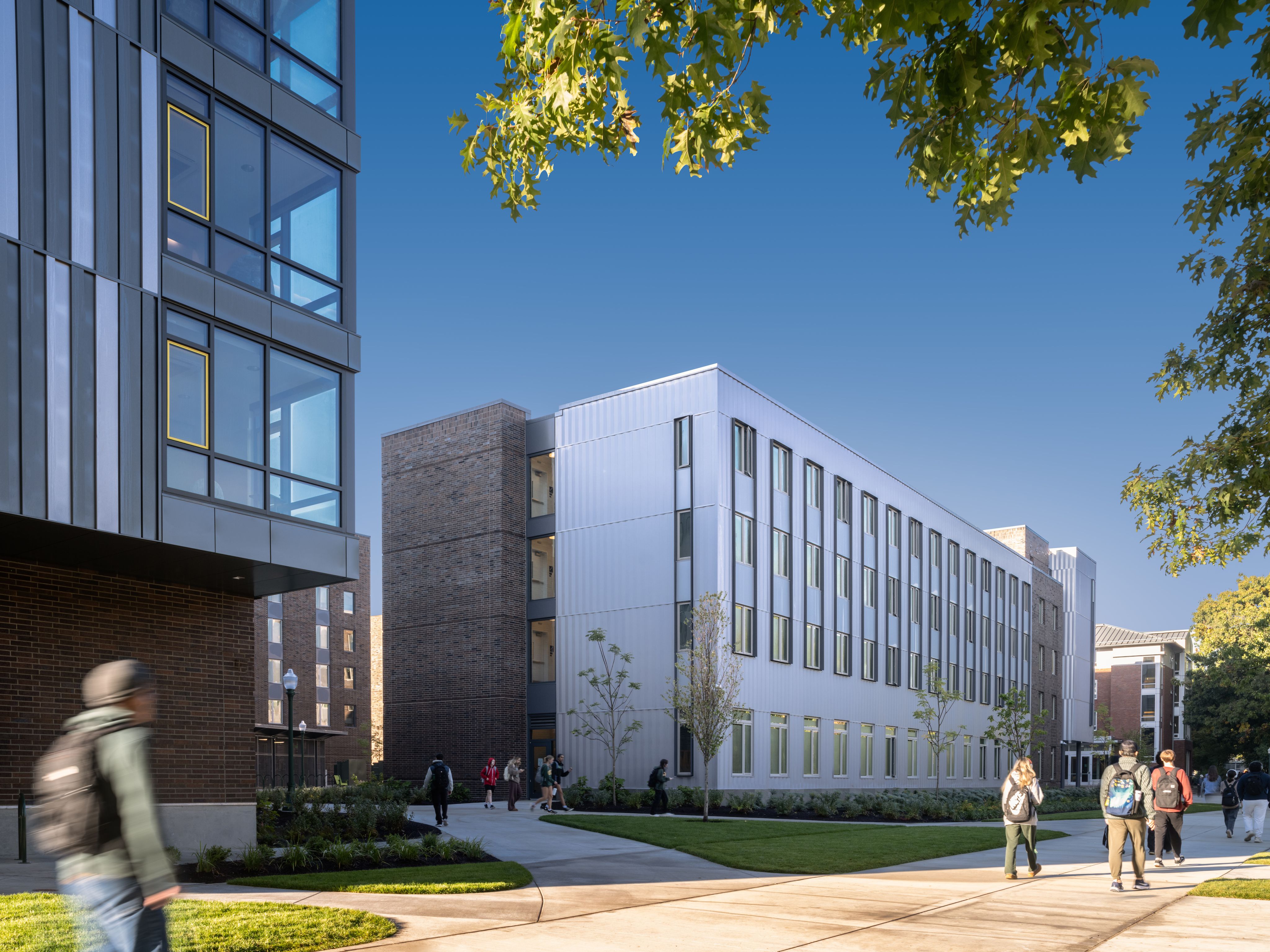
Yasui Hall, a 144-unit residence hall for 400 or so students, opened in fall 2023.
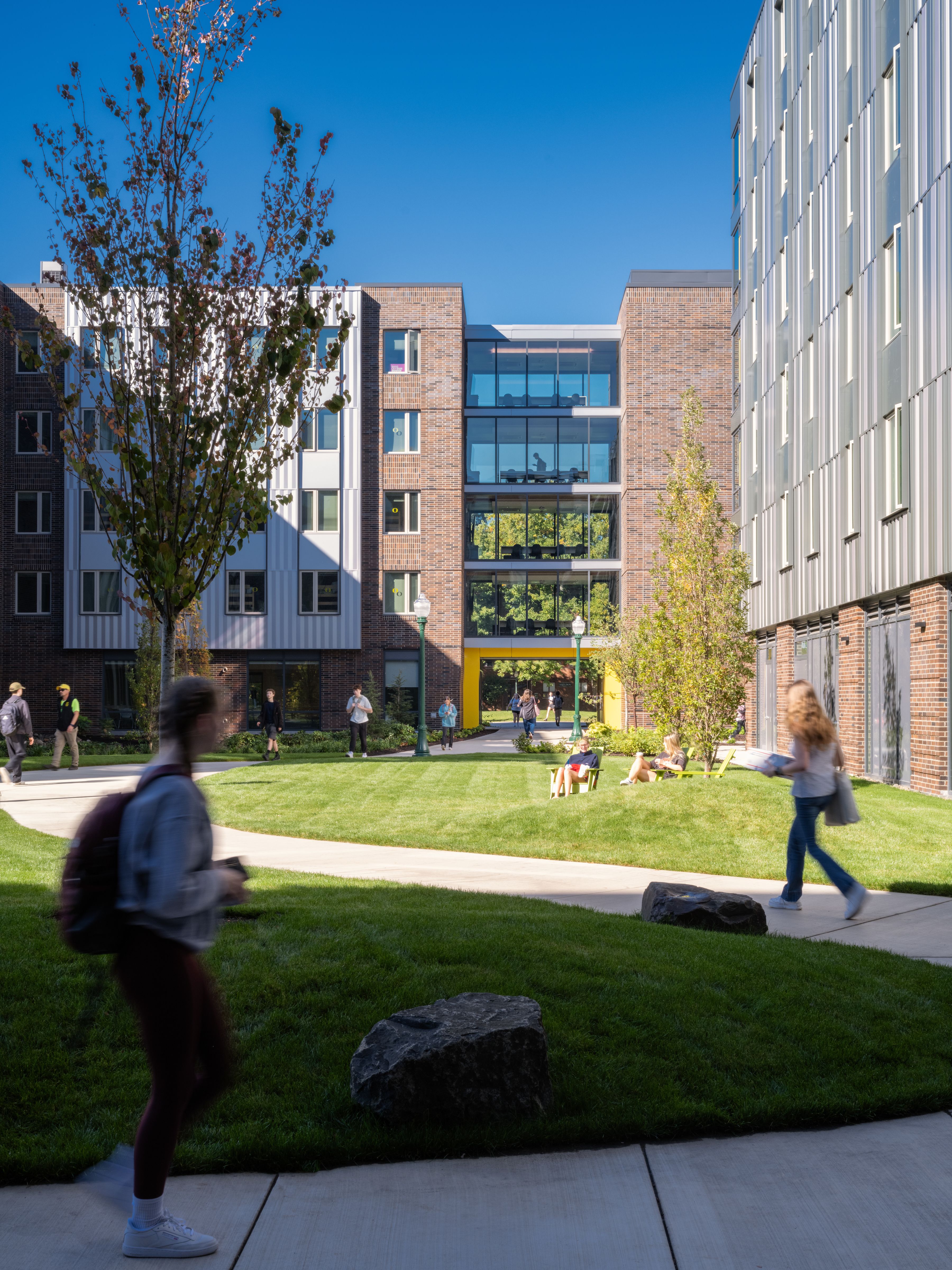
Designed for returning students, Yasui Hall includes micro-studio and quad units with kitchens
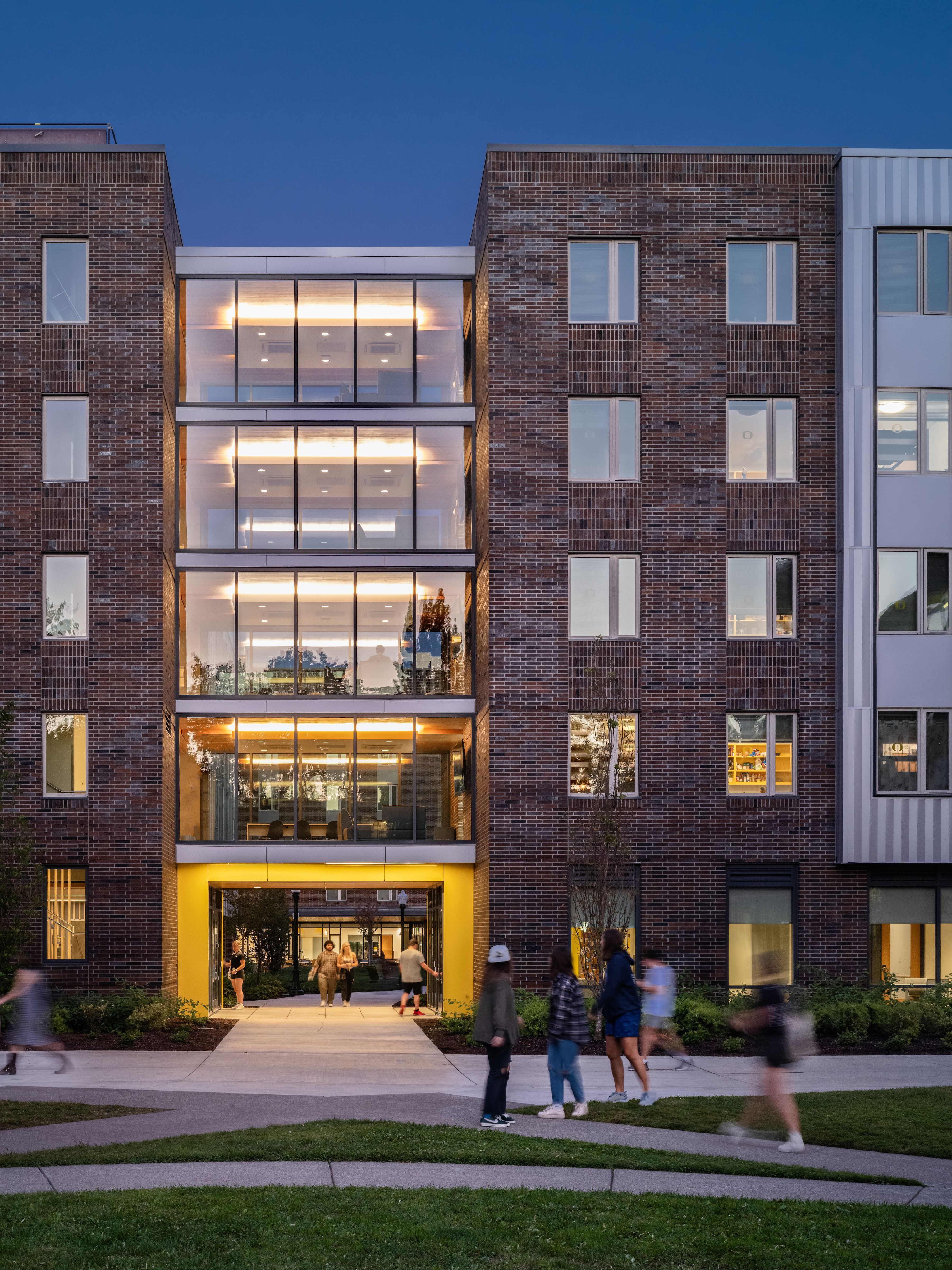
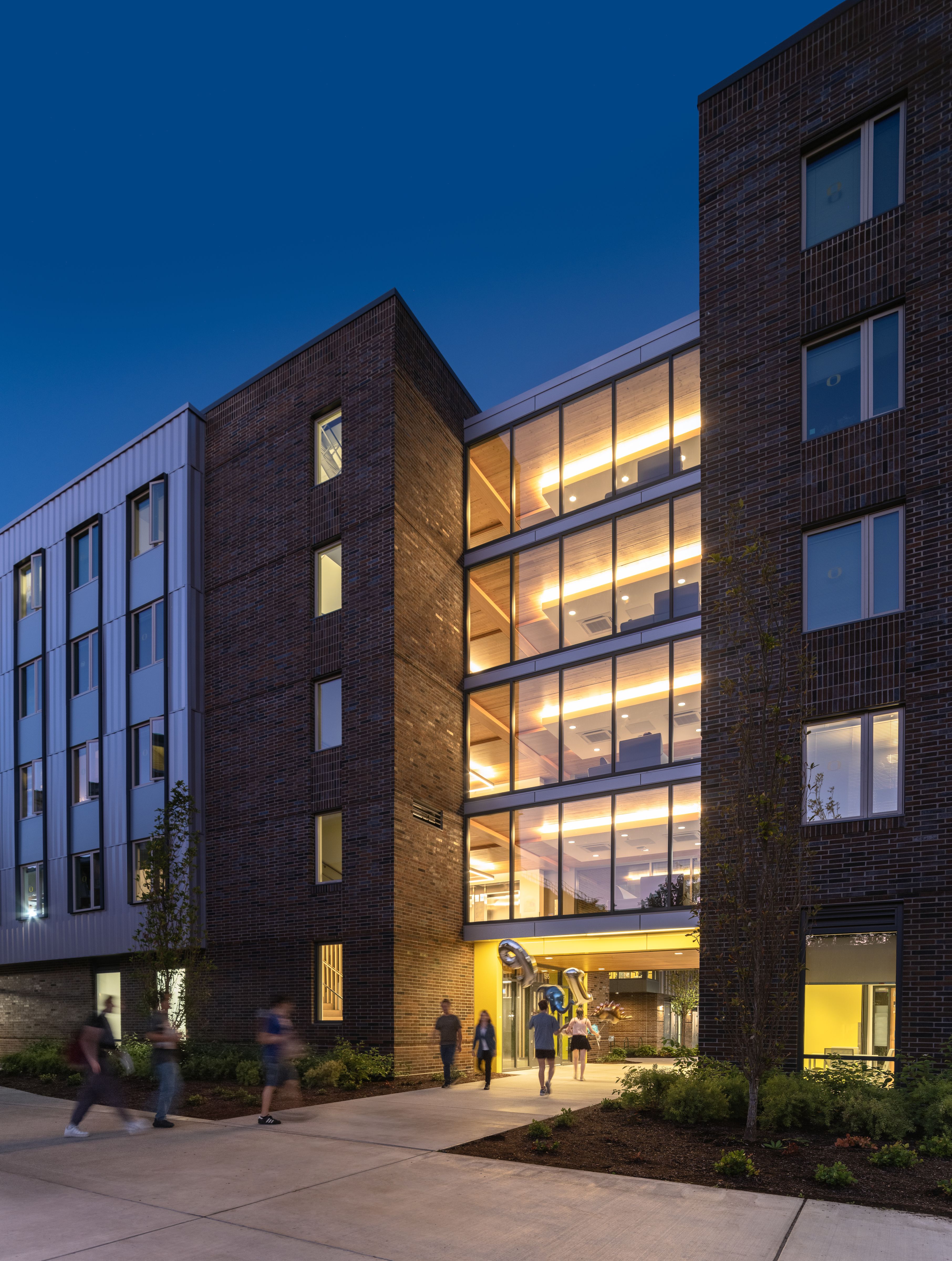
Student lounges feature floor-to-ceiling windows, revealing activity inside and creating a lantern effect.
Illuminating hidden history, celebrating the underserved
Naming Yasui Hall began with a call for suggestions. Faculty members, staff, students, alumni and community members submitted 240 proposals. The university considered all of them.
The team responsible for choosing the winner looked for ideas that would foster conversation and education about the UO’s hidden history. Special consideration also was given to the experiences and achievements of traditionally underserved people who have contributed to the university’s development and identity.
The University of Oregon Board of Trustees approved naming Yasui Hall in June 2024.
“Stubborn Twig” by UO Professor Emerit Lauren Kessler offers a comprehensive chronicle of Yasui family history and was a resource for this OregonNews feature. In her work of narrative nonfiction, Kessler recounts the stories of three generations of the Yasui family.
Winner of the Oregon Book Award, it was first published in 1993. It was chosen as the Everyone Reads selection for Oregon’s sesquicentennial in 2009, and Kessler presented the book at libraries and schools in 26 Oregon cities.
Special thanks to Densho for some of the photographs published in this series, as well as research and information. This nonprofit organization, named for a Japanese term meaning “to pass on to the next generation,” documents the testimonies of Japanese Americans who were unjustly incarcerated during World War II.
WWII soldier Harold Poole joins trial lawyer James Parkinson and newspaper columnist Lee Benson to discuss their new book Soldier Slaves: Abandoned by the White House, Courts, and Congress, which chronicles Poole’s life and his legal battle, along with other POWs, to seek restitution from Japanese companies that used them for slave labor following the Bataan Death March of April 1942. In the Bataan Death March, the Japanese soldiers marched Poole and other POWs 85 miles in Manila’s blistering heat and then shipped them to work as slaves for private Japanese corporations. Approximately 1,000 American soldiers died on the march. During the event, Sen. Orrin Hatch discussed his support of legislation that will help American WWII veterans who were enslaved receive compensation for their labor. This event was hosted by Deseret Book Company in Salt Lake City.
Read entire article at C-SPAN 2 “History on Book TV”
At 5:30 p.m. on May 1, there was a planned protest at the Park Blocks that began with a series of speeches. Participants then proceeded to march to Kesey Square.
“Organizers were present in order to facilitate a peaceful environment, and made several announcements for participants to stay on the sidewalk while marching,” Eugene PD says. “Roughly halfway into the march, several people began to disregard requests made by organizers and walked into the street while blocking police vehicles and other vehicular traffic.”
 Rosamond Press
Leave a comment