

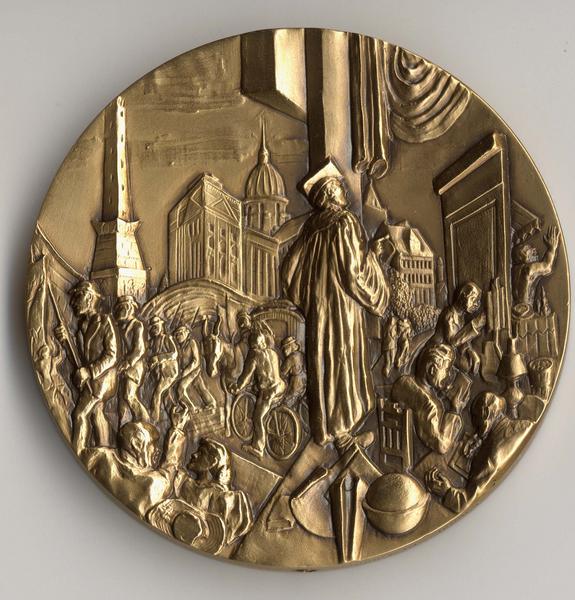
300dpi at 8×8
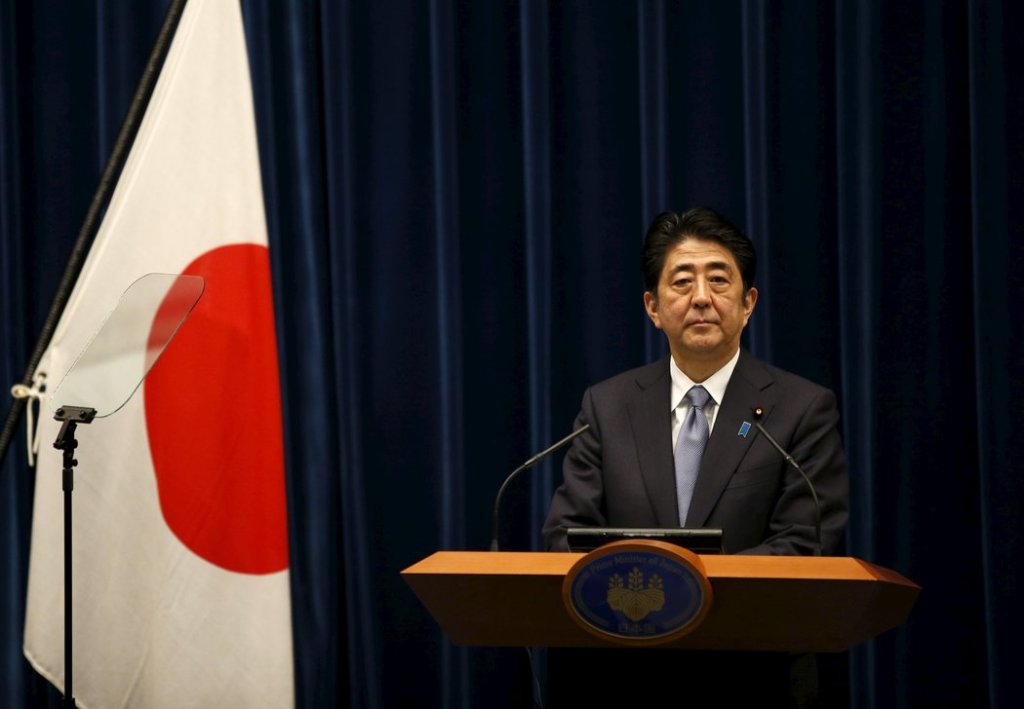
“The former vice minister of foreign affairs of Japan, Mitoji Yabunaka, wrote a column last month that appeared in a local Japanese newspaper in which he referred to Indiana as the most pro-Japanese state in America. To support this claim, he cited the fact that many major Japanese companies, including Honda, Subaru and Toyota and many automotive component companies, have invested heavily in the Hoosier state and its workforce.”
Mike Pence has an interest in getting Japanese businessmen to move plants to his State. All is forgiven. However, my Benton kindred – who made so much of Oregon’s history – are being vilified, and demonized, in regards to the late Senator Thomas Hart Benton the author of Manifest Destiny, wherein he predicts Celtic men will marry and have children by Chinese women. The Japanese did atrocious things to the Chinese.
http://www.eastasiaforum.org/2015/11/05/will-japans-war-apologies-ever-satisfy-china/
https://en.wikipedia.org/wiki/Nanking_Massacre
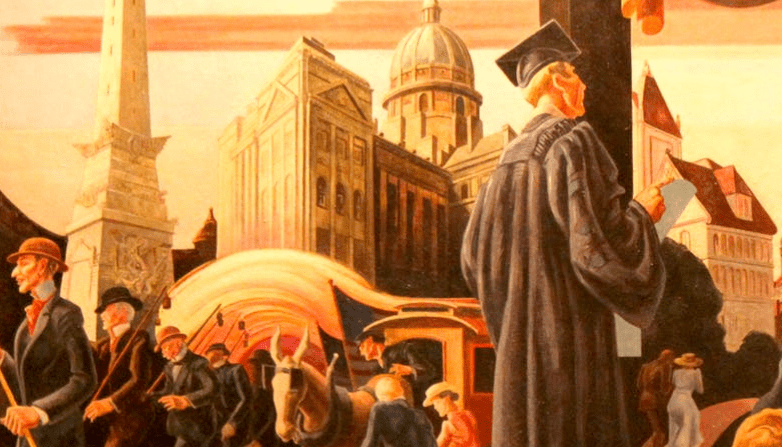
This morning I read that a medallion modeled after the mural rendered by Thomas Hart Benton, plays a big part in this forgiveness that has proven lucrative to business men who are due a huge tax cut in order to get more oversees companies to come home, or, find a home in America. Pence is the Chosen Crusader leading the way to defund the National Endowment of the Arts. How does he feel about the WPA? Is the American Taxpayer going to be funding Japan with the Republican Tax Reform, that will place artists on a dock in Boston, putting on real Patriotic War Paint?
I ask how much money has Japan and it business cartel given the arts? If I am elected Governor of Oregon, I will encourage the Japanese People to help fund a museum for Hippies and the Peace Movement. Several Japanese Citizens have received the Benton Mural Medallion.
Jon Presco
https://blogs.iu.edu/japan-australia-2017/2017/11/02/strengthening-and-renewing-ties-in-tokyo/
McRobbie also presented two of IU’s most prestigious international alumni awards. He awarded the Thomas Hart Benton Mural Medallion, given to individuals who have achieved a level of distinction in public office or service and have exemplified the values of IU, to distinguished business leader Hideo Ito.
As Senator Richard Durbin (D-IL) pointed out on the Senate floor yesterday, nearly all of the objections to the pending stimulus package are directed at a small number of programs that make up a fraction of 1 percent of the total stimulus measures in the bill. Perhaps no program remaining in the package has drawn more attention than the $50 million included for the National Endowment for the Arts.
Rep. Mike Pence (R-IN) was typical of the opponents to the stimulus legislation who seized on the arts to discredit the overall package; he told the House chamber, “It included wasteful government spending that has nothing to do with creating jobs. As I asked on this floor last week, what does $50 million to the National Endowment for the Arts have to do with creating jobs in Indiana?” Rep. Jack Kingston (R-GA) was even more emphatic, saying, “We have real people out of work right now and putting $50 million in the NEA and pretending that’s going to save jobs as opposed to putting $50 million in a road project is disingenuous.”
https://theconversation.com/the-misguided-campaign-to-remove-a-thomas-hart-benton-mural-86431
In recent years, people have protested the racism of Confederate statues, Hollywood and sports mascots.
But a curious campaign has taken place on Indiana University’s Bloomington campus. Students have circulated petitions and organized protests seeking the removal or destruction of painter Thomas Hart Benton’s 1933 mural “A Social History of Indiana,” which contains an image of the Ku Klux Klan.
“It is past time that Indiana University take a stand and denounce hate and intolerance in Indiana and on IU’s campus,” a petition from August read.
Since 1978, the Japan-US Friendship Commission and the National Endowment for the Arts (NEA) have worked with the Agency for Cultural Affairs in Japan and the International House of Japan (I-House) to organize the United States-Japan Creative Artists’ Program. Each year five leading U.S.-based artists, representing all genres, are selected from the United States and are provided funding to spend three months in Japan.
https://www.americanprogress.org/issues/economy/news/2009/02/06/5580/arts-bashing/
Apology rebuffed[edit]
In one version of the formal apology, Emperor Hirohito, the Japanese monarch, is reported to have said to General MacArthur: “I come before you to offer myself to the judgment of the powers you represent, as one to bear sole responsibility for every political and military decision made and action taken by my people in the conduct of the war.”[3]
In a second version of the formal apology, Patrick Lennox Tierney, claims that he was an eye-witness when the Emperor came to the Allied Supreme Commander’s headquarters to present this apology. Tierney was in his office on the fifth floor of the Dai-Ichi Insurance Building in Tokyo. This was the same floor where MacArthur’s suite was situated.[2] Tierney reported that when the emperor arrived, MacArthur refused to admit him or acknowledge him, and the pivotal moment passed.
Many years later, Tierney made an effort to explain his understanding of the significance of what he claimed he had personally witnessed: “Apology is a very important thing in Japan. […] It was the rudest, crudest, most uncalled for thing I have ever witnessed in my life.”[2] Whether true or not—issues which might have been addressed were allowed to remain open, and unanticipated consequences have unfolded across the decades since then.[4][5]
https://www.nytimes.com/interactive/2015/08/13/world/asia/japan-ww2-shinzo-abe.html
TOKYO — Japanese Emperor Akihito marked the 70th anniversary of the end of World War Two with an expression of “deep remorse” over the conflict on Saturday, in a departure from his annual script which could be seen as a subtle rebuke of Prime Minister Shinzo Abe.
Abe on Friday expressed “utmost grief,” but said future generations should not have to keep apologizing for the mistakes of the past. He offered no fresh apology of his own, noted the Christian Science Monitor’s Justin McCurry.
Strengthening and renewing ties in Tokyo
The former vice minister of foreign affairs of Japan, Mitoji Yabunaka, wrote a column last month that appeared in a local Japanese newspaper in which he referred to Indiana as the most pro-Japanese state in America. To support this claim, he cited the fact that many major Japanese companies, including Honda, Subaru and Toyota and many automotive component companies, have invested heavily in the Hoosier state and its workforce.
According to statistics from the Indiana Economic Development Corp., more than 280 Japanese companies operate across Indiana, and they employ more than 58,000 Hoosiers. Among all U.S. states, Indiana has the largest amount of Japanese investment per capita. Last year, Indiana exported $1.6 billion of Hoosier-made goods to Japan, which is currently the state’s fifth-largest export partner. Many Indiana-based companies, including Eli Lilly, Cook Medical, Cummins, Urschel Laboratories and Zimmer Biomet, have operations in Japan.
https://en.wikipedia.org/wiki/Nanking_Massacre
https://blogs.iu.edu/japan-australia-2017/2017/11/02/strengthening-and-renewing-ties-in-tokyo/
McRobbie also presented two of IU’s most prestigious international alumni awards. He awarded the Thomas Hart Benton Mural Medallion, given to individuals who have achieved a level of distinction in public office or service and have exemplified the values of IU, to distinguished business leader Hideo Ito. After earning a Master of Business Administration from IU’s Kelley School of Business in 1977, Ito went on to serve the Toshiba Corp. for a remarkable 36 years, including as chairman and CEO of Toshiba American Electronic Components. Later, McRobbie and Vice President Zaret, whose office organized the trip to Tokyo, delivered the Distinguished International Service Award to Yasunori Hattori (MBA, IU Kelley School of Business, 1969), a former manager at IBM’s Asia Pacific Service Corp.
To conclude the evening, IU Jacobs School of Music alumni Robert Ryker and Johann Schram Reed, who delivered such a powerful performance of Brahms’ Ein Deutsches Requiem on Tuesday night at the Tokyo Metropolitan Theatre, led attendees in a rousing sing-a-long of the IU fight song.
https://honorsandawards.iu.edu/presidential/benton-medal.shtml
https://honorsandawards.iu.edu/search-awards/honoree.shtml?honoreeID=8147
https://honorsandawards.iu.edu/search-awards/honoree.shtml?honoreeID=1776
https://honorsandawards.iu.edu/search-awards/honoree.shtml?honoreeID=6701
https://honorsandawards.iu.edu/search-awards/honoree.shtml?honoreeID=5744
https://honorsandawards.iu.edu/search-awards/honoree.shtml?honoreeID=1054
http://archive.news.iu.edu/releases/iu/2014/10/ortman-benton-medal.shtml

-
- <!–
-

Follow Story
Follow Story
-
–>
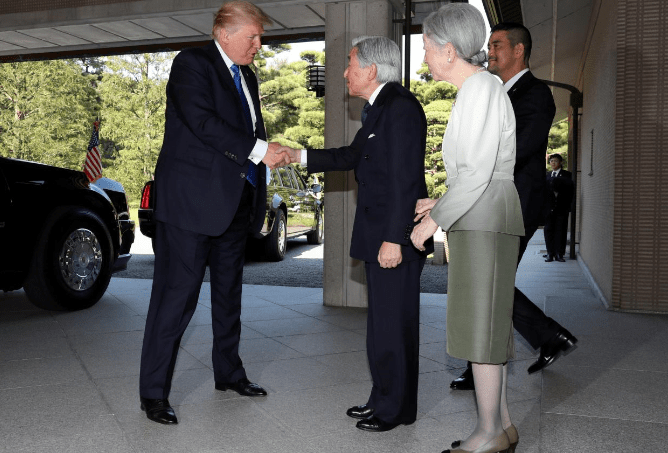
To bow or not to bow: That was the question when US President Donald Trump held a closely watched meet-and-greet with the Japanese emperor laden with potential protocol pitfalls.
Trump’s predecessor Barack Obama sparked a firestorm of criticism during one trip to Japan when he was photographed in an almost 90-degree bow to the diminutive Emperor Akihito.
US conservatives chided Obama for the act of deference towards Akihito, the son of wartime emperor Hirohito, in whose name Japanese troops fought in World War II.
So all eyes were on the meeting between the two heads of state in famously polite Japan where bowing is a way of life.
But the gaffe-prone Trump appeared to plot a respectable middle ground, slightly inclining his head upon meeting the 83-year-old despite towering over him.
The two couples were then led to a room where they engaged in deep conversation with the aid of interpreters.

Trump aides have been nervous about keeping the notorious ad-lib president on message during his gruelling Asia tour – the longest by a US leader since 1991.
And Trump is the second unorthodox world leader to meet the emperor in the space of a week.
Last Monday, Philippine President Rodrigo Duterte, not generally known for his respect of formal protocols, also received an audience at the imperial palace.
The occasionally foul-mouthed Duterte pledged to “limit my mouth” before his trip to Tokyo and Japanese media reported that he was on his best behaviour.
Japanese tabloid Yukan Fuji said the meeting was peaceful and Duterte bowed repeatedly towards the emperor and the empress afterwards.

 Rosamond Press
Leave a comment