 “Several times a year members invite ladies to share both the dinner and the entertainment — sometimes as performers. On these occasions guests always include widows of former Savages, who are known as Rosemaries (after rosemary, a symbol of remembrance).”
I am going to jump back to the Pre-Raphaelite Brotherhood in order to explain Rena’s role in the Art World. When I became a sexual being, I was soon torn down the middle. Should I join a monastery and remain a virgin, or, should I become a very sexual, and a very ethereal being who is dedicated to certain women I perceive ar spiritual, exotic – and terribly sex. Did I mention they had to be very beautiful.
The Pre-Raphaelite Artist were influenced by the Nazarene Artist of Germany who lived in a monastery and let their hair grow long. I let my hair grow long after I believed I found THE MIDDLE WAY. No sooner was that way found, then here come Rena out of a dark doorway. She is The Pre-Raphaelite Vision.
Joaquin Miller is founder of the Bohemian Club. I suspect he used the Savage Club in England as a model. If so, we are truly looking at something wonderful. Miller had dinner at the home of Gabriel Dante Rossetti – along with members of the Brotherhood. I wanted to form my own Artistic Brotherhood in honor of my patron, and the Brotherhood of Eternal Love. Art would replace LSD. Today, the visions of the Brotherhood – fill the internet! My titled friends on Facebook can not post enough Pre-Raphaelite Artwork.
We lived like Savages in our beloved tent. Rena went about – almost naked!
Rena was on some kind of War Path. After tearing up America – she had to flee to England.
Jon Presco
Miller went to England, where he was celebrated as a frontier oddity. There, in May 1871, Miller published Songs of the Sierras, the book which finalized his nickname as the “Poet of the Sierras”.[22] It was well-received by the British press and members of the Pre-Raphaelite Brotherhood, particularly Dante Gabriel Rossetti and William Michael Rossetti.
While in England, he was one of the few Americans invited into the Savage Club along with Julian Hawthorne, son of Nathaniel Hawthorne. The younger Hawthorne referred to Miller as “a licensed libertine” but admitted him “charming, amiable, and harmless”.
The Savage Club was formed to supply the want which Dr Samuel Johnson and his friends experienced when they founded the Literary Club. A little band of authors, journalists and artists felt the need of a place of reunion where, in their hours of leisure, they might gather together and enjoy each other’s society, apart from the publicity of that which was known in Johnson’s time as the coffee house, and equally apart from the chilling splendour of the modern club.
At present, there are 315 members. The club maintains a tradition of fortnightly dinners for members and their guests, always followed by entertainment. These dinners often feature a variety of famous performers from music hall to concert hall. Several times a year members invite ladies to share both the dinner and the entertainment — sometimes as performers. On these occasions guests always include widows of former Savages, who are known as Rosemaries (after rosemary, a symbol of remembrance).
Born in London, he was a son of immigrant Italian scholar Gabriele Rossetti, and the brother of Maria Francesca Rossetti, Dante Gabriel Rossetti and Christina Georgina Rossetti.
He was one of the seven founder members of the Pre-Raphaelite Brotherhood in 1848, and became the movement’s unofficial organizer and bibliographer. He edited the Brotherhood’s literary magazine The Germ which published four issues in 1850 and wrote the poetry reviews for it.
It was William Michael Rossetti who recorded the aims of the Pre-Raphaelite Brotherhood at their founding meeting in September 1848:
1. To have genuine ideas to express;
2. To study nature attentively, so as to know how to express them;
3. To sympathize with what is direct and serious and heartfelt in previous art, to the exclusion of what is conventional and self-parading and learned by rote;
4. And most indispensable of all, to produce thoroughly good pictures and statues.
Although Rossetti worked full time as a civil servant, he maintained a prolific output of criticism and biography across a range of interests from Algernon Swinburne to James McNeill Whistler. He edited the diaries of his maternal uncle John William Polidori (author of The Vampyre and physician to Lord Byron), a comprehensive biography of D. G. Rossetti, and edited the collected works of D. G. Rossetti and Christina Rossetti.
Rossetti edited the first British edition of the poetry of Walt Whitman, which was published in 1868; however, this edition was bowdlerized.[1] Anne Gilchrist, who became one of the first to write about Whitman, first read his poetry from Rossetti’s edition, and Rossetti helped initiate their correspondence.[2]
In 1874 he married Lucy Madox Brown, daughter of the painter Ford Madox Brown. They honeymooned in France and Italy. Their first child, Olivia Frances Madox, was born in September 1875, and her birth was celebrated in an ode of Swinburne.
William Michael Rosetti was a major contributor to the 1911 edition of the Encyclopædia Britannica; his contributions on artistic subjects were criticised by many reviewers at the time and since, as showing little evidence of having absorbed the mounting body of work by academic art historians, mostly writing in German.
Dinner at Rossetti’s
by Joaquin Miller
________________________________________
There is no thing that hath not worth;
There is no evil anywhere;
There is no ill on all this earth,
If man seeks not to see it there.
September 28. I cannot forget that dinner with Dante Gabriel Rossetti, just before leaving London, nor can I hope to recall its shining and enduring glory. I am a better, larger man, because of it. And how nearly our feet are set on the same way. It was as if we were all crossing the plains, and I for a day’s journey and a night’s encampment fell in with and conversed with the captains of the march.
But one may not gave names and dates and details over there as here. The home is entirely a castle. The secrets of the board and fireside are sacred. And then these honest toilers and worshippers of the beautiful are shy, so shy and modest. But I like this decent English way of keeping your name down and out of sight till the coffin-lid hides your blushes–so modest these Pre-Raphaelites are that I should be in disgrace forever if I dared set down any living man’s name.
But here are a few of the pearls picked up, as they were tossed about the table at intervals and sandwiched in between tales of love and lighter thoughts and things.
All London, or rather all the brain of London, the literary brain, was there. And the brain of all the world, I think, was in London. These giants of thought, champions of the beautiful earth, passed the secrets of all time and all lands before me like a mighty panorama. All night sol We dined so late that we missed breakfast. If I could remember and write down truly and exactly what these men said, I would have the best and the greatest book that ever was written, I have been trying a week in vain, I have written down and scratched out and revised till I have lost the soul of it, it seems to me; no individuality to it; only like my own stuff. If I only had set their words down on the next day instead of attempting to remember their thoughts! Alas! the sheaves have been tossed and beaten about over sea and land for days and days, till the golden grain is gone, and here is but the straw and chaff.
The master sat silent for the most part; there was a little man away down at the other end, conspicuously modest. There was a cynical fat man, and a lean philanthropist all sorts and sizes, but all lovers of the beautiful of earth. Here is what one, a painter, a ruddy-faced and a rollicking gentleman, remarked merrily to me as he poured out a glass of red wine at the beginning of the dinner:
“When travelling in the mountains of Italy, I observed that the pretty peasant women made the wine by putting grapes m a great tub, and then, getting into this tub, barefooted, on top of the grapes, treading them out with their brown, bare feet. At first I did not like to drink this wine. I did not think it was clean. But I afterward watched these pretty brown women” and here all leaned to listen, at the mention of pretty brown women– I watched these pretty brown women at their work in the primitive winepress, and I noticed that they always washed their feet after they got done treading out the wine.”
All laughed at this, and the red-faced painter was so delighted that he poured out and swallowed another full glass. The master sighed as he sat at the head of the table rolling a bit of bread between thumb and finger, and said, sitting close to me: “I am an Italian who has neven seen Italy. Belle Italia!…”
By and by he quietly said that silence was the noblest attitude in all things; that the greatest poets refused to write, and that all great artists in all lines were above the folly of expression. A voice from far down the table echoed this sentiment by saying:”Heard melodies are sweet; but unheard melodies are sweeter.” “Written poems are delicious; but unwritten poems are divine,” cried the triumphant cynic. “What is poetry?” cries a neighbor. “All true, pure life is poetry,” answers one. “But the inspiration of poetry?” “The art of poetry is in books. The inspiration of poetry in nature.” To this all agreed.
Then the master very quietly spoke: “And yet do not despise the books of man. All religions, said the Chinese philosophers, are good. The only difference is, some religions are better than others, and the apparent merit of each depends largely upon a mans capacity for understanding it. This is true of .poetry. All poetry is good. I never read a poem in my life that did not have some merit, and teach some sweet lesson. The fault in reading the poems of man, as well as reading the poetry of nature, lies largely at the door of the reader. Now, what do you call poetry?” and he turned his great Italian eyes tenderly to where I sat at his side.
To me a poem must be a picture,” I answered.
Proud I was when a great poet then said: “And it must be a picture–if a good poem so simple that you can understand it at a glance, eh? And see it and remember it as you would see and remember a sunset, eh?” “Aye,” answered the master, “I also demand that it shall be lofty in sentiment and sublime in expression. The only rule I have for measuring the merits of a written poem, is by the height of it. Why not be able to measure its altitude as you measure one of your sublime peaks of America?”
He looked at me as he spoke of America, and I was encouraged to answer:”Yes, I do not want to remember the words. But I do want it to remain with me a picture and become a part of my life. Take this one verse from Mr. Longfellow:
“And the night shall be filled with music,
And the cares that infest the day
Shall fold their tents like the Arabs,
And as silently steal away.’”
“Good!” cried the fat cynic, who, I am sure, had never heard the couplet before, it was so sweet to him; “Good! There is a picture that will depart from no impressible clay. The silent night, the far sweet melody falling on the weary mind, the tawny picturesque Arabs stealing away m the darkness, the perfect peace, the stillness and the rest. It appeals to all the Ishmaelite in our natures, and all the time we see the tents gathered up and the silent children of the desert gliding away in the gloaming.”
A transplanted American, away down at the other end by a little man among bottles, said: “The poem of Evangeline is a succession of pictures. I never read Evangeline but once.” “It is a waste of time to look twice at a sunset,” said Rossetti, sotto voce, and the end man went on: “But i believe I can see every picture in that poem as distinctly as if I had been the unhappy Arcadian; for here the author has called in ail the elements that go to make up a perfect poem.”
“When the great epic of this new, solid Saxon tongue comes to be written,” said one who sat near and was dear to the master’s heart, “it will embrace all that this embraces: new and unnamed lands; ships on the sea; the still deep waters hidden away in a deep and voiceless continent; the fresh and fragrant wilderness; the curling smoke of the camp-fire; action, movement, journeys; the presence–the inspiring presence of woman; the ennobl- ing sentiment of love, devotion, and devotion to the death; faith, hope and charity,- and all in the open air.”
“Yes,” said the master thoughtfully, ‘no great poem has ever been or ever will be fitted in a parlor, or even fashioned from a city. There is not room for it there.”
“Hear! hear! you might as well try to grow a California pine in the shell of a peanut,” cried I. Some laughed, some applauded, all looked curiously at me. Of course, I did not say it that well, yet I did say it far better, I mean I did not use the words carefully, but I had the advantage of action and sympathy.
Then the master said, after a bit of reflection: “Homer’s Ulysses, out of which have grown books enough to cover the earth, owes its immortality to all this, and its out-door exercise. Yet it is a bloody book a bad book, in many respects–full of revenge, treachery, avarice and wrong. And old Ulysses himself seems to have been the most colossal liar on record. But for all this, the constant change of scene, the moving ships and the roar of waters, the rush of battle and the anger of the gods, the divine valor of the hero, and, above all, and over all, like a broad, white-bosomed moon through the broken clouds, the splendid life of that one woman; the shining faith, the constancy, the truth and purity of Penelope–all these make a series of pictures that pass before us like a panorama, and we will not leave off reading till we have seen them all happy together again, and been assured that the faith and constancy of that woman has had it reward. And we love him, even if he does lie!”
How all at that board leaned and listened. Yet let me again and again humbly confess to you that I do him such injustice to try thus to quote from memory. After a while he said: “Take the picture of the old, blind, slobber-mouthed dog, that has been driven forth by the wooers to die. For twenty years he has not heard the voice of his master. The master now comes, in the guise of a beggar. The dog knows his voice, struggles to rise from the ground, staggers toward him, licks his hand, falls, and dies at his feet.”
Such was the soul, heart, gentleness of this greatest man that I ever saw walking in the fields of art….
Miller earned an estimated $3,000 working as a Pony Express rider, and used the money to move to Oregon. With the help of his friend, Senator Joseph Lane, he became editor of the Democratic Register in Eugene,[7] a role he held from March 15 to September 20, 1862.[8] Though no copies survive, it was known as sympathetic to the Confederacy until it was forced to shut down.[9] That year, Miller married Theresa Dyer (alias Minnie Myrtle) on September 12, 1862, in her home four days after meeting her[10] in Port Orford, Oregon.
Swinburne Meets Joaquin Miller.” New York Times (10 May 1931) [Online: BR5]
Picture with the text: “Once Joaquin Miller and a British Writer Called on Swinburne, Whom the Englishman Claimed as an Intimate Friend. They Announced Themselves as Joaquin Miller, the American Poet, and a Friend. Swinburne Sent Down Word to ‘Bring the American Poet Up and Tell the Friend to Go to Hell.’” [MCK]
Algernon Charles Swinburne (London, April 5, 1837 – London, April 10, 1909) was an English poet, playwright, novelist, and critic. He invented the roundel form, wrote several novels, and contributed to the famous Eleventh Edition of the Encyclopaedia Britannica. He was nominated for the Nobel Prize in Literature in every year from 1903 to 1907 and again in 1909.[1]
At Oxford Swinburne met several Pre-Raphaelites, including William Morris and Dante Gabriel Rossetti. After leaving college he lived in London and started an active writing career, where Rossetti was delighted with his ‘little Northumbrian friend’, a reference to Swinburne’s diminutive height—he was just over five feet tall.[citation needed]
The first of Rosamond’s five scenes is the most forceful in demonstrating Swinburne’s debt to troubadour conventions as well as to Pre-Raphaelite stylistic influences. Courtly love preoccupations and the medieval setting overshadow elements of Jacobean revenge tragedy throughout the play. Swinburne’s Rosamond, rather than the historical queen of the Courts of Love, espouses the religion of love and, as a result of her lived creed, is poisoned by Eleanor out of jealousy.
Swinburne’s choice of the “rose of the world” as one of his first subjects for verse suggests that he associated his conception of Rosamond with courtly love allegory, specifically the Roman de la Rose, in which the rose is the eternal symbol of the beloved and of the perfect beauty that is fearfully transient but simultaneously immortal.3 As in Swinburne’s later lyrics “Before the Mirror” and “The Year of the Rose,”
Many and varied are the stories that have been told about the first meeting of the Savage Club, of the precise purposes for which it was formed, and of its christening. But it would hardly be possible to discover a more reliable record than that written by Andrew Halliday, who was elected a joint honorary secretary at the first Annual Meeting in 1858, and who later became its first president:
The Savage Club was formed to supply the want which Dr Samuel Johnson and his friends experienced when they founded the Literary Club. A little band of authors, journalists and artists felt the need of a place of reunion where, in their hours of leisure, they might gather together and enjoy each other’s society, apart from the publicity of that which was known in Johnson’s time as the coffee house, and equally apart from the chilling splendour of the modern club.When about a dozen of our original members were assembled in the place selected for their meeting, it became a question what the Club should be called. Everyone in the room suggested a title. One proposed the “Addison”, another the “Johnson”, a third the “Goldsmith”, and so forth. At last, after we had run the whole gamut of famous literary names of the modern period, a modest member in the corner suggested the “Shakespeare”. This was too much for the gravity of one of the company (the late Robert Brough) whose keen sense of humour enabled him, in the midst of our enthusiasm, to perceive that we were bent on making ourselves ridiculous. “Who are we,” he said, “that we should take these great names in vain? Don’t let us be pretentious. If we must have a name, let it be a modest one – that signifies as little as possible.”Whereupon a member called out, in a spirit of pure wantonness, “The Savage”. Robert’s sense of humour was once again tickled. “The very thing!” he exclaimed. “No one can say that there is anything pretentious in assuming that name. If we accept Richard Savage as our Godfather, it shows that there is no false pride in us.” And so, in a frolicsome humour, our little society was christened the “Savage” Club.
The history of Richard Savage gives ample proof of the lack of pretentiousness and false pride (and of “the spirit of pure wantonness”) which settled the choice of its name. For Richard Savage, a shady, satirical poet, had died, after a very chequered career, more than a century before the Savage Club was born. We read of him as a crony of Dr Johnson, and that he had occasional successes with his plays and poems. But his history also records the facts that he killed a man in a brawl, and was reprieved only by the intercession of a noble patron, that his life was mainly a story of quarrels, bitterness and vindictiveness, that he was prosecuted for libel, and finally that, after his irregular habits had reduced him to penury, he was imprisoned for debt and died in the year 1743.
This grim record will correct the assumptions that Savage was either one of the original members of the Club, or a distinguished person whose name the members wished to honour – or that they were born in some vague savage clime surrounded by assegais and tom-toms, shields and skulls, and other barbaric trophies such as those which decorate the walls.
Taken from “Brother Savages and Guests: A History of the Savage Club” by Percy Bradshaw
Location[edit source]
The club has moved around over the years, from its original home at the Crown Tavern, Vinegar Yard, Drury Lane, the next year to the Nell Gwynne Tavern, in 1863 to Gordon’s Hotel in Covent Garden, then to 6-7 Adelphi Terrace, later to 9 Fitzmaurice Place, Berkeley Square, London W1, and on to 1 Carlton House Terrace in St James’s (previously the home of the Conservative statesman Lord Curzon) and elsewhere.
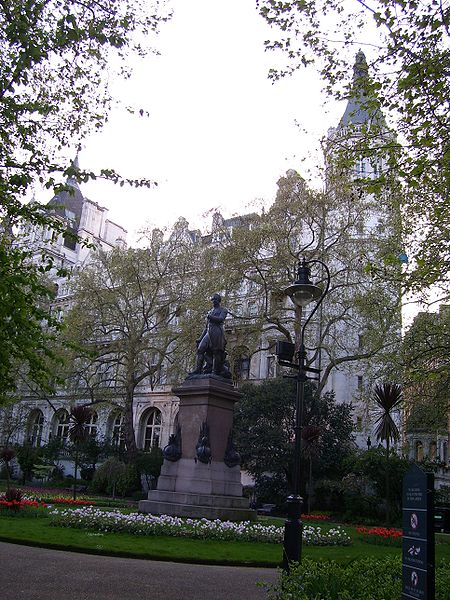
At the moment it is based in the National Liberal Club, at 1 Whitehall Place, London SW1. The nearest underground station is Embankment.
Founders of the Savage Club[edit source]
The club was founded in 1857 by George Augustus Sala and 11 other members, including:
William Brough
Robert Brough
Gustav von Franck
Dr G.L.Strauss
William Bernhardt Tegetmeier
The club today[edit source]
At present, there are 315 members. The club maintains a tradition of fortnightly dinners for members and their guests, always followed by entertainment. These dinners often feature a variety of famous performers from music hall to concert hall. Several times a year members invite ladies to share both the dinner and the entertainment — sometimes as performers. On these occasions guests always include widows of former Savages, who are known as Rosemaries (after rosemary, a symbol of remembrance).
There are also monthly lunches, which are followed by a talk given by a member or an invited guest on a subject of which he has specific expert knowledge.
Membership[edit source]
Members are classified into one of six categories which best describes their main interest: art, drama, law, literature, music or science. They must be proposed and seconded by two existing members, and if unknown by any members, are required to attend a club function in order to meet some members.
The category of membership might mirror a member’s profession, though there are many members with an interest in one or more of the membership categories, but who practise none professionally.
Membership fees range from £248 to £654 per annum depending on membership category. The joining fee for 2008 for gentlemen introduced by present Savages is £200 if aged 35 or over at the date of joining, or £90 for those under 35. For those who apply for membership without introduction the fees are £500 and £150 respectively.

 Rosamond Press
Leave a comment