





Yesterday I was forced to look at a hard fact, being, after Gloria Ehlers left me for my bartender, I was never the same. I went mad and became a full blown drunk. Indeed, you can say I was Dionysus Unveiled. Alas you know who the phantom of the Rosamond Opera is.
When Gloria moved out of our house, and in with Frank, I and my loyal friends went looking for another bar. We moved into the Hut where I used to get shit-faced drunk with Stephen Kupka of the Tower of Power. Steve was a roadie for the Loading Zone who had a great horn section. Steve suggested the Power get one themselves.
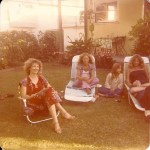
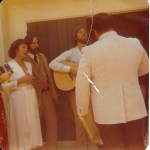
In the photo of Mary Ann and I in front of the church singing Amazing Grace with Bryan McLean, is a person almost out of the picture. She is holding a Polaroid and looking at a image she just took, develop. This person was the ‘Love of my Life’ until she got married eight years ago to the Jazz drummer, Kenny Reed. Shortly after we met, Marilyn took me up to the Hollywood Hills to meet her best friend, the jazz great, Les McCann. I was sixteen and Marilyn, fifteen. Les sang us a few songs, then looked at me sternly and said;
“You better take care of my little girl here!”
Les had married a white woman who left her wealthy home in Pasadena and became a torch singer in France. Charlotte took Marilyn under her wing, and she would stay a month out of the summer up at her house. Marilyn’sister, Shanna, was married to Ron Jefferson, Les McCann’s drummer. Shanna moved to Paris with Ron, and after Marilyn and I broke up, she went to live with her sister in the Bohemian capital of the world.
Shanna left Ron and was the lover of Carlos Moore. Together they authored ‘This Bitch of a Life’ the story of Fela Kunti, an African saxophonist who was a charismatic Messiah. The Black Panthers took an interest in Fela.
When I met Gloria, she had twelve lovers and gave them all up for me. Later, after we lived together, I asked her why? What was so special about my love-making? Gloria was a great lover.
“The first time we made love, you looked deep into my eyes, and kept looking.”
When Gloria left me for Frank, I went down to LA with my painting tied on the roof of my car. The day I left, Marilyn came up to Oakland to see me. She never met Gloria, who took her to a club on the waterfront in San Francisco where they had open mike. Gloria got up and sang a couple of Bessy Smith tunes.
Gloria had soul. She could sew, cook, and make a man happy in bed. She took me to see her friends, a brother and sister who were White Panthers. They did legal work for the Black Panthers. My daughters mother had a child by a black man who was a Black Panther in Chicago. This son named his son after Malcolm X.
When Gloria’s parents drove all the way from Wisconsin to visit their little girl in Oakland they checked into a motel on McCarthur that was recommended by triple A. It was a three star motel located two blocks away, according to an old brochure. They wanted to be close to only child so we could come over and visit them.
In the morning they came to take us for breakfast. My lover threw a fit when they mentioned how tired they were after being kept up all night by these black party girls dressed in satin hot pants.
“Boy, did they have allot of boyfriends that kept coming and going all night! We heard California was liberal, but, this was……..”
Gloria turned into a monster before my eyes. She went into a rage and tore into her parents that just walked out of the painting ‘American Gothic’ by Grant Wood, and into the most natorious whore motel in Oakland where they spent the night surrounded by prostitutes who were screwing horny white men for a living. Then here come the pimps covered in bling to take their women to a late night dinner. They thought they were demonstrating to their daughter their willingness to be a little more opened minded, because she left them in her wake when she came to live in Berkeley where she was the lover of the Twelve Magical Berkeley Hobbits. Gloria screwed their brains out, she a Deep Throat Master! No Snow White was she.
“I hate you. I want you out of my life! You have embarassed me for the last time. That was a whore house you slept in. A fucking whore house!”
“A whore house!” they said in unison, and I came to their defence.
“Gloria! THESE are your parents!”
My plea for peace was like throwing a bucket of gasoline on a fire, for Gloria would have been happy with any parents, but – THOSE parents!
“I don’t give a fuck! Get out!”
She broke her father’s heart right in front of me. He left in an avalanche of pain. In the nearly three years we lived together, I dare not bring her parents up. She never called them on the holidays. I think I slept with her with one eye open, knowing I was expendable.
I was six months sober when I moved in with Mary Ann. I had gotten a DUI and had to attend a class that informed me I had a real problem that endangered the lives of innocent people. I agreed. No sooner am I settled in then Mary Ann put a book in my hand. It was V by Thomas Pynchon. My wife to be showed me the inscription her lover wrote to her. Then she put Gravity’s Rainbow in my other hand, and I read the immortal words from the Mystery Man of our age. Thomas makes references to Jazz all through his books. He was a great fan of Jazz, as was Jayrl Zorthian, who befriended Charlie Parker. Marilyn knew several Jazz greats. Marilyn put Mary Ann in her bed the night before our wedding. Marilyn let Mary Ann wear her white dress from her Train Line. They could have passed for sisters. If Gloria had come to my wedding, then then these three women have gotten along famously. Now add the Zorthian sisters and Nancy Van Brasch, and you began to see who is at the center of the Labyrinth that Thomas Pynchon disapeared into, never to reamerge! Why?
Thomas Pynchon has become a god, or, the son of god. He is the Minotaur of his own making he haven taken literature back to its roots, back into the dark age of Greek tragedy where Bacchus gets the maenads drunk so they can go completely mad, they tearing their teeth into living animals while drunk in the fruit if the vine. Consider Mary Magdalene Wieneke and the notion Catholicism is Dionysus worship in disguise. To eat of the living flesh of Dionysus and drink his blood like wine – is the acme of dying and regenerating god who is even seduced by his mother.
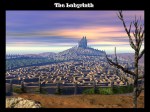
Pynchon has to be the Minotaur simply because he is not good looking enough to be Dionysus. This genius of American Literature could not die a drunken womanizer. So, he sent his lover out of the Labyrinth to capture Dionysus, and bring him to center of the Labyrinth in order to meet her, Ariadne, the love of his life.
King Henry built a labyrinth at WOODSTOCK in order to put Fair Rosamond Clifford at its center. Henry claims he descends from the Kings of Troy. He was one of the most educated men in the world. He built a zoo at WOODSTOCK, and out panthers within. There are three PANTHERS on his shield, and the shield of his father, Godfrey de Anjou. Queen Eleanore follows a RED THREAD to discover Rosamond so she can murder her, because…..she wanted it all!
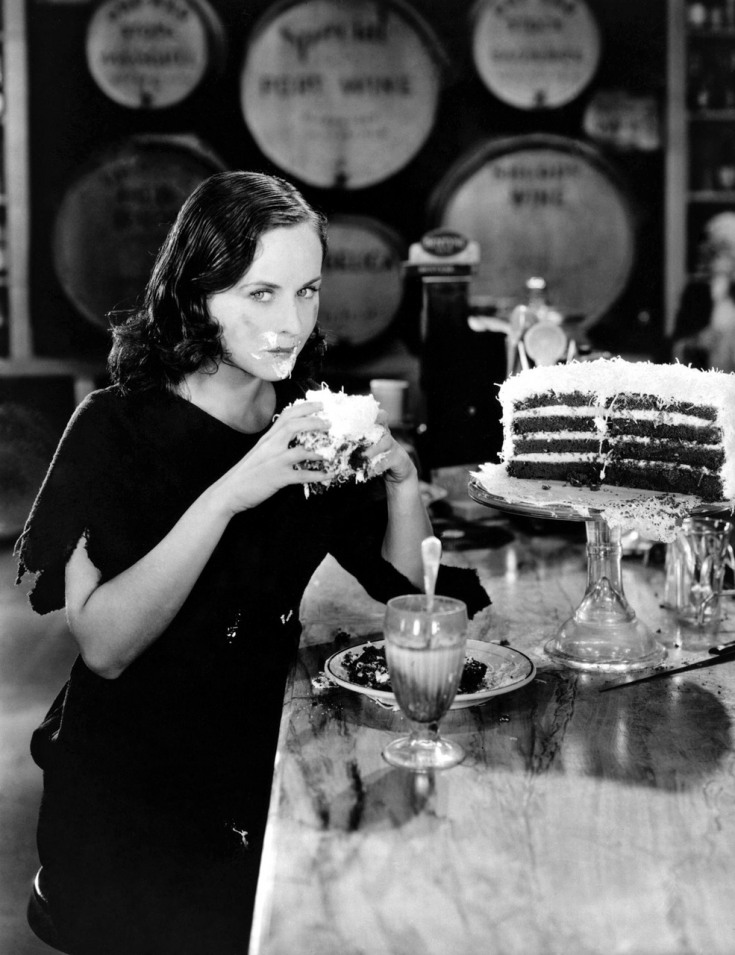
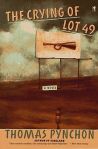
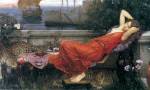
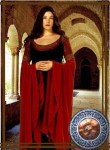
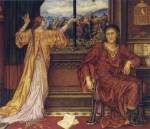
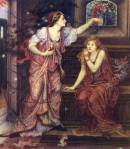
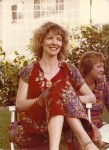
In Pynchon’s book The Crying of Lot 49 is the red clue of Ariadne and Rosamond. This story parallels my autobiography ‘Capturing Beauty’ that is inspired by Rosamond’s labyrinth at WOODSTOCK. My late sister, Christine Rosamond Benton is the embodiment of Ariadne and Fair Rosmond. She is the spitting image of the woman in the top photo. She is the Woman Who Wantes It All – like men want it all! She wants her cake and eat to. She is the woman who could not stand to be in the shadow of her narcisstic lover, the most st charismatic god-man that ever lived.
When Mary Ann put V in my hands, a Author was born. My novel ‘The Gideon Computer’ is unfinished, because it began to come true, and, I had to get sober if I were to finish it.
Last night, I had to conclude I lost Gloria because I had become a drunk and a braggart. I lost the best woman a man could have. I lost Gloria, because she wanted it all to herself. She wanted a great lover, and I had become the king of fools, the god-man Silenis. I had donkey ears. I brayed at the moon.
But, this is not the whole truth. The truth is, I was everything Gloria wanted, but, then she did not want me anymore she threw me away, exchanged me for another man, another mirror to reflect her image of herself. She threw her parents away for the same reason. She could not have come from their union, their, vow!
My daughter threw me away for the same reason. Her and Bill and my drunken parents, reborn! My daughter wants it all, and had bonded with Bacchus.
Now, here the kicker. Rosamond Clifford descends from the kindred of Rollo the Viking, and may be kin to Mary Ann Tharaldsen – as well as Rena Christiansen, my and Christine’s Muse. I knew Rena wanted it all when I first lay eyes on her. When it came to owning all the beauty in the world, she was pig! When she said;
“I love you more afar, then near!” what she was saying I want your undying love – and many lovers in my life!
“I want my cake, and eat it too!”
“Me too!”
Thomas Pynchon and I are Lovers of Words. Women are Lovers of Words. Women want to be God……too! This is the realization that came to Woodstock. This truth was too much for our parents who had made bonds of love and an agreement with Judeo-Christianity that insisted women would be subserviant to Man. This is why hated us – and still do. We solved the Dionysus Mystery with the help of LSD. We worshipped Huey Newton, the black Dionysus who was a Motown Romantic like every young man and woman was in Oakland. Consider his panther party and Dionysus’ chariot being pulled by panthers. Of course they had to shoot him down!
I have seen God! I have loved, and been loved by beautiful women! I danced the Belro (Flaminco sytle) for Marilyn on her sixteenth birthday. I was too poor to buy her a present. So, for weeks I practiced, and danced before her for twelve minutes. I do not think I took my shirt off, because there was nothing I could do to make Marilyn love me more then she did. She fell in love with me from afar, and had to have me. She threw me away after I failed to convert to Christianity at four Billy Graham crusades at the LA Coleseum. When I failed to go down on the field and bow down to Dionysus-Jesus of the Wine Vine, Marilyn’s mother told the love of my life she would have me arrested if I came around. The young Dionysus was crucified. But, he was reborn.
I never met Thomas Pynchon. He reminds me of Athar Frayne in the movie Zardoz, where clues ar given. But, are they ever recieved? Surely the Clue Master can find and behold Pynchon if he uses his mind. Is he not with the Philistines and the Priory de Sion?
Jon Presco
Dionysus of the Age
Copyright 2012

The earliest cult images of Dionysus show a mature male, bearded and robed. He holds a fennel staff, tipped with a pine-cone and known as a thyrsus. Later images show him as a beardless, sensuous, naked or half-naked androgynous youth: the literature describes him as womanly or “man-womanish.”[8] In its fully developed form, his central cult imagery shows his triumphant, disorderly arrival or return, as if from some place beyond the borders of the known and civilized. His procession (thiasus) is made up of wild female followers (maenads) and ithyphallic, bearded satyrs. Some are armed with the thyrsus, some dance or play music. The god himself is drawn in a chariot, usually by exotic beasts such as lions or tigers, and is sometimes attended by a bearded, drunken Silenus. This procession is presumed to be the cult model for the human followers of his Dionysian Mysteries. In his Thracian mysteries, he wears the bassaris or fox-skin, symbolizing a new life. Dionysus is represented by city religions as the protector of those who do not belong to conventional society and thus symbolizes everything which is chaotic, dangerous and unexpected, everything which escapes human reason and which can only be attributed to the unforeseeable action of the gods.[9]
When Dionysus grew up, he discovered the culture of the vine and the mode of extracting its precious juice; but Hera struck him with madness, and drove him forth a wanderer through various parts of the earth. In Phrygia the goddess Cybele, better known to the Greeks as Rhea, cured him and taught him her religious rites, and he set out on a progress through Asia teaching the people the cultivation of the vine. The most famous part of his wanderings is his expedition to India, which is said to have lasted several years. Returning in triumph he undertook to introduce his worship into Greece, but was opposed by some princes who dreaded its introduction on account of the disorders and madness it brought with it (e.g. Pentheus or Lycurgus).
The Worship of Venus is a oil on canvas painting by the Italian artist Titian completed between 1518-1520. It describes a Roman rite of worship conducted in honour of the goddess Venus each 1 April. On this occasion, women would make offerings to representations of the goddess so as to cleanse “every blemish on their bodies”.[1]
Ariadne has been left on the island of Naxos, deserted by her lover Theseus, whose ship sails away to the far left. She is discovered on the shore by the god Bacchus, leading a procession of revelers in a chariot drawn by two cheetahs (These were probably modeled on those in the Duke’s menagerie and were leopards in Catullus’s original text). Bacchus is depicted in mid-air as he leaps out of the chariot to protect Ariadne from these beasts. In the sky above the figure of Ariadne is her crown, which Bacchus has thrown into the sky and it then becomes the constellation Corona. However, this is only one analysis[by whom?] of the events pictured. The National Gallery’s website states that in the painting, ‘Bacchus, god of wine, emerges with his followers from the landscape to the right. Falling in love with Ariadne on sight, he leaps from his chariot, drawn by two cheetahs, towards her. Ariadne had been abandoned on the Greek island of Naxos by Theseus, whose ship is shown in the distance. The picture shows her initial fear of Bacchus, but he raised her to heaven and turned her into a constellation, represented by the stars above her head.’
The earliest discussions of mythological parallels between Dionysus and the figure of the Christ in Christian theology can be traced to Friedrich Hölderlin, whose identification of Dionysus with Christ is most explicit in Brod und Wein (1800–1801) and Der Einzige (1801–1803).[42]
Modern scholars such as Martin Hengel, Barry Powell, and Peter Wick, among others, argue that Dionysian religion and Christianity have notable parallels. They point to the symbolism of wine and the importance it held in the mythology surrounding both Dionysus and Jesus Christ;[43][44] though, Wick argues that the use of wine symbolism in the Gospel of John, including the story of the Marriage at Cana at which Jesus turns water into wine, was intended to show Jesus as superior to Dionysus.[45]
Scholars of comparative mythology identify both Dionysus and Jesus with the dying-and-returning god mythological archetype.[7] Other elements, such as the celebration by a ritual meal of bread and wine, also have parallels.[46] Powell, in particular, argues precursors to the Christian notion of transubstantiation can be found in Dionysian religion.[46]
Another parallel can be seen in The Bacchae where Dionysus appears before King Pentheus on charges of claiming divinity which is compared to the New Testament scene of Jesus being interrogated by Pontius Pilate.[45][46][47]
E. Kessler in a symposium Pagan Monotheism in the Roman Empire, Exeter, 17–20 July 2006, states that Dionysian cult had developed into strict monotheism by the 4th century CE; together with Mithraism and other sects the cult formed an instance of “pagan monotheism” in direct competition with Early Christianity during Late Antiquity.[48]
In Greek mythology, maenads (Greek: μαινάδες, mainádes) were the female followers of Dionysus (Bacchus in the Roman pantheon), the most significant members of the Thiasus, the god’s retinue. Their name literally translates as “raving ones”. Often the maenads were portrayed as inspired by him into a state of ecstatic frenzy, through a combination of dancing and drunken intoxication.[1] In this state, they would lose all self-control, begin shouting excitedly, engage in uncontrolled sexual behavior, and ritualistically hunt down and tear to pieces animals — and, at least in myth, sometimes men and children — devouring the raw flesh. During these rites, the maenads would dress in fawn skins and carry a thyrsus, a long stick wrapped in ivy or vine leaves and tipped by a cluster of leaves; they would weave ivy-wreaths around their heads, and often handle or wear snakes.[2] German philologist Walter Friedrich Otto writes that
http://www.forartist.com/forensic/modification/pynchon/pynchon.htm
Hailing from Long Island, Pynchon served two years in the United States Navy and earned an English degree from Cornell University. After publishing several short stories in the late 1950s and early 1960s, he began composing the novels for which he is best known: V. (1963), The Crying of Lot 49 (1966), Gravity’s Rainbow (1973), and Mason & Dixon (1997). Pynchon is also known for being very private; very few photographs of him have ever been published, and rumors about his location and identity have circulated since the 1960s.
The Crying of Lot 49 is a novella by Thomas Pynchon, first published in 1966. The shortest of Pynchon’s novels, it is about a woman, Oedipa Maas, possibly unearthing the centuries-old conflict between two mail distribution companies, Thurn und Taxis and the Trystero (or Tristero). The former actually existed, and was the first firm to distribute postal mail; the latter is Pynchon’s invention. The novel is often classified as a notable example of postmodern fiction.
Time included the novel in its TIME 100 Best English-language Novels from 1923 to 2005.[1]
Contents
[hide]
1 Characters
2 Plot summary
3 Critical reception
4 Allusions within the book
4.1 The Beatles
4.2 Vladimir Nabokov
4.3 Remedios Varo
4.4 California Gold Rush
4.5 The Courier’s Tragedy
5 References in popular culture
6 Notes
7 References
8 External links
[edit] Characters
Oedipa Maas – The novel’s protagonist. After her ex-boyfriend, Pierce Inverarity, dies and she becomes co-executor of his estate, she discovers and begins to unravel what may or may not be a worldwide conspiracy.
Pierce Inverarity – Oedipa’s ex-boyfriend and a wealthy real-estate tycoon. The reader never meets him directly: all encounters are presented through Oedipa’s memories. At the beginning of the novel he is already dead and is said to have been extremely rich, having owned, at one time or another, a great deal of real property and holdings in California.
Wendell “Mucho” Maas – The husband of Oedipa, Mucho once worked in a used-car lot but recently became a disc jockey for KCUF radio in Kinneret, California (a fictional town). Towards the end of the novel, the effects of his nascent LSD use alienate Oedipa.
Metzger – A lawyer who works for Warpe, Wistfull, Kubitschek and McMingus law firm. He has been assigned to help Oedipa execute Pierce’s estate. He and Oedipa have an affair.
Miles, Dean, Serge and Leonard – The four members of the band called The Paranoids, American teenagers who sing with British accents.
Dr. Hilarius – Oedipa’s psychiatrist, who prescribes LSD, which she does not take, to Oedipa as well as other housewives. He goes crazy toward the end of the story, admitting to being a former Nazi doctor at Buchenwald, where he worked in a program focused on experimentally-induced insanity to render Jews permanently catatonic. He claims to use facial expressions as a weapon, and boasts of a face he made once that drove a subject insane. He holes up in his office, but is taken away peacefully by the police after Oedipa disarms him.
John Nefastis – A scientist obsessed with perpetual motion. He has tried to invent a type of Maxwell’s demon, in an attempt to create a perpetual motion machine. Oedipa visits him to see the machine after learning about him from Stanley Koteks.
Stanley Koteks – An employee of Yoyodyne Corporation who knows something about the Trystero. Oedipa meets him when she wanders into his office while touring the plant.
Randolph Driblette – A leading Wharfinger scholar and the director of the production of Wharfinger’s The Courier’s Tragedy seen by Oedipa and Metzger. Driblette commits suicide before Oedipa can extract any useful information from him about Wharfinger’s mention of the Tristero, but meeting him spurs her to go on a quest to find the meaning behind Trystero.
Mike Fallopian – Oedipa and Metzger meet Mike Fallopian in The Scope, a bar frequented by Yoyodyne employees. He tells them about The Peter Pinguid Society. Oedipa searches him out again later.
Genghis Cohen – The most eminent philatelist in the LA area, Cohen was hired to inventory and appraise the deceased’s stamp collection. Oedipa and he discuss stamps and forgeries.
Professor Emory Bortz – Formerly of Berkeley, now teaching at San Narciso, Bortz wrote the editor’s preface in a version of Wharfinger’s works. Oedipa tracks him down to learn more about Trystero.
[edit] Plot summary
The novel follows Oedipa Maas, a Californian housewife who becomes entangled in a convoluted historical mystery when her ex-lover dies and designates her the co-executor of his estate. The catalyst of Oedipa’s adventure is a set of stamps that may have been used by a secret underground postal delivery service, the Trystero (or Tristero).
According to the historical narrative that Oedipa pieces together during her travels around the San Francisco Bay Area, the Trystero was defeated by Thurn und Taxis – a real postal system – in the 18th century but went underground and continued to exist into Oedipa’s present day, the 1960s. Their mailboxes are disguised as regular waste-bins, often displaying their slogan W.A.S.T.E., an acronym for We Await Silent Tristero’s Empire, and their symbol, a muted post horn. The existence and plans of this shadowy organization are revealed bit by bit; or, then again, it is possible that the Tristero does not exist at all. The novel’s main character, Oedipa Maas, is buffeted back and forth between believing and not believing in them, without ever finding firm proof either way. The Tristero may be a conspiracy, it may be a practical joke, or it may simply be that Oedipa is hallucinating all the arcane references to the underground network that she seems to be discovering on bus windows, toilet walls, and everywhere in the Bay Area.
The Trystero muted post horn
Prominent among these references is the “Trystero symbol”, a muted post horn with one loop. Originally derived, supposedly, from the Thurn and Taxis coat of arms, Oedipa finds this symbol first in a bar bathroom, where it decorates a graffito advertising a group of polyamorists. It later appears among an engineer’s doodles, as part of a children’s sidewalk jump rope game, amidst Chinese ideograms in a shop window, and in many other places. The post horn (in either original or Trystero versions) appears on the cover art of many TCL49 editions, as well as within artwork created by the novel’s fans.
Oedipa finds herself drawn into this shadowy intrigue when an old boyfriend, the California real estate mogul Pierce Inverarity, dies. Inverarity’s will names her as his executor. Soon enough, she learns that although Inverarity “once lost two million dollars in his spare time [he] still had assets numerous and tangled enough to make the job of sorting it all out more than honorary.” She leaves her comfortable home in Kinneret-Among-The-Pines, a northern California village, and travels south to the fictional town of San Narciso (Spanish for “Saint Narcissus”), near Los Angeles. Exploring puzzling coincidences she uncovers while parsing Inverarity’s testament, Oedipa finds what might be evidence for the Trystero’s existence. Sinking or ascending ever more deeply into paranoia, she finds herself torn between believing in the Trystero and believing that it is all a hoax established by Inverarity himself. Near the novel’s conclusion, she reflects,
He might have written the testament only to harass a one-time mistress, so cynically sure of being wiped out he could throw away all hope of anything more. Bitterness could have run that deep in him. She just didn’t know. He might himself have discovered The Tristero, and encrypted that in the will, buying into just enough to be sure she’d find it. Or he might even have tried to survive death, as a paranoia; as a pure conspiracy against someone he loved.
Along the way, Oedipa meets a wide range of eccentric characters. Her therapist in Kinneret, a Dr. Hilarius, turns out to have done his internship in Buchenwald, working to induce insanity in captive Jews. “Liberal SS circles felt it would be more humane,” he explains. In San Francisco, she meets a man who claims membership in the IA, Inamorati Anonymous—a group founded to help people avoid falling in love, “the worst addiction of all”. (Ironically, the anonymous inamorato wears a lapel pin shaped as the Trystero post horn, which Oedipa first saw on an advertisement for group sex.) And, in Berkeley, she meets John Nefastis, an engineer who believes he has built a working version of Maxwell’s demon, a means for defeating entropy. The book ends with Oedipa attending an auction, waiting for bidding to begin on a set of a rare postage stamps, which she believes representatives of Tristero are trying to acquire. (Auction items are called “lots”; a lot is “cried” when the auctioneer is taking bids on it; the stamps in question are “Lot 49”.)
[edit] Critical reception
Critics have read the book as both an “exemplary postmodern text”[2] and an outright parody of postmodernism.[3] “Mike Fallopian cannot be a real character’s name”, protests one reviewer.[4] Pynchon himself disparaged this book, writing in 1984, “As is clear from the up-and-down shape of my learning curve, however, it was too much to expect that I’d keep on for long in this positive or professional direction. The next story I wrote was The Crying of Lot 49, which was marketed as a ‘novel,’ and in which I seem to have forgotten most of what I thought I’d learned up until then.”[5]
[edit] Allusions within the book
The Crying of Lot 49 book cover, featuring the Thurn und Taxis post horn
As ever with Pynchon’s writing, the labyrinthine plots offer myriad interconnecting cultural references. Understanding these references allows for a much richer reading of the work. J. Kerry Grant wrote A Companion to the Crying of Lot 49[6] in attempts to catalogue these references, but it is neither definitive nor complete.
[edit] The Beatles
The Crying of Lot 49 was published shortly after Beatlemania and the “British invasion” which took place in America and other Western countries. Indeed, internal context clues indicate that it is probably set in 1964, the year in which A Hard Day’s Night was released. Pynchon makes a wide variety of Beatles allusions. Most prominent are the Paranoids, a band composed of cheerful marijuana smokers whose lead singer, Miles, is a high-school dropout. The Paranoids all speak with American accents but sing in English ones; at one point, a guitar player is forced to relinquish control of a car to his girlfriend because he cannot see through his hair. It is not clear whether Pynchon was aware of the Beatles’ own nickname for themselves, “Los Para Noias”;[7] since the novel is replete with other references to paranoia, Pynchon may have chosen the band’s name for other reasons.
Pynchon refers to a rock song, “I Want to Kiss Your Feet”, a self-abasing version of “I Want to Hold Your Hand”. The artist, Sick Dick and the Volkswagens, echoes such actual groups as the El Dorados, the Edsels, the Cadillacs and the Jaguars[6] (as well as an early name the Beatles themselves were forced to use, “Long John and the Silver Beetles”). Sick Dick and the Volkswagens is also a play on words. “Sick Dick” may also echo Richard Wharfinger, author of “that ill, ill Jacobean revenge play” known as The Courier’s Tragedy.[6] On top of all this, the song’s title also keeps up a recurring sequence of allusions to Saint Narcissus, a 3rd-century bishop of Jerusalem.
Late in the novel, Oedipa’s husband Mucho Maas, a disc jockey at Kinneret radio station KCUF, describes his experience of discovering the Beatles. Mucho refers to their early song “She Loves You”, as well as hinting at the areas the Beatles were later to explore. Pynchon writes,
“Whenever I put the headset on now,” he’d continued, “I really do understand what I find there. When those kids sing about ‘She loves you,’ yeah well, you know, she does, she’s any number of people, all over the world, back through time, different colors, sizes, ages, shapes, distances from death, but she loves. And the ‘you’ is everybody. And herself. Oedipa, the human voice, you know, it’s a flipping miracle.” His eyes brimming, reflecting the color of beer.
“Baby,” she said, helpless, knowing of nothing she could do for this, and afraid for him.
He put a little clear plastic bottle on the table between them. She stared at the pills in it, and then understood. “That’s LSD?” she said.
[edit] Vladimir Nabokov
Pynchon, like Kurt Vonnegut, was a student at Cornell University, where he probably at least audited Vladimir Nabokov’s Literature 312 class. (Nabokov himself had no recollection of him, but Nabokov’s wife Véra recalls grading Pynchon’s examination papers, thanks only to his handwriting, “half printing, half script”.)[8] The year before Pynchon graduated, Nabokov’s novel Lolita was published in the United States; among other things, including the novel’s adaptation to cinema in 1961 by Stanley Kubrick, Lolita introduced the word “nymphet” to describe a sexually attractive girl between the ages of nine and fourteen. In following years, mainstream usage altered the word’s meaning somewhat, broadening its applicability. Perhaps appropriately, Pynchon provides an early example of the modern “nymphet” usage entering the literary canon. Serge, the Paranoids’ teenage counter-tenor, loses his girlfriend to a middle-aged lawyer. At one point he expresses his angst in song:
What chance has a lonely surfer boy
For the love of a surfer chick,
With all these Humbert Humbert cats
Coming on so big and sick?
For me, my baby was a woman,
For him she’s just another nymphet.
[edit] Remedios Varo
Near the beginning of The Crying of Lot 49, Oedipa recalls a trip to an art museum in Mexico with Inverarity during which she encounters a painting: Bordando el Manto Terrestre by Remedios Varo. The painting shows eight women inside a tower, where they are presumably held captive. Six maidens are weaving a tapestry that flows out of the windows. The tapestry seems to constitute the world outside of the tower. Oedipa’s reaction to the tapestry gives us some insight into her difficulty in determining what is real and what is a fiction created by Inverarity for her benefit.
She had looked down at her feet and known, then, because of a painting, that what she stood on had only been woven together a couple thousand miles away in her own tower, was only by accident known as Mexico, and so Pierce had taken her away from nothing, there’d been no escape.
[edit] California Gold Rush
The significance of the number 49 within the novel cannot be placed for sure, but, as the book is preoccupied with the theme of communications, the year 1849 would seem to be a possible reason for the title’s choice. In 1849, the second year of the California Gold Rush, vast quantities of telecommunications equipment, including a private mail system, were rolled out to support those rushing to California.[9]
[edit] The Courier’s Tragedy
Pynchon devotes a significant part of the book to a “play within a play”, a detailed description of a performance of an imaginary Jacobean revenge play, involving intrigues between Thurn und Taxis and Tristero. Like “The Mousetrap”, based on “The Murder of Gonzago” which Shakespeare placed within Hamlet, the events and atmosphere of The Courier’s Tragedy (by the fictional Richard Wharfinger) mirror those in the larger story around them.
In many aspects it resembles a typical revenge play, such as The Spanish Tragedy by Thomas Kyd, Hamlet by William Shakespeare and plays by John Webster and Cyril Tourneur.
[edit] References in popular culture
The Yoyodyne company, which first appears in V., is also referenced in The Adventures of Buckaroo Banzai Across the 8th Dimension, and it is a manufacturer of starship drives in the Star Trek universe. Angel, the spin-off series of Buffy the Vampire Slayer, includes a firm named Yoyodyne, although this may be an indirect allusion via the Buckaroo Banzai film. ABC television created a website for a fictional company named PB-Sales, in connection with their TV show Lost; PB-Sales specializes in managing and controlling other corporations, including Yoyodyne and Daystrom Data Concepts (a nod to the Star Trek episode “The Ultimate Computer”).[10] The GNU General Public License uses “Yoyodyne, Inc.” as the name of a company in an example of a copyright disclaimer.
Both Radiohead and Yo La Tengo have included Pynchonian motifs in their works, some of them hinging upon TCL49.[11] Yo La Tengo named a song “The Crying of Lot G” on their album And Then Nothing Turned Itself Inside Out. Radiohead also references the novel in the name of their online merchandise shop and mailing list, W.A.S.T.E. (which originally sent out physical mail, making the reference more apt).
Nicholas Meyer’s 1993 novel The Canary Trainer describes a fictional painting by the famous Impressionist Degas, which happens to show Sherlock Holmes playing violin in the Opera Garnier. To explain why this work is not prominently displayed in an art gallery, Meyer adds a tongue-in-cheek footnote, explaining that it was bought by the late “Marquis de Tour et Tassis”, then auctioned off by the Marquis’s widow. Both the aristocrat’s name (a clear variant of “Thurn and Taxis”) and the auction are nods to Pynchon.
In the William Gibson novel Count Zero (1986), the multinational corporation Maas Neotek is named in honor of Oedipa Maas.[12]
In 2003, the peer-to-peer program WASTE briefly appeared, designed by Justin Frankel as a reference to the book’s dark postal service W.A.S.T.E. It uses encryption to maintain privacy, while also requiring encryption keys on both sides to get into the network in the first place.
In the opening shot of the Mad Men episode “Lady Lazarus” (season 5, episode 8), character Peter Campbell is reading the novel.
The Thomas Pynchon Connection
Thomas Pynchon (1937 – ) is a contemporary Amercian author of the first rank, creator of several marvelously intricate novels. Pynchon also seems to have spent some time listening closely to jazz in the late fifties, and the inclusion of allusions and echoes of that jazz scene provides additional enjoyment for those of us who also know jazz.
Pynchon’s first novel V (1961) includes a minor character named McClintic Sphere. Pynchon introduces him in a remarkable section (page 47 in my Bantam edition) with a whole series of links, allusions, echoes, and satirical reflections of the late 1950’s and Ornette Coleman’s legendary Five Spot appearance in Greenwich Village.
The section starts with several of the New York cast arriving at a Greenwich Village nightclub called the V-Note:
1. V for the title of the novel and an elusive woman, object of a novel-long search by one of the characters.
2. V as in the Roman Numeral for Five = Five Spot. This famous club featured Thelonious Monk and John Coltrane (1957) in a legendary engagement; it was the nightclub where Ornette Coleman first opened in November 1959 (and where he played a number of times over the following years)
3. V-Note. The Note = Half Note. Another Greenwich Village club, and another venue at which Coleman played during the period
McClintic Sphere is playing onstage when the group enters. Sphere is Thelonious Monk’s middle name (Monk was a frequent performer in the village at the time and as noted is closely associated with the Five Spot). McClintic may be an echo of Coleman’s unusual first name. (The only jazz musician with a somewhat similar first name would be Kenny Dorham, whose given first name was McKinley. He performed regularly in New York during that period and may be associated with groups that played the Five Spot).
p. 48 “He blew a hand-carved ivory alto saxophone” Obvious reference to the plastic alto saxophone which Ornette used in the late fifties, evidently because it was cheaper than a metal sax and because it gave him a more flexible sound. “…with a 4 1/2 reed” Also a reference to the 4 1/2 strength reed which Ornette used in Los Angeles (described by Don Cherry in a famous passage in an interview with Joe Goldberg).
The next paragraphs include some nice descriptions of the reactions in the audience, from those who simply left, to those from other groups who were unwilling to reject it, to those few who liked it. This directly echoes the reports in down beat about Coleman’s first appearances at the Five Spot in 1959.
“The group on the stand had no piano: it was bass, drums, McClintic and a boy he had found in the Ozarks who blew a natural horn in F”. This is an echo of the Ornette Coleman Quartet, and the natural horn may be a reference to the unusual pocket trumpet which Don Cherry favored at the time. (Cherry was of course from Los Angeles). “The bass was small and evil-looking and his eyes were yellow with pinpoints in the center”. I have no idea which of Ornette’s bassists this refers to-possibly David Izenzon? The bassist at the time of course was Charles Haden, by no means small and evil looking. The next paragraph is a biting description of some of those in the audience, “mostly those who wrote for Downbeat magazine or the liners of LP records…”. (Reader Clay Thurmond also points out that Sphere’s playing is described here as “something else”–which is the title of Coleman’s first LP on Contemporary Records recorded in 1958).
On the next page (p.49): “Since the soul of Charlie Parker had dissolved away into a hostile March wind nearly a year before…”. This is too early for Ornette, but only by three years. Parker died in March 1955 which would make this early 1956. In 1956 Ornette was still an unemployed, unknown musician in Los Angeles. He did not arrive in New York city until the fall of 1959, and the controversy, the club names and the rest of the allusions belong to that specific period. On the same page: “He plays all the notes Bird missed”, somebody whispered”. Another allusion to the impact of Ornette, who received a lot of attention as the next alto saxophonist after Parker to move the music forward…
(McClintic Sphere reappears elsewhere in the novel, specifically starting around page 326, but there are no direct allusions to Ornette Coleman or other jazz figures).
Incidentally, several other Pynchon works contain references to jazz and its practitioners. There are a number of sections dealing with Charlie Parker in Gravity’s Rainbow (1973) and the short story Entropy (first published in the Kenyon Review) should amuse those enamored of the original Gerry Mulligan Quartet.
Written by David Wild, copyright 1997 by David Wild
Fela: This Bitch of a Life was first published in 1982. The new version, published by Cassava Republic, includes remarkable never-before-seen content: a Preface by renowned Brazilian musician and statesman Gilberto Gil, a Prologue by Fela’s friend Lindsay Barrett, an introduction and a moving epilogue by Carlos Moore written specially for this edition. It also includes the two part magnificently illustrated Afa Ojo sections, which delve into the mystical aspects of Fela’s character. The cover and artwork for this new version were designed by Lemi Ghariokwu, the original designer of some of Fela’s most iconic album covers. The book is set to become a collector’s item and to take pride of place on bookshelves across the continent.
Click here to download and read an extract.
“Fela is still a voice for Nigerians. He brought our struggles and social challenges to the fore. It’s vital for us to use his life and music as a reference point for social consciousness. Fela protects our identity and reminds those in power to respect our rights as young Africans.” Naeto C
“Fela Anikulapo Kuti was James Brown, Huey Newton, Rick James, Bob Marley, Duke Ellington and ODB all rolled up in one black African fist…” Mos Def
Ariadne ( /æriˈædniː/; Ἀριάδνη; Latin: Ariadna; “most holy”, Cretan Greek αρι [ari] “most” and αδνος [adnos] “holy”), in Greek mythology, was the daughter of Minos king of Crete,[1] and his queen Pasiphaë, daughter of Helios, the Sun-titan.[2] She is mostly associated with mazes and labyrinths, due to her involvement in the myths of the Minotaur and Theseus. Her father put her in charge of the labyrinth where sacrifices were made as part of reparations (either to Poseidon or to Athena, depending on the version of the myth); however, she would later help Theseus in overcoming the Minotaur and saving the would-be sacrificial victims. In other stories, she became the bride of the god Dionysus, with the question of her background as being either a mortal or a goddess varying in those accounts.[3][4]
In the days of Henry and Rosamond the palace of Woodstock was surrounded with very extensive and beautiful gardens and grounds. Somewhere upon these grounds the story was that Henry kept Rosamond in a concealed cottage. The entrance to the cottage was hidden in the depths of an almost impenetrable thicket, and could only be approached through a tortuous and intricate path, which led this way and that by an infinite number of turns, forming a sort of maze, made purposely to bewilder those attempting to pass in and out. Such a place was often made in those days in palace-grounds as a sort of ornament, or, rather, as an [57] amusing contrivance to interest the guests coming to visit the proprietor. It was called a labyrinth. A great many plans of labyrinths are found delineated in ancient books. The paths were not only so arranged as to twist and turn in every imaginable direction, but at every turn there were several branches made so precisely alike that there was nothing to distinguish one from the other. Of course, one of these roads was the right one, and led to the centre of the labyrinth, where there was a house, or a pretty seat with a view, or a garden, or a shady bower, or some other object of attraction, to reward those who should succeed in getting in. The other paths led nowhere, or, rather, they led on through various devious windings in all respects similar to those of the true path, until at length they came to a sudden stop, and the explorer was obliged to return.
The paths were separated from each other by dense hedges of thorn, or by high walls, so that it was impossible to pass from one to another except by walking regularly along.
It was in a house, entered through such a labyrinth as this, that Rosamond is said to have lived, on the grounds of the palace of Woodstock, while Queen Eleanora, as the avowed [58] wife and queen of King Henry, occupied the palace itself. Of course, the fact that such a lady was hidden on the grounds was kept a profound secret from the queen. If this story is true, there were probably other labyrinths on the grounds, and this one was so surrounded with trees and hedges, which connected it by insensible gradations with the groves and thickets of the park, that there was nothing to attract attention to it particularly, and thus a lady might have remained concealed in it for some time without awakening suspicion.
At any rate, Rosamond did remain, it is supposed for a year or two, concealed thus, until at length the queen discovered the secret. The story is that the king found his way in and out the labyrinth by means of a clew of floss silk, and that the queen one day, when riding with the king in the park, observed this clew, a part of which had, in some way or other, become attached to his spur. She said nothing, but, watching a private opportunity, she followed the clew. It led by a very intricate path into the heart of the labyrinth. There the queen found a curiously-contrived door. The door was almost wholly concealed from view, but the queen discovered it and opened it. She found that it [59] led into a subterranean passage. The interest and curiosity of the queen were now excited more than ever, and she determined that the mystery should be solved. So she followed the passage, and was finally led by it to a place beyond the wall of the grounds, where there was a house in a very secluded spot surrounded by thickets. Here the queen found Rosamond sitting in a bower, and engaged in embroidering.
She was now in a great rage both against Rosamond and against her husband. It was generally said that she poisoned Rosamond. The story was, that she took a cup of poison with her, and a dagger, and, presenting them both to Rosamond, compelled her to choose between them, and that Rosamond chose the poison, and, drinking it, died. This story, however, was not true, for it is now known that Rosamond lived many years after this time, though she was separated from the king. It is thought that her connection with the king continued for about two years after his marriage with Eleanora. She then left him. It may be that she did not know before that time that the king was married. She may have supposed that she was herself his lawful wife, as, indeed, it is possible that she may actually have been [60] so. At any rate, soon after she and Eleanora became acquainted with each other’s existence, Rosamond retired to a convent, and lived there in complete seclusion all the rest of her days.
Stephen McKenzie “Doc” Kupka (a.k.a. “The Funky Doctor”) (born 25 March c.1946, in Berkeley, California) is a baritone saxophone player and composer, and is a founding member of the band.
In 1968, Kupka met Emilio Castillo and joined his soul music cover band, The Motowns, which was based in Oakland, California. Kupka convinced Castillo to start performing original songs, and they changed the band’s name to Tower of Power. Kupka has been with Tower of Power ever since, and is also responsible for co-writing (with Castillo) a majority of the band’s songs.
For more than 40 years, Tower of Power’s horn-based R&B has pleased crowds and backed up acts like Phish, Elton John and Huey Lewis and the News.
Saxophone player Emilio Castillo founded Tower of Power, which performs tonight at Hoyt Sherman Place, with baritone sax player Stephen “Doc” Kupka in 1968. Castillo’s band was opening for The Loading Zone at the Alameda County Fair (in the the San Francisco area) over the Fourth of July weekend that year.
The Loading Zone used a Hammond B3 organ Castillo was hoping to borrow for a set, and that band sent its roadie, Kupka, over to interview Castillo. The Loading Zone let Castillo borrow the organ and Kupka offered a suggestion.
“He comes up to me after the show and says, ‘The band’s really good, there’s only one thing wrong,’ ” Castillo said during a phone interview. “I ask what that was and he said ‘Your horn section, it lacks bottom. By the way, I play the baritone sax.’
Yeah, I heard a funny thing
Somebody said to me
You know that I could be in love with almost everyone
I think that people are
The greatest fun
And I will be alone again tonight my dear
The original Silenus resembled a folklore man of the forest with the ears of a horse and sometimes also the tail and legs of a horse.[1] The later Sileni were drunken followers of Dionysus, usually bald and fat with thick lips and squat noses, and having the legs of a human. Later still, the plural “Sileni” went out of use and the only references were to one individual named Silenus, the teacher and faithful companion of the wine-god Dionysus.[2]
A notorious consumer of wine, he was usually drunk and had to be supported by satyrs or carried by a donkey. Silenus was described as the oldest, wisest and most drunken of the followers of Dionysus, and was said in Orphic hymns to be the young god’s tutor. This puts him in a company of phallic or half-animal tutors of the gods, a group that includes Priapus, Hermaphroditus, Cedalion and Chiron, but also includes Pallas, the tutor of Athena.[3]
When intoxicated, Silenus was said to possess special knowledge and the power of prophecy. The Phrygian King Midas was eager to learn from Silenus and caught the old man by lacing a fountain from which Silenus often drank. As Silenus fell asleep, the king’s servants seized and took him to their master.
Silenus, Roman bas-relief, late 1st century (Cabinet des Médailles, Paris)
Silenus shared with the king a pessimistic philosophy: That the best thing for a man is not to be born, and if already born, to die as soon as possible.[4]
An alternative story was that when lost and wandering in Phrygia, Silenus was rescued by peasants and taken to King Midas, who treated him kindly. In return for Midas’ hospitality Silenus told him some tales and Midas, enchanted by Silenus’s fictions, entertained him for five days and nights.[5] Dionysus offered Midas a reward for his kindness towards Silenus, and Midas chose the power of turning everything he touched into gold. Another story was that Silenus had been captured by two shepherds, and regaled them with wondrous tales.


 Rosamond Press
Leave a comment