
“WHEN JIRAYR ZORTHIAN moved onto his Altadena ranch in 1945, the property consisted of one adobe-brick cabin and 45 acres of chaparral, oak trees, and coyotes. As a child he had escaped the holocaust in Turkish Armenia, and as an art student he had survived four years of Michelangelo and da Vinci at Yale. Once on the ranch, Zorthian, who died on January 6, set about dissolving all his ties to the East. He embraced Western artists like Thomas Hart Benton, then Mexican muralists like Jose Orozco, until finally, in the 1950s, Zorthian threw in his lot with the California assemblage artists, whose big wheel was Ed Kienholz”
Jirayr Zorthian was heavily influenced by the artist Thomas Hart Benton. You could say he lifted the style of my kindred, and put it on public walls all over America. My late brother-in-law, Garth Benton, was also heavily influenced by his third cousin. Garth’s murals are found in the homes of very famous people. Garth did the murals at the old Getty Museum which was modeled after a Roman villa. My niece, Shannon Rosamond Benton, helped this artist, who adopted her. Drew Benton is a accomplished artist and is creating characters for virtual fantasy worlds. This is to say she starts with a maniquin, and puts clothes she designed on them. Then she gives her avatars their own unique identity. Does she use real people’s faces as a model?
Christine Rosamond Benton came to live with us at ‘The Idol Hands’ commune. One evening I beheld my beautiful sister descending the staircase. My childhood friend, Nancy Van Brasch, introduced me to Nick Sands who was Christine’s date. She was going on a double date. Nancy was Stanley Augustus Owlselys lover. Nick and Stanley are famous manufactures of LSD.
I first met Owlsely when Keith and I lived with Nancy and Carol in an apartment on Pine Street. Nancy was working at the Bank of America, and was fired when they falsely accused her of cooking the books. Nancy would become the bookkeeper for the Springfield Creamery owned and operated by Ken Kesey’s brother, Chuck.
When the Creamery was just getting started, and about to fail, Chuck invited the Grateful Dead to come to Eugene and hold a benefit. They played on the grounds that became the site of Country Fair that I attended this year, and beheld a story behind the clothes folks were wearing. Is this where the Boho style got started? No. It was in the Height that the first hippies began to dress in costume. However, the Genesis of this may have begun at the Renaissance Fair.
In 1963 my friend Bryan McLean who played lead guitar in the group ‘Love’ told me he had just landed a job as a troubadour in his friends ‘Renaissance Fair’. Bryan was already ahead of everyone when it came to the Bohemian style of dress. But, the person that may be the Eve of the Boho look, is my first girlfriend, Marilyn Reed, the wife of the Jazz drummer, Kenny Reed. Marilyn looked like she walked out of a Renoir painting. Her sister, Shanna, was living in Paris when we met, and it became out dream to go there. Shanna married Les McCann’s drummer, Ron Richardson, and remains Les’s good friend today.
Marilyn made allot of her clothes and went to school in order to become a fashion designer. She would make clothing for several famous and semi-famous people, including her friend, Maggie Thrett, who appeared on a Star trek episode. Maggie and Marilyn partied with John Philips in his Laurel Canyon home. I have seen a photo of Marilyn with her friend at the Renaissance Fair. They are wearing Boho. Marilyn made the dress she is wearing on the beach where the famous fashion photographer, Stephen Silverstein, did a study of his friend. The gold scarf is Boho.
Christine made her own clothing as did Rosemary, whose mother made hats for a living. Mary Magdalene Rosamond was a haberdasher she rasing four beauftul daughters by herself in Ventura by the Sea. Marilyn, Christine, and Rosemary had several sewing sessions. Marilyn made the coat the actor, Rick Partlow, wore at his wedding to the world famous artist Rosamond who offered to teach me her style so I could be rich and famous, too! When I accidentally discovered the secret of her success, Rosamond asked me to help her, because;
“I don’t feel like an artist.”
“I can’t give your that.” I told my beautiful sister who had become trapped by the art dealer who signed her to wicked contract that forced her to buy a projector, cut beautiful women out of fashion magazines, and broadcast them on to an empty canvas. I was so shocked to have discovered that prohector, I didn’t know what to say or do. I was so happy to see a peer and a member of my family – make it! What Bill and I set out to do, was not in vain.
In hindsight, I would have again brought up my dream to restart the Pre-Roahelit Movement, that is credited as a source of Boho Fashion. Christine and I were a shoe-in to found a Rose of the World clothes line that would have a enlightened message sewn into the label. We could have been a Brand. We still can – if folks around us do not form any secret alliances and try to chip off a little slice of Our Dream, and like rats carry it into their dark tunnel and feed off it like parasites.
The connection I have made between the artists, Rosamond, Zorthian, and the two Bentons, is the history the real Art World is interested in for they represent a Back to Earth Bohemian movement that is at the heart of the cultural warfare raging in this Democracy. That my daughter brings a cop wanna-be, a fink, into our family in order to bust my ass in the name of his daddy, is the last straw.
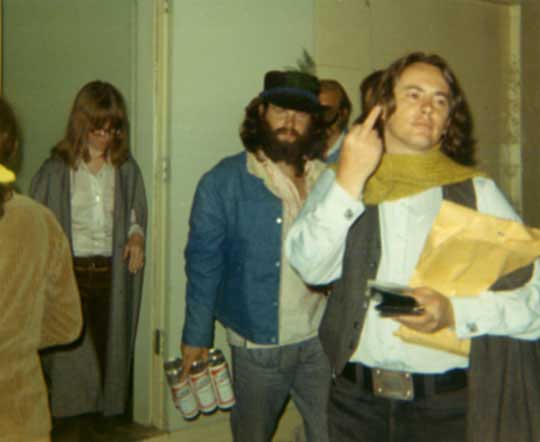
Above is a photo of the famous Beat Poet, Micchael McClure flipping the press the bird. He and his good friend, Jim Morrison, are going to go off and drink some suds and do some Bohemian phlitofpphizing. My childhood friend, Michael Harkins, was a good friend of Jim and Michael. Harkins came to Santa Rosa to visit me while I was visiting my daughter. We took Tyler to lunch and the playground.
I met Harkins when he was fifteen in 1965 at his home in the Oakland Hills. Keith, Nancy, Carrol, myself, and Blair had come to buy some marijuana for our trip to LA. Keith was Christine’s boyfriend in 1964, and came to live with me in New York. He and Nancy were lovers.
We first partied at Betty zorthians mansion in Pasadena where I met Berry and Ceyburn, Betty’s two daughters. We dropped LSD and had an amazing party attended by over a hundred beautiful young people, who also managed to get their hands on some LSD that legal at the time. Two day later, we went out to the Zorthian Ranch where I was introduce to Jary who was painting in his studio. We exhaled words about art, and, it was back to the party that lasted two years. On many ocassion, Zorthian was the Grand of he Doo-Dah parade that was a model for the Eguene Celebration Parade, and is a stage for the Boho look found at the Country Fair.
There was this beautify young girl on the huge trampoline built over a pit. Van Morrison’s ‘Gloria’ was blaring on the outdoor speaker system. She did back flips and twists high in the air. She was so free! I never felt freer, since the death of our dear friend Bill. I knew our Bohemianism would not die, but would live on. Then a beautiful young man got on the trampoline with the girl. At then end of the movie, this young man and girl will flip Bill Cornwell the bird for my generations sake, who are just becoming seniors who will be receiving Social Security and thus will be “parasites” according to Bill and my daughter.
The true and real hippies looked down on being famous. Christime Rosamond Benton was a real hippie who knew where the source of her success came from, and wanted to share her good fortune with her hippie brother.
Bill is not a cop, nor was he ever a cop like his father. Bill is not a veteran, like his father. Bill Cornwell is a Fink Wanna-be who thought he was busting a Sunday wanna-be hippie, but, bagged a Big One. Bill busted he ass of ‘The Bohemian California Kid’ whose history is going to highlight Bill as an enemy of Bohemianism. Yep, you made the big time – asshole!
People like Bill have been busting hippie ass for decades jut to make a name for themselves. The destructive one are so jealous of these creative and free peoples, they can’t see straight. Just beause they pay taxes, they think they own a tin star from Texas. A hundred million democrats who hate these wanna-be patriots, pay their taxes. But, they don’t whine, don’t prentend they are good buddies with billioaires – who use jerks like Bill to get more tax breaks.
Bohemianism, and Rock and Roll, has generated billions of dollars, and put money in Uncle Sam’s Tax pile. The fashion industry may be the largest industry in the world. Then there is the hippie food industry. What have the Destructive Hate Groups that Bill Cornwell loves – done for America?
To the haters of the world, on behalf of my love generation – this bird’s for you!
Play your drums, son! Play all Gloria songs below AT THE SAME TIME – and get off……….my case!
Jon Presco
Copyright 2012
https://rosamondpress.wordpress.com/2012/03/02/clue-of-the-red-thread/
Poem by Jim Morrison
People need Connectors
Writers, heroes, stars,
leaders
To give life form.
A child’s sand boat facing
the sun.
Plastic soldiers in the miniature
dirt war. Forts.
Garage Rocket Ships
Ceremonies, theatre, dances
To reassert Tribal needs & memories
a call to worship, uniting
above all, a reversion,
a longing for family & the
safety magic of childhood.
Poem by The Bohemian California Kid
The child plays
the toy boat sail across the pond
the work has just begun
Oh child
look what you have done
http://archives.waiting-forthe-sun.net/Pages/Players/Personal/mcclure_recalls.html
Robert “Tim” Scully (born August 27, 1944) is best known in the psychedelic underground for his work in the production of LSD from 1966 to 1969, for which he was indicted in 1973 and convicted in 1974.[1] His best known product, dubbed “Orange Sunshine”, was considered the standard for quality LSD in 1969.[2]
Scully grew up in Pleasant Hill, which was across the Bay from San Francisco. In eighth grade he won honorable mention in the 1958 Bay Area Science Fair for designing and building a small computer. During high school he spent summers working at the Lawrence Berkeley Laboratory on physics problems. In his junior year of high school, Scully completed a small linear accelerator in the school science lab (he was trying to make gold atoms from mercury) which was pictured in a 1961 edition of the Oakland Tribune. Scully skipped his senior year of high school and went directly to U.C. Berkeley majoring in mathematical physics. After two years at Berkeley, Scully took a leave of absence in 1964 because his services as an electronic design consultant were in high demand. Tim Scully first took LSD on April 15, 1965.
Scully knew the government would move quickly to suppress LSD distribution, and he wanted to obtain as much of the main precursor chemical, lysergic acid, as possible. Scully soon learned that Owsley Stanley possessed a large amount (440 grams) of lysergic acid monohydrate. Owsley and Scully finally met a few weeks before the Trips Festival in the fall of 1965. The 30-year-old Owsley took the 21 year old Scully as his apprentice[3] and they pursued their mutual interest in electronics and psychedelic synthesis.
Nick Sand (born 1941) is a cult figure in the psychedelic community for his work as a clandestine chemist from 1966-1996 for the Brotherhood of Eternal Love. [1][2] Sand was also Chief Alchemist for the League for Spiritual Discovery at the Millbrook estate in New York and was credited as the “first underground chemist on record to have synthesized DMT”.[3]
Contents
[hide]
1 Background
2 Prosecution
2.1 Resurfacing
3 References
4 External links
[edit] Background
Sand grew up in Brooklyn, New York and by his late teens he was already aware of the LSD scene developing around Greenwich Village. While attending Brooklyn College, Sand became interested in the teachings of Gurdjieff, the study of different cultures, and various Eastern philosophers.[4] Graduating in 1966 with a degree in Anthropology and Sociology, Sand followed Leary and Alpert to Millbrook and became a guide to the psychedelic realm for many of the people who came to Millbrook. During this time Sand also began extracting DMT in his bathtub.[4]
Sand later started a perfume company as a front for the production of Mescaline and DMT.[5] During this time Sand began to attract the attention of the police due to his lengthy visits to Milbrook and chose to move his lab to San Francisco after Owsley visited Milbrook in April 1967.[citation needed] Sand’s San Francisco Lab was operational by July 1967. Sand wanted to make LSD but was lacking the necessary precursors. Owsley had given him a formula for STP and would tablet Sand’s product from his own lab in Orinda.
http://druglibrary.net/schaffer/lsd/books/belcont.htm
The illicit drug World is the largest and most profitable of all criminal enterprises, making substantial but secretive contributions to the economies of Third World countries, turning individuals in the West from paupers to millionaires in a matter of years, and spurring greater international police co-operation than any other activity. No other criminal problem draws an annual individual message from the President of the United States or a biennial United Nations report. The amount of money generated by illicit drugs makes their trafficking, manufacture and sale one of the great industries of the world in the late twentieth century.
It was with these facts in mind that this book first began as an idea in 1978, spawned during one of the world’s largest LSD trials then taking place in Britain. The original intention was an exploration of drugs, guiding the reader through the secret passages of supply and mapping their extent. But in the course of the trial, the Brotherhood of Eternal Love was mentioned. Created in 1966 in California, it was credited with having generated $200 million through an estimated membership of 750 people, and was held responsible for widely distributing LSD and marijuana in the United States. The police described it as a ‘hippie mafia’ and the counter-culture talked softly of a secretive, mystical band whose motives were idealistic. Despite its size and the tantalizing mystery surrounding it, no book had looked at the Brotherhood in any detail. Our project turned from a general study into a concentrated examination of one particular group.
The hippies of the 1960s are normally remembered for their pacific dispositions, their preaching of ‘Peace and Love’; and yet, if the stories were to be believed, some banded into a ‘mafia’. A social phenomenon which spurned materialism, the hippies had none the less made millions. Yet that Alternative Society, or what is left of it, claimed they were idealists whose history was to be guarded as carefully as any state secret. The Brotherhood supplied LSD and marijuana as a sacred mission, believing in the righteousness of their profession. No one could grasp what they did without understanding the rise of LSD, the growth of the psychedelic movement and the heady, optimistic, revolutionary, energized days of the 1960s.
In trying to achieve that comprehension, our book began to shift ground again. The Brotherhood existed, achieving many of the things claimed on its behalf. It did indeed generate millions of dollars, and it was a loose-limbed mafia of sorts. It was also fired with idealism. The Brotherhood of Eternal Love was one part of a much greater movement fascinated by the potential of LSD to improve the quality of Man’s life.
In the beginning, LSD was little more than a promising psychiatric tool which might at the same time also become a potent new weapon in the hands of generals and spymasters. The research, both civilian and military, was widespread. And it brought with it a third possibility-that through the heightened perceptions and insights it produced, LSD could radically alter the direction of the human race towards a better pathway for the future.
The dream brought together many diverse individuals from a renowned philosopher to a Harvard professor and a best-selling novelist-and led to the creation of the psychedelic movement. Drugs in the 1960s no longer meant the inebriation of the socially deprived or inept, but a means to ‘enlightenment’. LSD brought in its train greater use of marijuana, classified as a narcotic but in fact a natural member of the same class of drugs-the hallucinogens.
LSD was proscribed, as marijuana had long been, but the dream could not be shaken so easily. There were those who were prepared to make LSD and those, like the Brother hood, who were prepared to distribute it: there was the millionaire scion of one of America’s richest families who became a financial adviser and banker to LSD-makers; the underground chemist, dubbed the ‘unofficial mayor of San Francisco’; and the core of the Brotherhood, living on a secluded ranch at the centre of an ever-increasing group of dealers and smugglers.
Their experiences, sometimes seen through the eyes of an individual and at other times through those of a crowd, make up the story of a movement which crossed frontiers and oceans in pursuit of the promised millenium. They are figures seen against the backdrop of a decade in which Youth seemed about to conquer the world with rock and roll for its battle hymns and slogans for a manifesto.
Yet somehow the old ways refused to surrender, fighting back with all the strength they could muster. The story became one of how the supporters of a dream were driven underground, where ideals wither before the demands of survival. Any alternative society which tries to establish itself alongside the status quo faces the problems of hostility, the potential for corruption and the ambiguities of its uneasy existence. The psychedelic movement never possessed discipline and order with which to combat its difficulties. The drugs at its core were sacred tools but also commercial commodities.
The story moved to a bleaker landscape, heavy with the scent of corruption, profit and betrayal. The book became a story of fallen idealism, a modern morality play, peopled not only with psychedelic ideologues but with terrorists, criminal entrepreneurs and those who walk on the wilder shores of life.
Perhaps the book has returned to its original intention. Before-the 1960s, the illicit drug industry was a relatively small but persistent enterprise. Today, it is enormous. This book may go some way to explaining that phenomenon.
People often ask, “where did Nancy’s Yogurt get its name?” Simple, from Nancy Van Brasch Hamren, the Springfield Creamery’s long-time bookkeeper and recipe supplier.
Born and raised in California, Texas and Iowa, Nancy’s was the third generation in a lineage of health food enthusiasts. In 1966, Nancy moved to Haight Ashbury in San Francisco to attend college. It was 1969 when she met Ken Kesey, counterculture leader and author of One Flew Over the Cuckoo’s Nest, and she was invited to take care of Ken’s Pleasant Hill, Oregon farm while he was in London recording stories with the Beatles. When Nancy heard Ken’s brother, Chuck, had a little creamery in Springfield, Ore., and was looking for a bookkeeper, she applied and soon found herself sharing her knowledge of making yogurt.
This was just when live cultures were becoming a topic of conversation. Using Nancy’s grandmother’s recipe for yogurt, Nancy and Chuck began experimenting using acidophilus in a sour cream-like yogurt. What they ended up with was traditional, creamy, full-bodied, tangy yogurt that is now known as Nancy’s Yogurt.
Chuck Kesey comes across as quirky — a 71-year-old mad scientist in a milkman’s cap. A charismatic, anti-establishment entrepreneur whose frothy white mutton chops nearly meet mid-chin. A fellow who launched his career in 1960 with the help of two great loves, his new bride, Sue, and that biological trickster, bacteria.
The stuff fascinated him. It had ever since he studied live cultures as a dairy science student at Oregon State University in the 1950s. Sue Kesey, a secretarial science major in OSU’s business administration school, remembers typing his term papers extolling the virtues of Lactobacillus acidophilus, one of those good microorganisms that lives naturally in the human gut, and the bacteria commonly used to ferment yogurt.
But that would come later.
The Keseys graduated in 1960 and moved to Springfield, where Chuck and his brother, celebrated author Ken Kesey, grew up as “creamery rats,” working alongside their father, Fred, who managed the Eugene Farmers Creamery.
With $350 in the bank, Chuck and Sue leased the defunct Springfield Creamery for $150 a month, and began packaging milk in gallon glass jugs for other creameries. They delivered milk to stores, homes and Springfield’s schools.
But by the end of that decade, the milk business changed, and not in the little guys’ favor. Production consolidated and industrialized. Rather than having it delivered to their doorsteps, consumers stocked up on milk at increasingly prolific supermarkets.
If the Keseys wanted to stay in business for themselves, they needed a niche product — one that suited the back-to-nature sensibility they shared with so many in their generation and those that followed.
Chuck Kesey’s great notion: yogurt, infused with his beloved bacteria.
**
Nancy Van Brasch Hamren brought her grandmother’s recipe to Springfield Creamery in the late ’60s when she started as bookkeeper. She still works in 2010 as office manager.Nancy Van Brasch Hamren had a recipe. Her health-conscious grandmother made yogurt, and so did she during the months she lived on Ken Kesey’s farm near Eugene.
Hamren, a lanky, soft-spoken Californian, ran in circles simply psychedelic with history. She lived in San Francisco’s Haight-Ashbury district from 1966 to 1968, the bookends to 1967’s Summer of Love. Her boyfriend’s sister was married to Jerry Garcia, the Grateful Dead’s shaggy-haired lead guitarist. And they all knew Ken Kesey — from his books, “One Flew Over the Cuckoo’s Nest” and “Sometimes a Great Notion,” and from the infamous, drug-juiced parties known as Acid Tests, which he hosted and promoted.
When Ken Kesey traveled to Britain to work with the Beatles in 1969, Hamren and her boyfriend moved to Oregon to look after his farm. When Kesey and his family returned, she needed a new pad and a job. Down at the creamery, his brother, Chuck, needed a bookkeeper. He and Sue hired Hamren, and they started talking yogurt.
The time was right. The place, too.
Eugene and Springfield brimmed with hippie bakeries, granola makers, co-ops and natural-food stores. College kids and others living there moved beyond white bread long before the mainstream pondered crafting diets around fresh, local, organic food.
“It was a very fertile place for an alternative vision, particularly in the natural foods world,” says Cameron Healy, who in 1972 paid $1,000 for a little bakery next to the Keseys’ creamery. “People had a real sense of mission.”
Healy went on to found Kettle Foods, of Salem, a leading natural and organic snack manufacturer, which had estimated annual sales of $150 million when he sold it in 2006. Today he and his son, Spoon Khalsa, run Kona Brewing Co., which makes, among other brews, Hawaii’s only certified organic beer.
Hamren and Chuck Kesey started cooking yogurt, experimenting with various bacteria, natural sweeteners and fruit from nearby farms and orchards. They think Springfield was the first U.S. creamery to use live acidophilus cultures in its yogurt. It’s among the bacteria known as probiotics, believed to aid in digestion and perhaps stimulate the immune system and help prevent infection.
Willamette People’s Co-op bought the first commercially available batches of the creamery’s yogurt, and when the stock ran out, a caller from the co-op asked, “Can you bring us some more of that Nancy’s yogurt?”
It had a nice ring — more palatable, Sue Kesey says, than a yogurt called Chuck’s.
The Nancy’s Yogurt brand was born.
**
Faith Cathcart, The OregonianTim Green works the line at the Springfield Creamery in Eugene.The year was 1970 and next door to the creamery, the Keseys opened the Health Food and Pool Store. A mural outside depicted a fun-filled utopia, complete with a rainbow, a man in the moon, a smiling sun and dancing milk jugs. Inside, not far from the pool table, bulk foods, whole grains, herbs, candles and, of course, Nancy’s Yogurt, filled the shelves.
Chuck Kesey smiles slyly and his eyes glint as he describes the store as “a real culture shock to Springfield.”
Healy, the fellow who bought the bakery next door, remembers that the place lit up whenever Ken Kesey, who died in 2001, rolled up in his Cadillac. He and a few of the Merry Pranksters, as those in his entourage were known, would hop out, shoot pool and raise the sort of high-energy ruckus that fueled their radical reputation.
That reputation and the impact Ken Kesey had on 1970s youth culture gave Nancy’s Yogurt a nudge, or, as Gilbert Rosborne puts it, “The Kesey name gave it hippie star power.”
Rosborne was a University of Oregon graduate student who delivered Rolling Stone magazine in Portland and Seattle. He recalls sitting outside the creamery chatting with Chuck Kesey when he wondered aloud: Why not drive a truckload of Nancy’s Yogurt to that long-hair haven, the San Francisco Bay Area, and try to sell it?
He needed a partner and asked a Mill Valley, Calif., acquaintance — a guy as sharp at auto mechanics as he was with a harmonica — to join him. Rosborne and his new partner, Huey Lewis, called their venture Natural Foods Express.
They bought old delivery trucks and Lewis tuned them until they purred. The two men took turns driving the long slog between Springfield and the Bay Area, Lewis blowing tunes on the harmonica as they traveled. And the Bay Area devoured Nancy’s Yogurt.
“Rock’n’roll, natural foods, pot. We were gonna create a whole new world,” says Rosborne, who lives north of San Francisco, in a Larkspur, Calif., home he and Lewis once co-owned.
The men dissolved their business partnership around the time Lewis’ band, Huey Lewis and the News, hit it big in the 1980s.
These days, Rosborne delivers wine for a living, but he still fills his fridge with Nancy’s Yogurt.
“The main thing I got out of it,” he says, “was good digestion.”
**
In post-World War II America, there was a resurgence of interest in medieval and Renaissance culture. In the 1950s, there was a very strong early music revival, and out of that came folk musician and traditionalist John Langstaff. In 1957, Langstaff held “A Christmas Masque of Traditional Revels” in New York City, and the following year another in Washington, D.C.. A televised version was broadcast on the “Hallmark Hall of Fame” in 1966 which included Dustin Hoffman playing the part of the dragon slain by Saint George, and in 1971 Langstaff established a permanent Christmas Revels in Cambridge, Massachusetts.[4]
In 1963, Los Angeles schoolteacher Phyllis Patterson held a very small Renaissance fair as a class activity, in the backyard of her Laurel Canyon home in the Hollywood Hills. On May 11 and 12 of that year, Phyllis and her husband Ron Patterson, presented the first “Renaissance Pleasure Faire” as a one-weekend fundraiser for radio station KPFK, drawing some 8,000 people.
Blacksmith at Scarborough Faire, Texas (2009)The fair was designed by the Living History Center to resemble an actual spring market fair of the period.[5] Many of the original booths were no-charge reenactments of historical activities including printing presses and blacksmiths. The first commercial vendors were mostly artisans and food merchants and were required to demonstrate historical accuracy or plausibility for their wares. Groups of volunteers were organized into “guilds” to focus on specific reenactment duties (musicians, military, celtic clans, peasants, etc.). Both actors and vendors were required to successfully complete workshops in period language and accents, costuming, and culture, and to stay “in character” while working.
For many years thereafter, the Renaissance Pleasure Faire of Southern California (RPFS) was held in the spring at the Paramount Ranch located in Agoura, California, partaking of the rich lore and age-old customs of English springtime markets and “Maying” customs. Five years later, the Pattersons created a fall Renaissance fair, with a harvest festival theme, first at what is now China Camp State Park in San Rafael, California and two years later at the Black Point Forest in Novato, California. Both fairs developed into local traditions and began a movement that spread across the country, though fairs that copied the original frequently did not attempt such historical accuracy.[citation needed]
Zorthian is known among physicists for his friendship with Richard Phillips Feynman, Nobel Prize winning physicist. They met at a party where Feynman played bongos: Zorthian removed his shirt and made funny designs on his own chest with available materials. Zorthian and Feynman’s attempts to teach each other physics and art respectively are described in Feynman’s autobiography Surely You’re Joking, Mr. Feynman!.
[edit] Zorthian’s work
Zorthian, who earned his own kaleidoscopic descriptives as the last bohemian, a rustic latter-day Henri de Toulouse-Lautrec or an ongoing work of performance art, died on January 6, 2004 of congestive heart failure. The nonagenarian’s paintings, primarily of nude women that he said expressed “every man’s fantasy,” sold for tens of thousands of dollars.
For Zorthian… the beautiful human body was … not merely an object but a potent means of communication for any and all ideas, as well as a source of inspiration and aesthetic delight
In a very real sense, his nudes are autobiographical, telling more about him than his subjects.[2]
But Zorthian was perhaps better known in Southern California art circles for his free-form lifestyle than for his prodigious art. Each spring during the last decade of his life he threw a primavera birthday party, dubbing himself Zor-Bacchus, wearing a toga over long red underwear, and nibbling grapes from the hands of nude, garlanded nymphs (many of which were his artist models). Zorthian joined the nymphs in dancing to the pipes of a cavorting Pan garbed in furry goat leggings. Alcohol flowed freely and a roasted pig fed hundreds of guests who could include scientists, movie stars, internationally known artists, writers and musicians and ordinary people.
The diminutive Armenian-American was friends with jazzman Charlie Parker, artist Andy Warhol and Nobel-winning physicist Richard Feynman.
The ranch served as a haven of bohemian life and a backdrop for items of Zorthian’s artistic expression—salvaged wood, bed springs, rusted vehicles, broken concrete, beer bottles, old shoes and other junk he could recycle into various sculptures and architecture. Zorthian called the ranch The Center for Research and Development with an Emphasis on Aesthetics, and fashioned rental houses out of discarded items including telephone poles and railroad ties. He also built rock walls, towers, inlaid bridges and walkways. He painted in a studio and bred horses for his horse ring.
Zorthian and his wife, Dabney (March 21, 1933 – May 10, 2006), lived in a small pseudo-brick house on the ranch, well loved by friends as welcoming although very cluttered. The couple often preferred to sleep outdoors. They slaughtered their own livestock and made their own sausage, milked their own goats and made cheese, raised their own vegetables and gathered eggs from their chickens. As a young immigrant, Zorthian had been startled by how wasteful Americans seemed and vowed to recycle everything he could and to create his own self-sufficient environment, a trait he share with rival/fellow castle-builder Michael Rubel.
Proudly, Zorthian offered his own down-to-earth appraisal of his art ranch for the Los Angeles Times in 1990: This entire property has sort of been sculpted with a skip-loader. I have 40 more years of work. I don’t have time to die…. A lot of people my age have given up being curious or vital. Can you imagine me in a retirement home playing shuffleboard?
Zorthian was equally at home attending posh art events in a tuxedo as in digging through restaurant trash cans for recyclable objects. He chaired the Pasadena Art Fair in 1954 and 1955 and staged a show of his work at what was then the Pasadena Art Museum in 1953.
Ernest M. Saenz’ recalls his meetings with Jerry: “A pig’s balls are more beautiful than a man’s; so much more beautiful that a pig can display them with pride: not like us men that have to hide them with drawls and pants. That’s why I paint them, pig balls and naked women, they are the only two things that have gained the public’s approval for open display!” my private art teacher Col. J. Zorthian in a conversation relating on composition – 1979
JIRAYR ZORTHIAN: I think, perhaps, it might be interesting for me to give you a slight — just a small history of it. You know, I’m from the East originally. Was born in Turkish Armenia. Came to this country when I was 12 to New Haven, Connecticut. Was educated there. Went through Yale school of Fine Arts. I won a fellowship to study there. And I won a fellowship to study in Europe. On my graduation – came back and did many, many murals throughout the country. Most of them in the East Coast. And, I was interrupted by the Second World War. I spent three and a half years in the Army. With my first wife, whom I married just before I got into the Army. She was from New Orleans. She, however, was educated in the East, Sarah Lawrence. And when the war ended, I had done enough long distance murals . . .
PAUL KARLSTROM: What do you mean by that?
JIRAYR ZORTHIAN: For instance, I did 11 murals for the [Tennessee]state capitol in Nashville in this studio in New York. And when they were finished, transported them over there and put them up. And I felt . . . I had never really acclimated myself to the East. And I always felt that if I was gonna be an American artist, I should go West. Go West, young man, go West. And, believe it or not, Betty and I chose . . .
PAUL KARLSTROM: Your wife’s name was Betty?
JIRAYR ZORTHIAN: Betty. That was this wife.
PAUL KARLSTROM: What was were maiden name?
JIRAYR ZORTHIAN: Her maiden name was Betty Williams.
PAUL KARLSTROM: Williams.
JIRAYR ZORTHIAN: She was from New Orleans from a very affluent family. She had 30 suitors after her. She was an heiress. But she and I started having children in the East and decided that we — first, one of the reasons I — we — got this place was — first, we didn’t trust supermarket food and we were very particular about what went into our children’s stomachs and we decided to have some land where we could grow our vegetables, our own — have our own chickens and slaughter our own animals, even though both of us had never done this before. And we bought 10 acres of land outside of San Antonio, Texas and I felt San Antonio was an excellent place for me to fulfill this idea I had of doing murals — it’s centrally located in the country. Now, for instance, if I wanted to do something for . . . and I loved Mexico, too, that was another reason. The southern part would have been Mexico, I could go to Mexico frequently. If I wanted to do something for Chicago, it was a short trip to Chicago. To New York, to San Francisco, to Los Angeles. However, my — as time went on, it was almost impossible to find a place in San Antonio to live. We lived in the East waiting for a place to even rent.
PAUL KARLSTROM: Where did you live in the East? Where were you living then when you were first married?
JIRAYR ZORTHIAN: In New Haven.
PAUL KARLSTROM: You were still in New Haven?
JIRAYR ZORTHIAN: In New Haven, yes. But since, I said, the war interrupted with our, you know, our life. By this time we were living in Maryland somewhere in this country estate of somebody and we became accustomed to this country life and that was another reason we wanted some land and so we were hell-bent on going to San Antonio, outside of San Antonio. But my former wife’s mother had other ideas and she said, “You’re going live in Texas?”. So, somehow, we ended up coming to California and first to La Jolla for three months in some person’s house who had temporarily went to New Orleans. And looking for a appropriate place to have a ranch.
JIRAYR ZORTHIAN: And I was educated in Yale, etcetera. So my circumstances improved as far as our social life was concerned. And Betty, of course, was from the highest social background — from New Orleans. Her father was head of the Whitney National Bank and when we came to California we immediately started meeting people who apparently liked us because we used to go to these fancy Valley Hunt Club parties, constantly. So, it was through a social gathering that I met her. There was this Spinster’s Ball, it was considered one of the fanciest parties of the year and so the — it wasn’t completely bohemian, that’s pretty . . .
PAUL KARLSTROM: No, I understand that. I mean . . .
JIRAYR ZORTHIAN: . . . we — I have a very important philosophy about that. I have never, ever, I think, been in any cause to try to prove a point about how one should live and doesn’t. For instance, I was never caught up in the ’60’s . . .
PAUL KARLSTROM: Counter culture . . .
JIRAYR ZORTHIAN: Counter culture. Because I felt that they were doing exactly the same thing that people in the Valley Hunt Club were doing. The Valley Hunt Club you played tennis, you had swimming pools, you wore tweeds and talked a certain way and the hippies wore sandals and smoked marijuana, and talked a certain way. But in my experience in all my life has been that I’ve been able to travel in almost any circle so it wasn’t that Dabney was throwing away her social life, at all. We went to many, many social gatherings and still do.
PAUL KARLSTROM: Yes, I know you do. Well, then do you feel, really — you saw all of this as increasing your options of experience — amplifying your experience. You know, keeping the connections with more established society?
JIRAYR ZORTHIAN: Not purposely. It seems that, for instance, we got to know some very — Betty and myself — we used to frequently go to the Hixons. Adelaide and Alex Hixon, who live in San Marino. And — but Betty’s mother was very much against — now I must make it very clear — she was very much against this concept of life. In fact, she used to call it the “dirty old farm”. She once came to me and said, “Jerry, look, if you feel that you’ve made a mistake, don’t worry about the money. We can give it to charity. We can get rid of it. We have enough money for you to live in much better circumstances, certainly. For instance, you should live in San Marino.” And, “I brought my daughter up to be a lady and now you’ve made a farmer woman out of her”. This kind of thing. And, of course, as I said, we frequently went to these parties where all these people lived and I remember once — the Hixons were very much aware of this — and when she came to visit us from New Orleans once, they gave a wonderful, wonderful party for us. Only about 14 people were there and it was the most luxurious thing and when it was all over — on the way home — Betty’s mother said, “Now, Jirayr, why is it that you can’t live like the Hixons? Why can’t you buy a house somewhere in San Marino and live like those Hixons?”
PAUL KARLSTROM: And what did you say?
JIRAYR ZORTHIAN: I said, “Look, I don’t want to live like the Hixons. I’m very happy the way I live and so is Betty”. But, just not too long ago, about six months — eight months ago, maybe — I did something for the Hixons for charity. I did a picture fence, I think you’ve seen it.
PAUL KARLSTROM: Um-hmm. Um-hmm.
JIRAYR ZORTHIAN: While we were having lunch, discussing this thing, I told Adelaide this story . . .
PAUL KARLSTROM: What are their names? Adelaide and . . .
JIRAYR ZORTHIAN: Adelaide and Alex.
PAUL KARLSTROM: Okay.
JIRAYR ZORTHIAN: And I said, “Do you remember”, I said, “that party you gave some 40 years ago, 30 years ago?”, I done forgot where it was. And I told her the story about how Betty’s mother told me this thing I just told you and before I finished my sentence she grabbed my arm and she said, “And we want to live like you.”
PAUL KARLSTROM: I love it.
JIRAYR ZORTHIAN: But you see they can’t live like me. This is the fascinating part of it. They have to live the way they do. The environment they’ve created requires that. They have to . . .
PAUL KARLSTROM: They have their jobs and so forth.
JIRAYR ZORTHIAN: Pardon me?
PAUL KARLSTROM: Their jobs, businesses, there are all these . . .
JIRAYR ZORTHIAN: Their business, their every — their social everything. Give a party, they have to invite certain people. You know, it’s just — they can’t get out of it suddenly.
[SESSION 1; TAPE 1, SIDE B]
PAUL KARLSTROM: . . .[continuing] with this first interview with Jirayr Zorthian. This is Tape 1, side B. We were learning about the history of this place — your property. What I call the “art ranch.” Is that alright to call it an art ranch?
JIRAYR ZORTHIAN: Alright. Fine.
PAUL KARLSTROM: What do you call it?
JIRAYR ZORTHIAN: Well, I’m sure eventually it’ll end up being some kind of an art center where artists and creative people will meet, which is what we do all the time anyway.
PAUL KARLSTROM: Um-hmm. Um-hmm.
JIRAYR ZORTHIAN: But, probably be officially something like that. Right now I call it Center for Research and Development of Industrial Discards with the Emphasis on Aesthetics.
PAUL KARLSTROM: That’s a mouthful. What a title. Center for Research and Development of . . .
JIRAYR ZORTHIAN: Industrial Discards . . .
PAUL KARLSTROM: . . . Industrial Discards. Uh-huh.
JIRAYR ZORTHIAN: With the Emphasis on Aesthetics.
PAUL KARLSTROM: I like that.
JIRAYR ZORTHIAN: That last part has to be there or else it isn’t . . .
PAUL KARLSTROM: Do you see — let’s, you know, forget for a moment about lifestyle and those kinds of choices and maybe even how you’re perceived, how you perceive yourself. The property itself — this place — this Center for Research and Development of Industrial Discards with Emphasis on Aesthetics — do you see this as the reification of your ideas about art? I mean, do you see it as, like, a process piece? The whole environment? Do you think of it that way? Is it your artwork? Or is that something we bring to it? How do you feel about that?

 Rosamond Press
Leave a comment