

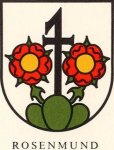


My Rosamond kin were members of two Swiss Guilds. Hans in John. There is a father and son named John de Rougemont. The mythical Grand Masters of the Priory de Sion were named John. My famous sister rendered many images of beautiful women – for money! I render the portrait of one woman – for prosperity! Why? Who am I?
I am the one who found her. I am the one whom she finds. Together, we open the door for returning souls – who come into the bodies of the dead. We are the New Eden. Consider Matthew 27:53
Jon
“This James (or Jacob, for these names were once interchangeable) was the son of Hans Ulrich Rosemond, born 1623, a weaver; who was a son of Hans, a weaver, born 1581; who was a son of Fred Rosemond, born 1552, a weaver, member of town council and a local captain; who was the son of another Hans whose date of birth is not known, but he too, was a weaver and became a citizen of Basle in 1534. His father was Erhart de Rougemont who bought in 1495 ¡°the house called Rebleuten-Zunft in Basle in the Freistrasse”
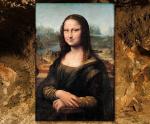
“Her name was given to Mona Lisa, her portrait commissioned by her husband and painted by Leonardo da Vinci during the Italian Renaissance.
“On 5 March 1495, Lisa married Francesco di Bartolomeo di Zanobi del Giocondo, a modestly successful cloth and silk merchant, becoming his third wife at age 15. Lisa’s dowry was 170 florins and the San Silvestro farm near her family’s country home, a sign that the Gherardini family was not wealthy at the time and reason to think she and her husband loved each other.
Hans is a masculine given name. In German, Danish, Dutch, Norwegian, Icelandic and Swedish, originally it is short for Johannes (John) but is also recognized in Sweden, Germany, Denmark and the Netherlands as a name in its own right for official purposes.
“Hansel” (German Hänsel) is a variant, meaning “little Hans.” Another variant with the same meaning is Hänschen, found in the German proverb “Was Hänschen nicht lernt, lernt Hans nimmer mehr,” which translates roughly as: “What [little] Johnny doesn’t learn, [grown-up] John will never learn.”
Other variants include: Hanns, Hannes, Hansi (also female), Hansele, Hansal, Hensal, Hanserl, Hännschen, Hennes, Hännes, Hänneschen, Henning, Henner, Honsa, Johan, Johann, Jan, Jannes, Jo, Joha, Hanselmann, Hansje.
For centuries, Mona Lisa’s famous mysterious smile has captivated everyone who saw her, leaving behind one burning question: what does it mean?
Now, with the potential discovery of the remains of the woman who could have posed for Leonardo da Vinci’s masterwork, the mystery might be on the verge of being solved.
An archaeological team that had been excavating the historical St. Ursula convent in Italy announced last weekend that they had found the crypt of Lisa Gherardini Del Giocondo. The Italian merchant’s wife, who died in 1542, is a prime suspect in the search for the model behind the Mona Lisa.
Professor Silvano Vinceti, the archaeologist in charge of the dig, remained cautious. “We don’t know yet if the bones belong to one single skeleton or more than one.”
Her remains were found five feet under the original floor of the convent. The centuries-old brick flooring was uncovered after a layer of modern concrete was removed.
There have been many theories about the woman with the enigmatic smile. Some have suggested that the model had actually been male, while others believe that there was no model, and da Vinci based the painting off several different women.
However, most modern historians believe that the model is none other than Lisa Ghirardini. The name of the painting itself is evidence towards that conclusion: “Mona” in Italian means “married”, and “Lisa” is taken from the name of the woman. Also, the oil-on-canvas painting is known as “La Giaconda” in Italy. Lisa Gherardini’s husband was named Francesco del Giocondo.
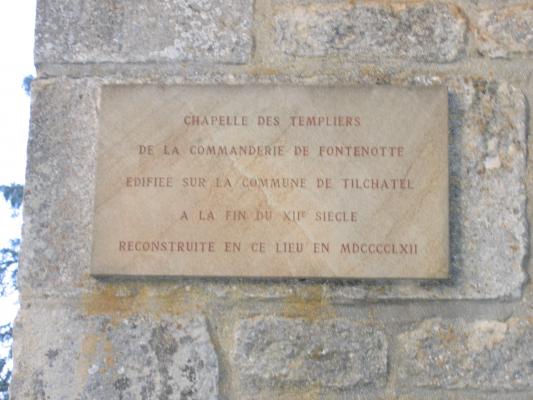
Three years ago I discovered the Templar Chapel of Fontenotte where the Rougemont family of Knights Templar worshipped.
Jon Presco
Copyright 2008
http://www.petit-patrimoine.com/fiche-petit-patrimoine.php?id_pp=21231_3
Dove seal ssed on the Seal of Etienne de Til-Chatel, lord of Pichanges, Preceptor of La Fontenotte. Representation of a dove, facing backwards and grasping an olive branch within its beak.
http://en.wikipedia.org/wiki/Knights_Templar_Seal
This Templar Order came to own the Templar Seal of Etienne de Til-Chatel.
http://www.ordotempli.org/the_first_preceptor.htm
In this genealogy we see the Lords of Rougemont are also the Lords of
Til-Chatel, and Trichatel which is the same place.
http://tinyurl.com/ycfnto
Allow me to change the names.
“The First Preceptor of La Fontenotte
The fifth son of Guy II of Rougemont and Guillemette de Coublant,
Etienne de Rougemont was lord of Pichanges. In December 1265, having
recalled the donations made to the temple by Aimon IV and Guy II, he
gave to the Templars, with the agreement of his elder brother, Jean,
Lord of Rougemont, the right of pasturage on his lands of Pichanges
and Spoy. He died in 1271 and was buried before the altar in the
chapel of Fontenotte and conferring his Templar rank of Preceptor
(priest-templar).
After the death of Etienne, Jean de Til-Chatel had to confirm in 1274
the rights of the Templars over Fontenotte. In 1278 his younger
brother, Guy, who had been curate of Til-Chatel in 1242 then
archdeacon of Le Tonnerois in the church of Langres, succeeded him at
the head of the lordship of Pichanges.
In May, 1274, Jean de Rougemont, Marshal of Burgundy legally
recorded “for the repose of his soul and that of his elder brother,
Etienne de Rougemont, who lies in the cemetery of the said Temple,
and of the souls of his forebears”, granted to Henri de Dole,
Commander of the House of Fontenotte:”
http://tinyurl.com/ycfnto
I have found a Hughes/Hue de Rougemont who a “grand maître du
Temple”in two accounts, and the maître du Temple of Burgundy in
another.This Hugues appears to be related to Humbert de Villersexel
who wasthe Lord of Rougemont and Til-Chatel. Is this the Hughes that
preceeded Bernard de Tramelay/Dramelay? Did this Hugues come after
Bernard. In the Fromond/Dramelay genealogy we find a line of De La
Roches, and thus the Rougemonts are kin to another Templar Grand
Master, Amaury de La Roche.
“Bernard de Tramelay (died August 16, 1153) was the fourth Grand
Master of the Knights Templar. He was born in the castle of Tramelay
near Saint-Claude in the Jura. According to Du Cange, he succeeded a
certain Hugues as Master of the Temple, although this Hugues is
otherwise unknown. He was elected Grand Master in June of 1151, after
the abdication of Everard des Barres, who had returned to France
following the Second Crusade.et”
“Hugues de Rougemont, grand maître du Temple””and Hugues de
Rougemont, large main of the Temple”
Humbert de Rougemont owned the Shroud of Turin. Humbert is a Hue name
and is kin to at least two Templar Grandmasters. Humbert was also the
Lord of Villersexel. He married the great granddaughter Geoffrey de
Charnay a Templar Grand Master. This is to say this Knights Templar
family, and thus the Knights Templars, owned and protected the Shroud
of Turin that they may have seized at Ascalon along with a great
treasure which would account for the large number of castle owned by
this very large Templar family. Never has such a constellation of
Knights Templars gathered in one place, under one roof as they did
come Sunday in Fontenotte.
Amaury and Othon de La Roche brought Jacque de Molay into the Templar
Order, the last Grand Master. Amaury disappears from history, it
alleged he was in keeping of the Templar Treasure. Did he go to
Holland where the Roesmont live, they members of the Swan Brethren
and Masters of Janskirk church?
“The legend says that it manages to escape and disparaitre
definitively at the same time as the Treasury and the secrecies of
Templiers.”
My search for my ancestor, Sergeant Rougemont, has led me to a
Templar family that was invisible. Sergeant was a Templar rank, a
title for a mayor of the Sungau, and a Seneschal. I have no direct
evident Sergeant Rougemont was kin to these Lords of Rougemont ? as
yet!
“I have three separate pages for Rosamond families we believe are
descended from a Sergeant Rosamond, a Huguenot who left France in
1685 at the Revocation of the Edict of Nantes, and fought in the
Battle of the Boyne in Ireland in 1689. We have not yet been able to
definitively tie these three families together, but each family was
independently aware of the story of Sergeant Rosamond and claimed him
as an ancestor. We are hoping that as research continues we will find
records showing us the relationship between our families.”
http://tinyurl.com/yyo7rc
(Images: Montfort Castle home to Humbert and Margaret de
Charny/Rougemont)”
June 1418: The widowed Margaret de Charny marries Humbert of
Villersexel, Count de la Roche, Lord of St.Hippolyte sur
Doubs.”Humbert de Villersexel is Humbert de Rougemont.
http://tinyurl.com/wfxst
 Rosamond Press
Leave a comment