Inside was a black wooden box. Curious, Wallace tugged it from its dark resting place. A white shroud appeared. Then leathery ribs. Then white candles.
“It was like a Dracula movie,” Wallace said. “The top of the skull was covered, but you could see the rib cage and the sinew.”
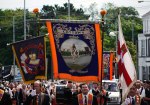
In the Rosicrucian tale by William Ainsworth, a Dracula like figure enters the secret tomb of Cyprian de Rougemont, an alleged Grand Master of the Rosy Cross. Rougemont in Neufchatel is the suggested source of the Rosamond name. The ancestors of Denis de Rougemont, a co-founder of the Eruopean Union and member of the Bilderberg conspiracy, opposed Frederick Wilhelm the third who claimed Neufchatel as a member of the Hohenzollern House of Orange. Above we see Bennett Rosamond the Grand Master of the Orange Lodge in Canada. The Bentons were Freemasons. I have shown that the Rougemonts were Knights Templar who owned the Shroud of Turin. The Rosemonts of Holland, were members of the Swan Brethren.
Jon Presco
Copyright
2011
As a major benefactor of the town he donated the money to build a hospital in Almonte which was named after him. He died on May 18, 1910 in England while preparing to return to Canada. Rosamond was a member of L.O.L. No. 389, located at Almonte and had served as master of the lodge. He also served as County Master of Lanark for a number of years.
http://roughian.tripod.com/BennettRosamond.html
http://thepeerage.com/p10072.htm
Denis de Rougemont is a Swiss writer. He was born on September 8, 1906 , in Couvet , canton of Neuchâtel , in Switzerland . He died on December 6, 1985 , in Geneva .Denis de Rougemont comes from the loves from George de Rougemont,
Pasteur, and of Anne Sophie, born Bouvet. The family of Rougemont is probably originating in the Franche-Comté ; she was established in Neuchâtel as of XIVème century. In 1784, it received a “Recognition of old nobility” of the King
Frederic II (Neuchâtel was then a Prussia Principality). The members of the family of Rougemont also belonged to the Council of State of Neuchâtel.”
“The door, which was of stout oak, was locked, but holding up the light towards it, he read the following inscription:
POST C.C.L. ANNOS PATEBO, 1550.
“In two hundred and fifty years I shall open!” cried Rougemont, “and the date 1550 — why, the exact time is arrived. Old Cyprian must have foreseen what would happen, and evidently intended to make me his heir. There was no occasion for the devil’s interference. And see, the key is in the lock. So!” And he turned it, and pushing against the door with some force, the rusty hinges gave way, and it
fell inwards. From the aperture left by the fallen door, a soft and silvery light, streamed forth, and, stepping forward, Rougemont found himself in a spacious vault, from the ceiling of which hung a large globe of crystal, containing in its heart a little flame, which diffused a radiance gentle as that of the moon, around, This,
then, was the ever-burning lamp of the Rosicrucians, and Rougemon at if with astonishment. Two hundred and fifty years had elapsed since that wondrous flame had been lighted, and yet it burnt on brightly as ever. Hooped round the globe was a serpent with its tail in its mouth — an emblem of eternity — wrought in purest gold; while above it were a pair of silver wings, in allusion to th soul. Massive chains of the more costly metal, fashioned like twisted snakes, served as suspenders to the lamp. The walls were covered with circles, squares and diagrams, and in some places were ornamented with grotesque carvings. In the centre
of the vault was a round altar of black marble, covered with a plate of gold, on which Rougemont read the following inscription: Hoc universi compendium unius mihi sepulcrum feci.
“Here, then, old Cyprian lies,” he cried.
“Dost hear me, old ancestor?” he cried. “I, thy descendant, Cyprian de Rougemont, call upon thee to point out where thy gold is hidden? I know that thou wert a brother of the Rosy Cross — one of the illuminati — and didst penetrate the mysteries of nature, and enter the region of light. I know also, that thou wert buried in this house with a vast treasure; but though I have made diligent search for it, and others have searched before me, thy grave has never yet
been discovered!”
San Francisco Chronicle
Page A6
Friday, March 30, 2001
Remnants of Secret Society Pose a Mystery Across the U.S.
Skeletons found in old lodges of Odd Fellows Maria Glod, Washington Post
Warrenton, Va. — Paul Wallace was alone, repairing overloaded circuits in the old red- brick building, when he discovered a tiny door to a dark recess between two walls.
Inside was a black wooden box. Curious, Wallace tugged it from its dark resting place. A white shroud appeared. Then leathery ribs. Then white candles.
“It was like a Dracula movie,” Wallace said. “The top of the skull was covered, but you could see the rib cage and the sinew.”
For a good 20 minutes, Wallace sat frozen. Finally, he returned the skeleton to its home between the walls of the Warrenton lodge of the Independent Order of Odd Fellows.
When police learned of Wallace’s macabre discovery, they rushed to get a search warrant and seized the remains. State medical examiners are studying the bones.
Around town, neighbors speculate about the identity of the corpse and why she was there. But perhaps the strangest thing about the mini-drama captivating this small town is that strikingly similar mysteries have played out across the
country.
It turns out that skeletons like “Jane Doe Odd Fellow,” as one officer calls her, reside in closets, drawers, attics and crawl spaces in Odd Fellows lodges nationwide. To members of the age-old fraternal order, the skeleton is a symbol of mortality, a treasured relic used in one of their most solemn and secret rituals: initiation.
But for many residents in the towns where the bones are found, the whole thing is just plain odd.
“A lot of people thought it was weird. They were like, ‘What if it were my daughter?’ ” Wallace said.
“I just couldn’t believe it,” said Elaine Walters, who lived in an apartment below the lodge as a child. “You have visions of people stealing it from a grave in the 1700s.”
As with many fraternal orders that compete with today’s fast-paced lifestyles, interest in the Odd Fellows has waned, and many lodges have closed.
More and more of the skeletons are emerging from their hiding places — often to the shock of the souls who come upon them. In recent years, the discovery of Odd
Fellows skeletons has sparked police investigations in Missouri, Indiana, Pennsylvania and Nebraska. In Oklahoma, the remains prompted a work crew to flee in terror.
Last year, Jim Leuschke, a Missouri accountant active in theater, was offered two free caskets by a disbanding Odd Fellows lodge. Always on the lookout for interesting props, he picked up the ornate wooden coffins and pried one open to
find a partial plaster skeleton.
Leuschke was unloading the coffins into his garage when the top of the second one jarred loose. What he saw wasn’t plaster.
“I told the kids, ‘Just keep it to yourselves. I don’t want you telling anybody we’ve got skeletons in our garage,’ ” he said.
Leuschke eventually reported his find, and skeptical police officers showed up at his door. “No one could believe what we had there,” he said.
Lisa Stone, a Chicago historian who has studied fraternal organizations, said one surprising part of the rituals is that the group has kept them secret for so long. The rituals are “not a booga-booga scary thing,” but out of context, the
skeletons are “frighteningly powerful objects,” she said. She noted that many fraternal orders, including the Masons, use similar images.
Even the Warrenton police haven’t been able to get the Odd Fellows to betray their order. Lt. Kerry White said members have cooperated — but with one caveat. “They specifically asked us not to divulge what they told us,” he said.
Odd Fellows Virginia Grand Lodge Secretary Jack Gibson Jr. bristles at the description of the organization’s rituals. “I don’t like the word ‘secret,’ ”
Gibson said. “It is a ceremony that is confined to the members, and if you’re not a member, you don’t discuss it.”
Why so hush-hush? “It makes you different,” Gibson said.
Wayne Colegrove, a longtime Odd Fellow from New York, still remembers his initiation more than 50 years ago. He hesitates to reveal too much but speaks of passwords and a skeleton that “wasn’t to be seen by anybody until you take the degree.”
“The words they say are something like, ‘You’re here, and pretty soon you’re gone, and there’s a hereafter,’ ” Colegrove said. “It’s a lesson in life.”
The Odd Fellows skeletons have popped up in costume shops and as decorations in bars. One made its way into a serial killer display at a New Orleans art gallery. Another made an appearance in the cult classic horror film “Dawn of the
Dead.”
The Independent Order of the Odd Fellows dates to 17th-century England as a charitable organization that worked to help families in need and buried their dead. The first American lodge opened in Baltimore in 1819.
Present-day Odd Fellows support a professorship of ophthalmology at John Hopkins University and contribute to the Arthritis Foundation and American Heart Association. The organization’s symbol — three interlocking rings — represents friendship, love and truth.
The skeletons likely were purchased from scientific or fraternal supply companies. One catalog from the early 1900s advertised a “genuine, full-size selected specimen, set up and wired, fairly deodorized.”
“Every one has a different story,” said Randall Kremer, a spokesman at the Smithsonian Institution. “The companies would obtain skeletons from anywhere possible. They could be indigents. Or often people, especially at the higher
levels of society, were anxious to donate their remains for scientific study.”
So far, authorities have learned that the Warrenton remains are those of a Caucasian woman who stood about 5 feet 1. Her arms, feet and lower jaw are missing. She could have died from 10 to 150 years ago. Medical examiners studying the bones are consulting with anthropologists at the Smithsonian,
police said.
Wallace, the electrician who revealed Jane Doe Odd Fellow, sees no harm in having her sent back to the hall. “It’s not witchcraft. It’s not satanic,” Wallace said. “They do a lot of good works.”
Still, he said, he hasn’t stopped wondering where she came from.
“Who was this person? When did they die? How did they die?” Wallace said.
“One of the Duke’s descendants claims to have excellent evidence concluding that Pierre de Rosemont was able to gain access to the tomb of Camus said to be very close to the secret treasure of the Knights Templars. Apparently, though, having almost reached his goal, the Duke was struck by violent blows and cries emanating from below, balls of mauve fire encircling the room and strange odours and visions.”
“Since 1959, many people have attempted to fathom this enigmatic secret. Having lived around the castle of Arginy, I am aware that many curious, painful and sometimes dangerous things happen every time someone tries to grasp the terrible secret. Local folklore has it that only one person is designated and recognised by the deceased
Templars to have access to them without risk to his or her life. The tradition thus reactivated, it is claimed that the Order shall rise from its ashes towards a higher and more certain glory.
“The noble association of the knights of Saint-Georges was founded in Rougemont about the year 1300 by the sovereigns of the county of Burgundy to gather Burgundian gentlemen of former knighthood.”
“This company had during a time the name of BROTHERHOOD of
Rougemont,because Philibert de Molan fixed it in this country, in 1431. Its assemblies were held above in l’église Large Carmelite friars of Besancon.
The Odd Fellows
In smaller towns and villages, there were too few Fellows from the same trade to set up a local Guild, so Fellows from a number of trades banded together to form a local Guild of Fellows from an odd assortment of trades. Hence, Guilds of Odd Fellows.[1]
Over the next 300 years or so, the idea of “ordinary” people joining together to improve their situation met with varying degrees of opposition (and persecution) from “the establishment”, depending on whether they were seen as a source of revenue (taxes) or a threat to their power. For example, when Henry VIII broke from the Roman Catholic Church, the Guilds were seen by him as supporters of the Pope, and in 1545 all material property of the Guilds was confiscated. Elizabeth I took away from the Guilds the responsibility for apprenticeships, and by the end of her reign, most Guilds had been suppressed.[1]
Ainsworth “The Byrom Collection.” and Sacred Geometry
John Byrom appeared in one of William Ainsworth’s novels. He was a Freemason and member of the Rosicrucians. In the Byrom Collection we are seeing the first interest in sacred geometry. Did Byrom read ‘Auriol’ and see himself in Cyprianus de Rougemont who has alas emerged as the leading fictional character in the Rosy interests of men and perhaps women who lived 150 years ago – and can be seen as
Dan Brown’s predecessors?
Ainsworth is considered the father of of ‘historic-fiction’ he the mentor and friend of Charles Dickens. These group of men have been described as “fringe Masons” as can so many authors of today, who are that much more credible with the revelations I bring forth….a descendant of the non-fictional Rougemonts?
“Build the field of dreams, and they will come.”
Consider the initials of my late sister, Christine Rosamond….in a mirror, and the meaning of her name ‘Christ Rose of the World’. I was told by a Seer I go each night to the Cathedral of the Souls where I have a reserved seat at a great oval table….and there is a hooded figure standing behind me.
Who named the Brother and the Sister, but Rosemary Rosamond,
daughter of Mary Magdalene Rosamond and Royal Rosamond, son of William Rosamond and Ida Lousiiana Rose.
If my daughter, Heather had a daughter, she was going to name her Lily-Rose.
“The Rosicrucian Rose was a rose in the center of a cross, just as the Compass Rose was a rose in the center of the cross of the four cardinal directions. There was also a connection of the lily with the mythos. A convention of the compass was that the lily (fleur-de- lis) was used on the compass to designate north.”
Jon Presco
Copyright 2004
http://www.roytaylorministries.com/am00100.htm
This morning, the 7th. of May, I discovered the Red (Rouge) Branch Knights. The Rosamond genealogy says that Sergeant Rosamond was knighted by William of Orange and offered Catholic lands in Ireland, but refused them. Were these lands in Ulster?
“Arise, shine; For your light has come! And the glory of the Lord is RISEN (Hebrew zarach!) upon you.”
“For behold, the darkness shall cover the earth (and it certainly is), And deep darkness the people; But the Lord will ARISE (Heb. zarach again! The Lord will raise up the Red Hand) over you, And Hi glory will be seen upon you.”
http://www.roytaylorministries.com/am00100.htm
“The Knights of the Red Branch keep the true story of their own foundation a deep secret within their ranks, and many even in the Order of Lords do not know the full tale. Within the Order though, one tale that is strongly believed to be the true one revolves around the name of this Knighthood. It is said that in ancient times, during the Age of Legends, before the Tessarakonta, a Mercenary Company of Noble Warriors wandered the land. Going where and when they pleased, they were different from all other such groups of the time, because they held themselves to a higher moral code that even most landed Nobles, and they only took commissions that they could accomplish honorably.
The dynasty was established as a result of the marriage of Hendrik III of Nassau-Breda from Germany and Claudia of Châlon-Orange from French Burgundy in 1515. Their son Rene inherited in 1530 the Principality of Orange from his mother’s brother, Philibert of Châlon. As the first Nassau to be the Prince of Orange, Rene’ could have used “Orange-Nassau” as his new family name. However, his uncle, in his will, had stipulated that Rene’ should continue the use of the name Châlon-Orange.
Dorothea Friederike of Brandenburg-Ansbach (born: 12 August 1676[1] in Ansbach, died: 13 March 1731 in Hanau) was the daughter of Margrave John Frederick of Brandenburg-Ansbach (1654 – 1686) and his first wife, Margravine Johanna Elisabeth of Baden-Durlach (1651 – 1680). She was a half-sister of Queen Caroline of Great Britain, the wife of King George II
Marina zu Schleswig-Holstein-Sonderburg-Glücksburg, Princess of Greece and Denmark was born on 30 November 1906 at Athens, Greece.1 She married George Edward Alexander Edmund Windsor, 1st Duke of Kent, son of George V Windsor, King of the United Kingdom and Mary Prinzessin von Teck, on 29 November 1934 at Westminster Abbey, Westminster, London, England.1
Nicholaos zu Schleswig-Holstein-Sonderburg-Glücksburg, Prince of Greece and Denmark was born on 22 January 1872 at Athens, Greece.1 He married Elena Vladimirovna Romanov, Grand Duchess of Russia, daughter of Vladimir Aleksandrovitch Romanov, Grand Duke of Russia and Marie Alexandrine Elisabeth Eleonore Herzogin von Mecklenburg-Schwerin, on 29 August 1902 at Tsarskoie Selo, Russia.1 He died on 8 February 1938 at age 66 at Athens, Greece.1
He was the son of William George I zu Schleswig-Holstein-Sonderburg-Glücksburg, King of the Hellenes and Olga Konstantinovna Romanova, Grand Duchess of Russia. He gained the title of Prince Nicholas of Greece and Denmark.3
http://en.wikipedia.org/wiki/Frederick_William_III_of_Prussia
http://monarchs.home.xs4all.nl/genealogy_nl/nassau/nassau_tekst.htm
http://www.unofficialroyalty.com/royal-burial-sites/171-danish-royal-burial-sites/1030-house-of-schleswig-holstein-sonderburg-gluecksburg-1863-present
1. Willem II of The Netherlands (1792-1849), heir.
2. Willem Frederik Karel (1797-1881), a soldier, married 1825 his cousin, Louise Augusta of Prussia (1808-1870). One child was stillborn. The others are:
A. Louise (1828-1871) married 1850 Karl XV of Sweden and Norway (1826-1872). Children:
Karl Oscar of Sweden (1852-1854)
Louisa of Sweden (1851-1926) married 1869 Frederik VIII of Denmark (1843-1912). Children:
I. Christian X (1870-1947), King of Denmark, married 1888 Alexandrina of Mecklenburg-Schwerin (1879-1952), ancestors of the present Queen of Denmark
II. Haakon VII (1872-1957), King of Norway, married 1896 Maud of Great-Britain (1869-1938). Only child:
Olav V (1903-1991), King of Norway, married his cousin 1929 Martha of Sweden (1901-1954), parents of the present King of Norway
III. Louisa of Denmark (1875-1906) married 1896 Frederik van Schaumburg-Lippe (1868-1945)
IV. Harald of Denmark (1876-1949) married 1909 Helena of Holstein-Sonderburg-Glucksburg (1888-1962), 2 sons, 3 daughters.

 Rosamond Press
Leave a comment