


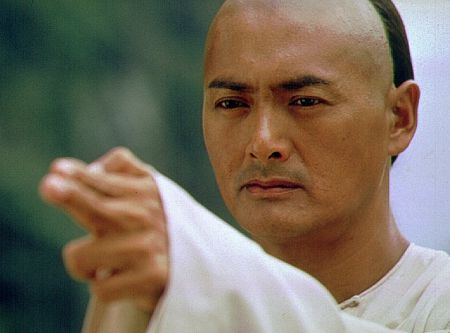
I awoke from a dream about destiny to push hands with Belle who was in bed with her master. This is not about sex. I am an enlightened being who long ago gave up the light to lie down with women so they may go on the path. One must overcome duality in order to be one with the truth. The truth is my student tried to steal my lessons, even have her teacher humiliated and slain by a minion of demons. This is profound for reasons yet to be explained. This is why men have kept women off the path because they are forever in search of a short-cut. Women are not honorable by nature. They are rarely culpable. If you catch a woman in a lie, or, being a thief in the night, there is hell to pay.
Belle Burch wrote in a e-mail how she likes the movie ‘Crouching Tiger, Hidden Dragon’. Jen steals the sword of Green Destiny. Master Li Mu Bai duels with Jen to retrieve Destiny. Jen is placed in a cave and put to sleep. Here is Sleeping Belle who woke this morning realizing our destinies are forever intertwined. There is no escape from this truth. In his Manifest Destiny Benton approves of the white race mating with the Chinee race.
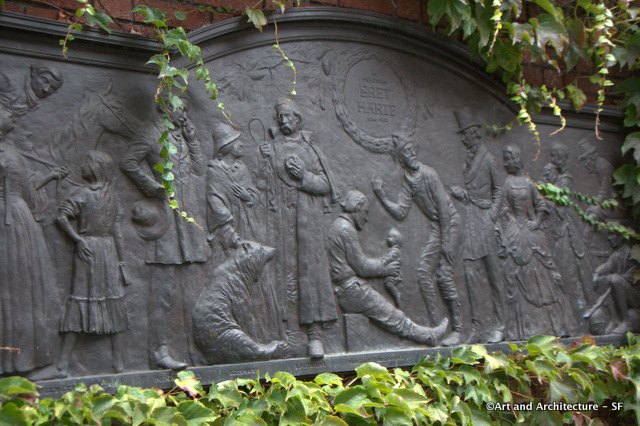
Below is a plaque on the outside wall of the Bohemian Club depicting characters from Bret Harte’s books. Heathen Chinee is on the far right. He is a gambler like my grandfather, Victor Hugo Presco, who was named after the author, Victor Hugo, whose book ‘The Hunchback of Notre Dame’ is the first Bohemian book. I believe ‘The Wandering Goat’ is named after Esmerelda’s goat.
It was at the Wandering Goat where Belle and I met, she taking me for an old fool while a very clever person lurks in the background. This is a Kung Fu movie. This person is Belle’s dark teacher who gave her protégé her first lesson so she could take her place as the Queen of the Night in the city of Eugene.
But, the Heathen Chinee alerted me ‘The Master of the Priory de Sion’ to this hidden agenda and duplicity. For there exist a time portal that lie open for members of the Bohemian Club, and the Master Bohemian. Poetry is the key for the lock.
My kindred, Jessie Benton Fremont, encouraged Bret Harte to write. Try as they may, Belle’s army of the dark alley did not prove I am deluded. I am the Benton Historian. Jessie’s father, Senator Thomas Hart Benton is the author of Manifest Destiny. He and Drew’s father look-alike. I asked Belle to marry me so she would inherit all my information as my platonic wife, and not my beloved mortal enemy. That she chose the latter was the correct choice, for this is a marriage on a level few understand. This marriage is ‘Capturing Beauty’ the pushing of hands – with ancient rings.
It would have furthered Belle to wash my pan and pots. At the Wandering Goat Belle offered to edit my book – for a fee! I made a better offer.
“I want you to co-author my book. I need a feminine touch.”
I have captured Belle’s mother, her history and her destiny. Belle is only beginning to understand she stole the Sword of Synchronicity. My story begins in the Barbary Coast of San Francisco where men had come west to fulfill their dream, and make history. The Benton family made much of Oregon’s history. I own this history and protect it for my niece, Drew, the daughter of Christine Rosamond Benton.
Belle became afraid when she thought she had grasped the tail of the dragon. But, she has grasped The Beast of the World when she took in her beautiful hand ‘The Rose of the World’….that takes no prisoners. This is what Belle wanted…..a life to die for!
So be it!
Jon Presco
Copyright 2012
Grand Master of the Priory de Sion
http://pages.uoregon.edu/mjdennis/courses/hst469_benton.htm
http://twain.lib.virginia.edu/roughingit/map/chiharte.html
“The sun of civilization must shine across the sea; socially and commercially the van of the Caucasians, and the rear of the Mongolians, must intermix. They must talk together, and trade together, and marry together. . . . Moral and intellectual superiority will do the rest; the White race will take the ascendant, elevating what is susceptible of improvement-wearing out what is not. . . . And thus the youngest people, and the newest land, will become the reviver and the regenerator of the oldest . . . .”
The artist, Jo Mora, created and donated the sculpture to the Bohemian Club of which he and Bret Harte were members. In 1933, when the old Bohemian Club was torn down, the memorial was removed and reinstalled on the new club in 1934,
Francis Bret Harte (August 25, 1836 – May 6, 1902) was an American author and poet, best remembered for his accounts of pioneering life in California. The plaque which is on the Post Street side of the club depicts 15 characters from Harte’s works.
The characters represented come from a handful of stories and a poem that established Harte’s reputation. He wrote these while living in San Francisco during the gold rush: Tennessee’s Partner, The Outcasts of Poker Flat, M’Liss and The Luck of Roaring Camp. Through his poem “Plain Language from Truthful James,” Harte created a wily Chinaman who outwits his Anglo gambling opponents shown on the far right as the Heathen Chinee.
“Although the San Francisco Circle broke apart in the early 1870s,
the circle quickly regrouped and then expanded. In the early 1870s,
the Bohemian Club, dedicated to good fellowship, support of the
arts, and literary pursuits, was founded in downtown San Francisco.
The Club’s spectacular Bohemian Grove festivals and “happenings”
continue to this day. The Bohemian Club, the revived Overland of the
1880s, and the establishment of The Wave in the early 1890s were
literary events that marked the continuation and expansion of the
Circle.”
Jon
The colorful count was no longer at the Mint by 1866, when Jessie
Benton Fremont helped Francis Brett Harte get a patronage position
as secretary of the Mint. The day job gave him time to edit
Californian magazine and begin his literary career as the author
Bret Harte.
http://www.tcm.com/mediaroom/video/215813/Hunchback-of-Notre-Dame-The-Movie-Clip-King-of-Fools.html
Following a duel where Mu Bai regains possession of the Green Destiny, he decides to throw the sword over a waterfall. In pursuit, Jen dives into an adjoining river to retrieve the sword and is then rescued by Fox. Fox puts Jen into a drugged sleep and places her in a cavern; Mu Bai and Shu Lien discover her there. Fox suddenly reappears and attacks the others with poisoned darts. Mu Bai blocks the needles with his sword and avenges his master’s death by mortally wounding Fox, only to realize that one of the darts hit him in the neck. Fox dies, confessing that her goal had been to kill Jen, because she was furious that Jen hid the secrets of Wudang from her.
Li Mu Bai
Harte helped his friend Mark Twain with his writing craft, and Twain’s literary and popular reputation eventually eclipsed that of Harte.
Mark Twain – Ambrose Bierce
and the Bohemian Grove Club
Poetic in its spectacular vistas and misty weather, in the late
1860s “The City” became the birthplace for what would come to be
called the local color movement in American literature. Practically
every writer associated with early western local color at least made
an appearance in San Francisco; many of these writers, who by the
early 1870s would be scattered all over the East Coast, England, and
Europe, called the place home. 1 While in San Francisco, most of
these writers knew each other, and came to regard themselves as the
circle or group that formed the cutting edge of a new kind of
American writing. Surely the dominant figure of this emerging
literary movement was young Francis Bret Harte. In the local color
decade of 1865 to 1875, he would rise from local fame (and sometimes
infamy) as a satirist, poet, editor, and short story writer to
become the most celebrated figure of current American literature,
before slipping away into a sad obscurity. Mark Twain, now
recognized as unquestionably the group’s greatest writer, was on the
way to fulfilling his potential, and should be regarded as the
second key figure in the San Francisco Circle. These, men were the
leading lights of local color, but what an amazing parade of writers
as characters passed through The City. The most familiar names
include Ambrose Bierce, Ina Coolbrith, Joaquin Miller, and Prentice
Mulford. …
Ambrose Bierce cut quite a different figure. Ever sneering at
Victorian poetry and all lofty sentiments, Bierce was a journalist
who could wield a bitter, abusive prose that maintained the
rhetorical stance of vituperative, frontal attack. In 1868, he took
over the “Town Crier” column of the News Letter, a San Francisco
newspaper which welcomed his relentless attacks and satiric jests.
Odd as it may seem, Bierce got along famously with Bret Harte. Harte
accepted for the Overland portions of what would become Bierce’s
Grizzly Papers, and it was Bierce, for better or for worse, who
persuaded Harte to retrieve “The Heathen Chinee” from the
wastebasket and print this satirical poem in the Overland.
Bierce was part of the literary contingent that left San Francisco
in the early 1870s. His satires, increasing in their skill and bite,
were very well received in England, where three books of his satiric
sketches on California were published. Like Miller, but unlike Harte
and Clemens, a now famous Bierce returned to San Francisco, the area
which he so often claimed treated him with alienation and
estrangement. As a satiric journalist in the corrupt “Gilded Age” of
the 1880s and ’90s, Bierce was not wanting for material. During
these years, he attacked virtually everything, from Denis Kearney’s
Workingmen’s Party to the local Humane Society. Having offended with
his Thersites-like wit practically everyone by the turn of the
century, Bierce, despite his brilliance, came to be regarded by many
as a crank. He disappeared in 1914, trying, at age seventy-one, to
join up with Pancho Villa. Fortunately, he departed for Mexico after
completing his classic collection of bitter definitions, The Devil’s
Dictionary. Bierce had come a long way from his salad days of
writing satiric columns for the News Letter.
As the century progressed, the San Francisco-based brand of local
color not only moved from theme to background, but it was indeed
more popular as a novelty, more popular the farther away from
California’s shores it was read, studied, and performed. By the
early 1880s, Harte’s uplifting stories seemed sentimental and dated.
As other parts of the West became more settled, a new generation of
local color writers emerged, a generation that pushed local color in
a decidedly realistic direction. This group included Mary Hallock
Foote (Colorado and Idaho), Bill Nye (Wyoming), Alfred Henry Lewis
(the Southwest), and, of course, Hamlin Garland (the northern
Plains). But the shaping influences of Bret Harte and Mark Twain can
be perceived in all of them.
Although the San Francisco Circle broke apart in the early 1870s,
the circle quickly regrouped and then expanded. In the early 1870s,
the Bohemian Club, dedicated to good fellowship, support of the
arts, and literary pursuits, was founded in downtown San Francisco.
The Club’s spectacular Bohemian Grove festivals and “happenings”
continue to this day. The Bohemian Club, the revived Overland of the
1880s, and the establishment of The Wave in the early 1890s were
literary events that marked the continuation and expansion of the
Circle.
Perhaps the most significant and far-reaching examples in the 1870s
and ’80s of this expanding circle were the works of nature writers
Clarence King and John Muir. A rather bizarre nonstop talker and
mountain climber, King in 1872 published Mountaineering in the
Sierra Nevada, a collection of short pieces in several genres. What
makes this uneven volume important is its subject matter; King wrote
not of people dealing with a frontier culture, but about the
relationship between wilderness and humanity. John Muir, who in the
early 1890s founded the Sierra Club and became known as the “Father
of our National Parks,” was the first widely read western writer
with a mystical, ecological vision. Far more than even King, Muir
explored Sierra Nevada wilderness areas, coming to the deep belief
that wild country must be preserved for its intrinsic value. Muir’s
statements about this “new philosophy” first appeared in 1873
Overland issues, and his influence on modern serious western writers
and thinkers has been considerable and important.
Excerpted from an article at
Texas Christian University Press
http://www.tcu.edu/depts/prs/amwest/html/wl0339.html
In San Francisco, Harte worked for a weekly newspaper, writing a column. He was encouraged as a writer by Jessie Benton Fremont, wife of the explorer, soldier, and politician John C. Fremont, who helped get one of his writings, “Legend of Monte del Diablo”, published in the Eastern literary magazine, the Atlantic Monthly.
Harte later worked for a literary magazine, writing essays, poems, factual articles, and getting Mark Twain to write for it. Harte also encouraged Twain to write up the story of the jumping frog that Twain had heard. In 1868, Harte became editor of the Overland Monthly, where he was known for encouraging young writers, getting material out of them, and for his good understanding of what readers wanted. The main attraction of the magazine, however, were the stories that Harte wrote for it, including “The Luck of Roaring Camp”, “The Outcasts of Poker Flat”, “Tennessee’s Partner”, and others. These stories, published in book form in the East, made Harte’s reputation, and are considered the peak of his literary career.
http://twainhartevisitor.com/bretharte/
[The Heathen Chinee]
Which I wish to remark,
And my language is plain,
That for ways that are dark
And for tricks that are vain,
The heathen Chinee is peculiar,
Which the same I would rise to explain.
Ah Sin was his name;
And I shall not deny,
In regard to the same,
What that name might imply;
But his smile it was pensive and childlike,
As I frequent remarked to Bill Nye.
It was August the third,
And quite soft was the skies;
Which it might be inferred
That Ah Sin was likewise;
Yet he played it that day upon William
And me in a way I despise.
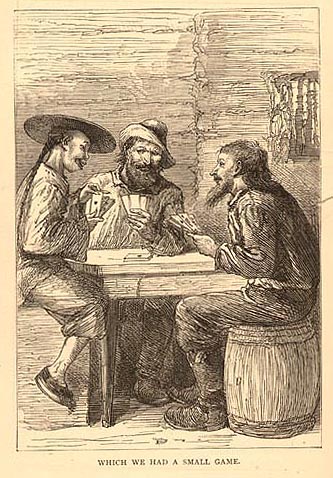
Which we had a small game,
And Ah Sin took a hand:
It was Euchre. The same
He did not understand;
But he smiled as he sat by the table,
With the smile that was childlike and bland.
Yet the cards they were stocked
In a way that I grieve,
And my feelings were shocked
At the state of Nye’s sleeve,
Which was stuffed full of aces and bowers,
And the same with intent to deceive.
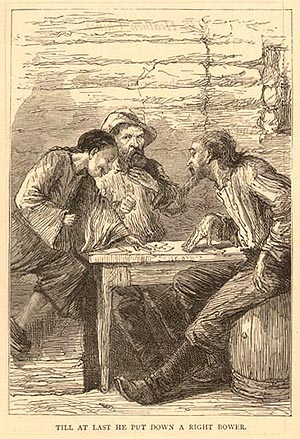
But the hands that were played
By that heathen Chinee,
And the points that he made,
Were quite frightful to see, —
Till at last he put down a right bower,
Which the same Nye had dealt unto me.
Then I looked up at Nye,
And he gazed upon me;
And he rose with a sigh,
And said, “Can this be?
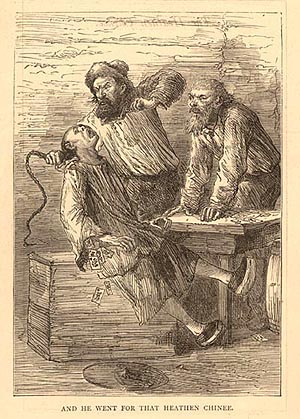
We are ruined by Chinese cheap labor,” —
And he went for that heathen Chinee.
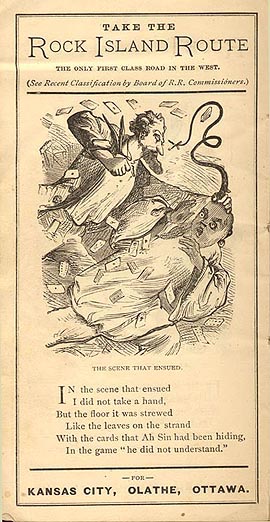
In the scene that ensued
I did not take a hand,
But the floor it was strewed
Like the leaves on the strand
With the cards that Ah Sin had been hiding,
In the game “he did not understand.”
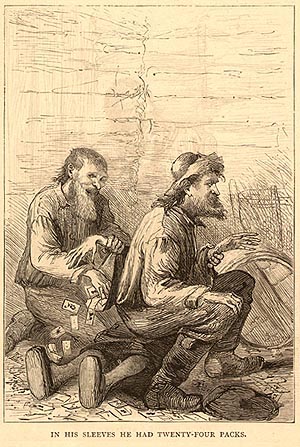
In his sleeves, which were long,
He had twenty-four packs, —
Which was coming it strong,
Yet I state but the facts;
And we found on his nails, which were taper,
What is frequent in tapers, — that’s wax.
Which is why I remark,
And my language is plain,
That for ways that are dark
And for tricks that are vain,
The heathen Chinee is peculiar, —
Which the same I am free to maintain.


 Rosamond Press
Leave a comment