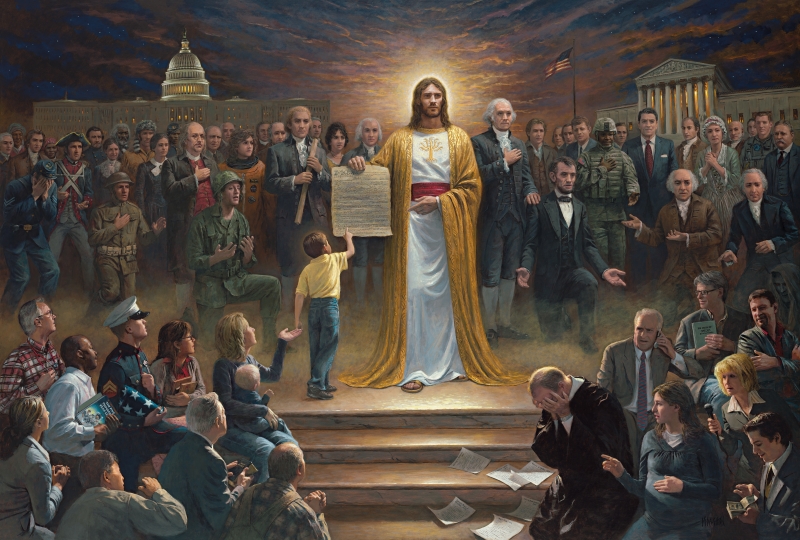
 The Zealots appear to have had a vow that separated and consecrated its adherents to God – DIERECTY! God took his Sons and Daughters out of the corrupt world so the New Children of God could serve Him DIRECTLY, take orders from their Father – DIRECTLY! This vow was probably titled THE WAY. Paul hunted down members of the first church, imprisoned them, murdered them, and tortured them in order to get them to “denounce their Lord.”
I have long puzzled over why Paul would torture women in order to get them to denounce God, because this would be an act of blaspheme. He is trying to get the New Children of God’s Way to break their DIRECT vow to the Lord God their Father, that bypassed and cut out the priest-temple system that had become utterly corrupt. This is why Paul worked hard to create a new Romanized temple-chcurch system where he is the supreme father surrounded by sub-fathers. He then uses human genetalia to shame God’s Children into submission.
Jesus the Zealot did go to John the Baptist after he took the vow of the Nazarite, so that he could be separated and consecrated to God – DIRECTLY. He, and others – including women who took the vow – would then go into the desert to be tempted by Satan who offered them a wealthy Judea under Roman rule, where Jewish Traitors walk in public with Roman slave owners, even purchasing and selling Jews as slaves.
Jon the Nazarite
The Problem with Jesus’ Arrest and Trial
James Still
There is a problem when dealing with the various contradictory biblical accounts of Jesus’ arrest and trial as they relate to each other and Jewish practice of the day. We are told in Mark’s gospel that after Jesus enters Jerusalem he is soon arrested praying at the Mount of Olives with his disciples who flee upon his arrest. (Mk. 15)
The High Priest Caiaphas, a Sadducee priest and a Roman-appointee, actively sought to prevent open rebellion against Rome lest it escalate and endanger what little autonomy the Temple priests were given by Caesar Augustus. It was Caiaphas who sent out the Temple police to arrest Jesus, most certainly on grounds that Jesus was seditious (rebellious) against Roman authority.
Our evidence is good that Jesus did act politically seditious against Roman authority:
1. Several of Jesus’ disciples were known Zealots, e.g., Simon the Zealot (Lk. 6:15); Simon Peter who was known as “Bar-jona” (Mt. 16:17) a derivation of of “baryona” Aramaic for “outlaw” which was a common name applied to Zealots; James and John shared the nickname “Boanerges” or in Hebrew “benei ra’ash” which is to say “sons of thunder” another common Zealot reference; and the most famous Zealot was Judas Iscariot, “Iscariot” a corruption of the Latin “sicarius” or “knife-man” which was a common Roman reference to Zealots.
2. The Zealot movement was a breakaway from the Pharisees who themselves sympathized with the nationalistic causes espoused by the Zealots and were awaiting a Messiah to seize the throne of Israel. Jesus himself is attributed with many sayings that are Pharasaic in origin, e.g., Mt. 7:12, Mk 2:27, Jn 7:22, B. Yoma 85b (Talmud), Mt. 7:15; and Jesus’ own affinity for the poor demonstrate Pharasaic philosophy. Jesus’ actions that are not depoliticized in the gospels (partially referenced here) indicate that Jesus sympathized with the Zealot cause.
3. The Zealot Judas, refers to Jesus as “Rabbi” a Pharasaic-title. (Mk 14:45) Many scholars subscribe to the “walks like a duck, must be a duck” philosophy and go as far as to say that Jesus himself was a Pharisee rabbi. The evidence does seem to support this conclusion, although Jesus seems to favor a more apocalyptic flavor of fringe Pharasaic thought. The “Jesus as Essene” theory still captivates many scholars as well–a theory that would also support his role of political Messiah as argued here.
4. Jesus equipped his followers with swords in anticipation of trouble. (Lk 22:36-38) and at least one of Jesus’ supporters scuffled with the Temple police to aid in resisting Jesus’ arrest. (Mk 14:47)
5. The manner in which Jesus entered Jerusalem was that of a Jewish king who claimed the throne. Convinced that he was King of the Jews and in deliberate fulfillment of Zechariah’s prophecy, Jesus rides into Jerusalem on an ass’s colt. The people greet Jesus with strewn palms and cries of “Hosanna!” the ancient cry of Jewish independence. For Jesus to not have known the seditious actions that this implied, and the political impact that his act caused, would be incredulous to say the least. (This is in direct contrast with the Gospels which attempt to contradict Jesus’ action and claim that he was not seeking an earthly kingdom–clearly absurd given the circumstances.)
Jesus was said to have been arrested due to a charge of blasphemy. The evidence for this is highly suspect. We begin to immediately question the gospel-accounts regarding the preliminary investigation and it is likely the gospel writers knew nothing of Jewish law regarding such matters. Additionally, the gospel accounts may be trying to smooth over Jesus political mission since when they wrote they had the benefit of hindsight and knew the political outcome of Jesus’ actions did end in failure. The gospel’s attempt to depoliticize Jesus while at the same time supporting his brief stint as the King of the Jews by reporting events that they seemed to not understand the Jewish context for. Let’s look at the story as Luke relates it and then discuss the context problems.
Luke tells us in chapter 26 that Jesus was taken in the middle of the night to the home of Caiaphas for questioning. Frustrated at Jesus’ answers to their questions as to whether or not he claimed to be the Messiah, the scribes and priests hit Jesus in the face and spit on him in disgust. There are several problems with this gospel account:
1. It was against Jewish law for the Sanhedrin to meet outside of the designated Chamber of Hewn Stone in the Temple and would not have been violated under any circumstance.
2. The Sanhredrin had an express rule that it could not meet at night because justice must be carried out in the “light of day.”
3. Jesus’ entry into Jerusalem was probably during the Feast of the Tabernacles, not Passover. (the palm leaves strewn in front of Jesus as he entered Jerusalem would not have been in bloom during Passover) The Sanhedrin would not have met during the eight-day festival for any reason.
4. The Elders of the Sanhedrin would no more strike or spit on an accused person, than would the Supreme Court of the U.S. hearing a case! Luke’s account is completely out-of-context and shows remarkable ignorance as to the machinations of Jewish Law.
5. It was not blasphemous to declare oneself a “Messiah” or a “Son of God” any more than it would have been to claim to be an angel. The Pharisees who composed the majority of the Sanhredrin would dismiss such a charge at once since blasphemy could only be applied to anyone who claimed to be God Almighty. Jesus’ declaration that he was a Messiah, merely referred to his earthly desire to ascend to the throne of David–an act of sedition against Rome surely, but not one of blasphemy.
If the Gospel of John is to be our authority, his account disagrees with the Synopticists in that the High Priest Caiaphas interrogates Jesus alone and charges him with sedition, not blasphemy, as the Synoptic Gospels allege. Clearly, the pseudipigraphical author of John is not as ignorant of Jewish Law as are the Synopticists for his account is in context with our findings thus far. If Jesus were charged with sedition, then a gathering of the Sanhedrin would not be necessary, the affair would be preliminarily investigated by the High Priest before turning the matter over to the Roman authorities. (Indeed Caiaphas would not wish to involve the Sanhedrin if Jesus really was seditious. In the trial of Peter as reported in Acts, the Pharisees sided against the High Priest and voted to release the accused.)
We can safely conclude at this point that Jesus was indeed supportive of the Zealot movement if not in deed, then certainly in principle. If Jesus were seeking the throne as the evidence suggests, he would have enlisted the aid of the militant Zealots. Also his actions as a claimant to the throne of Israel–which surely would have involved a rebellion of some sort for the Romans were not likely to cede authority quietly–made him guilty of sedition against Rome. Jesus was a patriot for the restoration of Israel. His motives were political and the context of his actions as we find in the more credible portions of the Gospels supports this conclusion.
Further complicating the truth of the Gospel accounts is the motivations and actions of the Roman Procurator Pontius Pilate, whom Jesus is brought to by the High Priest. Jesus is handed over to Pilate, accused of sedition, and Pilate questions Jesus personally asking him, “Are you the King of the Jews?” to which Jesus replies “I am.” For some reason, the priests are said to go on “heaping accusations” against Jesus despite the fact that his sedition was clearly established by Jesus himself. Even stranger still, Pilate seems to not even care that Jesus claims to be the King of the Jews and Pilate “wonders” if Jesus is dangerous. (Mk 15:1-5) At this point the author of Mark is either blatantly ignorant of the facts, or spinning a good yarn for the sake of his overall story.
This account is quite out of context with the monster that Philo wrote Gaius Caesar about, reporting that Pilate was inflexible and “cruel.” Further, Josephus reports several occurances where Pilate flagrantly incites insurrection in order to ruthlessly purge it with his soldiers. Pilate was eventually recalled to Vitellius (then Legate of Syria) after a particularly violent attack on the Samaritans in 36 CE, and was ordered sent to Rome in order to stand accusations of the slaughter. (Antiquities 18.4.85) The anti-Semitic Pilate was not the sort of governor that would have acted with even the slightest civility toward a Jew who openly admitted to sedition. Pilate’s dismal record of purges and punishments against seditious behavior was anathema and history shows him to be one of, if not the cruelest of the Procurators of Judaea.
These irreconciable problems with the arrest and trial of Jesus show that the Gospel accounts cannot be trusted with the truth of the matter. With the mystique and misunderstanding surrounding Jesus’ arrest, coupled with the legend and myth attached to the accounts at later times, the truth may never be fully known. But we can surmise a few things: Jesus was a political figure and a claimant to the throne of Israel. His Triumphal Entry into Jerusalem as that of a long-awaited Messiah who would destroy the Romans and seize his rightful kingship ended in failure and crucifixion as a rebel.
Jesus The Patriot
by Wayne Blank
The English word patriotism is based upon the Latin word for father, pater. A number of other words have the same origin, such as patriarch (the father of a family) and patrimony (an inheritance from one’s father). Since nations are founded by people, patriotism came to be used as a term for the love and loyalty to the nation that was established by the “founding fathers,” a term familiar to people of numerous countries around the world (patriotism literally means loyalty to the “father” of the nation”). Jesus Christ was and is a patriot, nationally and religiously. It was the basis, nationally and religiously, for which He was killed, and it is and will be the legal basis by which He will rule the world (see the Fact Finder question below).
“And set up over His head His accusation written, ‘This Is Jesus The King Of The Jews’”
The religious Father that Jesus was patriotic to was God.
“I can of mine own self do nothing: as I hear, I judge: and My judgment is just; because I seek not Mine own will, but the will of the Father which hath sent Me” (John 5:30 KJV)
“For I have not spoken of Myself; but the Father which sent Me, He gave me a commandment, what I should say, and what I should speak” (John 12:49 KJV)
“All things are delivered unto Me of My Father: and no man knoweth the Son, but the Father; neither knoweth any man the Father, save the Son, and he to whomsoever the Son will reveal Him” (Matthew 11:27 KJV)
“Not every one that saith unto Me, Lord, Lord, shall enter into the kingdom of heaven; but he that doeth the will of My Father which is in heaven. Many will say to Me in that day, Lord, Lord, have we not prophesied in Thy Name? And in Thy Name have cast out devils? And in Thy Name done many wonderful works? And then will I profess unto them, I never knew you: depart from Me, ye that work iniquity.” (Matthew 7:21-23 KJV) [see “Thou shalt not take The Lord’s Name in vain”]
“For the Son of man shall come in the glory of His Father with His angels; and then He shall reward every man according to his works.” (Matthew 16:27 KJV)
It was Jesus’ religious Patriotism that got Him murdered by the religious authorities of Judah.
“Jesus said unto them, If God were your Father, ye would love Me: for I proceeded forth and came from God; neither came I of myself, but He sent Me. Why do ye not understand My speech? Even because ye cannot hear My word. Ye are of your father the devil, and the lusts of your father ye will do. He was a murderer from the beginning” (John 8:42-44 KJV)
The political fathers that Jesus was patriotic to were King David (see Israelite Dynasties), and like David, the Israelite patriarch Judah, who was the progenitor of the Jews (“Jew” is an abbreviation for Judah), and through him, Abraham (see On His Own Two Feet), Isaac (see Isaac’s Faith And Obedience) and Jacob (see Children of Jacob).
“And, behold, thou shalt conceive in thy womb, and bring forth a son, and shalt call His name Jesus. He shall be great, and shall be called the Son of the Highest: and the Lord God shall give unto Him the throne of His father David” (Luke 1:31-32 KJV)
“Pilate therefore said unto him, Art thou a king then? Jesus answered, Thou sayest that I am a king. To this end was I born, and for this cause came I into the world, that I should bear witness unto the Truth. Every one that is of the Truth heareth My voice.” (John 18:37 KJV)
It was Jesus’ political patriotism that got Him assassinated; the first attempt at the time of His birth, the actual judicial assassination by the Romans about 30 years later. The official written charge for which He was convicted, nailed to the cross above His head? “This Is Jesus The King Of The Jews’”
“Where is he that is born King of the Jews? For we have seen his star in the east, and are come to worship him. When Herod the king [see The Herods] had heard these things, he was troubled, and all Jerusalem with him … Then Herod, when he saw that he was mocked of the wise men, was exceeding wroth, and sent forth, and slew all the children that were in Bethlehem, and in all the coasts thereof, from two years old and under, according to the time which he had diligently inquired of the wise men.” (Matthew 2:2-3,16 KJV)
“If thou let this man go, thou art not Caesar’s friend: whosoever maketh himself a king speaketh against Caesar.” (John 19:12 KJV)
“And set up over His head His accusation written, ‘This Is Jesus The King Of The Jews’” (Matthew 27:37 KJV)
Is Jesus God, or a Zealot Son of God?
It soon became apparent, however, that he was making shocking and startling statements about himself. He began to identify himself as far more than a remarkable teacher or prophet. He began to say clearly that he was God. He made his identity the focal point of his teaching. The all-important question he put to those who followed him was, “Who do you say I am?” When Peter answered and said, “You are the Christ, the Son of the living God,”2 Jesus was not shocked, nor did he rebuke Peter. On the contrary, he commended him!
Jesus frequently referred to “My Father,” and his hearers got the full impact of his words. We are told, “The Jews tried all the harder to kill him; not only was he breaking the Sabbath, but he was even calling God his own Father, making himself equal with God.”3
On another occasion he said, “I and My Father are One.” Immediately the Jews wanted to stone him. He asked them which of his good works caused them to want to kill him. They replied, “We are not stoning you for any of these but for blasphemy, because you, a mere man, claim to be God.”4

 Rosamond Press
Leave a comment